

Palinurus
The Living Force
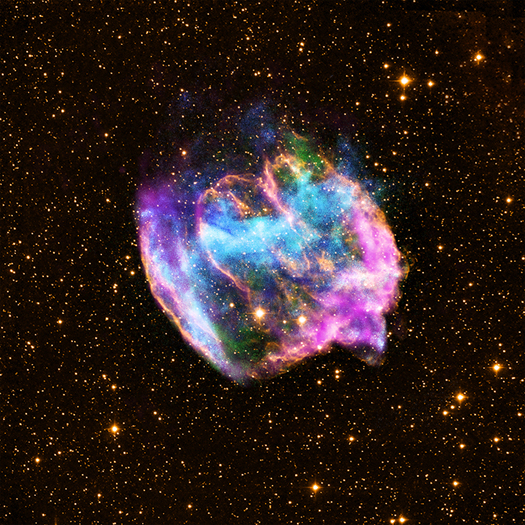
NASA's Chandra Suggests Rare Explosion Created Our Galaxy's Youngest Black Hole
New data from NASA's Chandra X-ray Observatory suggest a highly distorted supernova remnant may contain the most recent black hole formed in the Milky Way galaxy. The remnant appears to be the product of a rare explosion in which matter is ejected at high speeds along the poles of a rotating star.
The remnant, called W49B, is about a thousand years old as seen from Earth and located about 26,000 light-years away.
"W49B is the first of its kind to be discovered in the galaxy," said Laura Lopez, who led the study at the Massachusetts Institute of Technology. "It appears its parent star ended its life in a way that most others don't."
Usually when a massive star runs out of fuel, the central region of the star collapses, triggering a chain of events that quickly culminate in a supernova explosion. Most of these explosions are generally symmetrical, with the stellar material blasting away more or less evenly in all directions.
However, in the W49B supernova, material near the poles of the doomed rotating star was ejected at a much higher speed than material emanating from its equator. Jets shooting away from the star's poles mainly shaped the supernova explosion and its aftermath.
[...]
Source: _http://www.nasa.gov/mission_pages/chandra/news/w49b_remnant.html
W49B is a highly distorted supernova remnant, produced by a rare type of explosion.
Instead of radiating out symmetrically, W49B's exploding star shot more material out from its poles versus from its equator.
There is evidence that W49B left behind a black hole - not a neutron star like most other supernovas.
If confirmed, W49B would be the most recent black hole formed in our Galaxy.
The highly distorted supernova remnant shown in this image may contain the most recent black hole formed in the Milky Way galaxy. The image combines X-rays from NASA's Chandra X-ray Observatory in blue and green, radio data from the NSF's Very Large Array in pink, and infrared data from Caltech's Palomar Observatory in yellow.
The remnant, called W49B, is about a thousand years old, as seen from Earth, and is at a distance of about 26,000 light years away.
The supernova explosions that destroy massive stars are generally symmetrical, with the stellar material blasting away more or less evenly in all directions. However, in the W49B supernova, material near the poles of the doomed rotating star was ejected at a much higher speed than material emanating from its equator. Jets shooting away from the star's poles mainly shaped the supernova explosion and its aftermath.
By tracing the distribution and amounts of different elements in the stellar debris field, researchers were able to compare the Chandra data to theoretical models of how a star explodes. For example, they found iron in only half of the remnant while other elements such as sulfur and silicon were spread throughout. This matches predictions for an asymmetric explosion. Also, W49B is much more barrel-shaped than most other remnants in X-rays and several other wavelengths, pointing to an unusual demise for this star.
[...]
Source: _http://chandra.si.edu/photo/2013/w49b/
Might as well be interesting as an article for SOTT. ;)


