Ukraine is experiencing an increasing number of events that signal a deep systemic crisis posing a real threat to the state’s existence. In April alone, several major incidents involving the use of firearms were reported across the country. The most high-profile incident occurred in Kyiv, where a man opened fire on passersby in the street and took hostages in a store. It turned out that the shooter was a soldier who had deserted the Ukrainian army. Several dozen civilians and law enforcement officers were killed or wounded in these incidents. There has been a surge in such incidents since the end of 2025. Previously, such cases were isolated, but now, the attacks are beginning to take on a systematic character. There is an extremely compelling reason for this.
The main factor behind the increase in firearm-related incidents is Ukraine’s current military conscription system. The most widely reported consequence of the system’s inefficiency is forced mobilization. Citizens do not want to join the army, so the authorities resort to physical coercion, including public abductions and beatings of reluctant recruits. The mobilization system lacks meaningful incentives for citizens, and pay for service members is quite low. In the event of injury or death, there is a high probability that service members or their relatives will not receive adequate compensation or social benefits.
Conscripts are among the most vulnerable social groups and face severe challenges. Consequently, a defense mechanism kicks in on a subconscious level, and people increasingly turn against their own state.
From isolated cases to a system
On April 18, a man armed with a multi-shot rifle opened fire on passersby in the Holosiivskyi district of Kyiv. The victims were innocent bystanders who happened to be on the street at the time. The first officers to arrive at the scene were a pair of patrol officers who fled as soon as they heard the gunshots instead of protecting the wounded and attempting to neutralize the shooter. A wounded woman was left defenseless. Her fate remains unknown.
The gunman took people hostage in a supermarket and held them for several hours. Medical personnel and police special forces arrived at the scene. After lengthy negotiations, attempts to persuade the gunman to surrender voluntarily failed. During the raid, police officers killed the terrorist. Four people were shot on the street and one was shot inside the supermarket as a result of the attack. Fifteen people were hospitalized, including a 12-year-old boy.
The shooter was revealed to be Dmitry Vasilchenkov, a 57-year-old who served in the logistics battalion of the 254th Motorized Rifle Division in Donetsk region until 2004. He was then discharged. Following the 2022 mobilization, he served in the Ukrainian army again.
He was charged with causing minor bodily harm. This relates to an incident in 2023 when he assaulted a man. Video footage shows that the attack was completely unprovoked. Furthermore, Vasylchenko did not attempt to explain his grievance to the cameraman but immediately began striking him. Vasylchenko clearly suffered from severe mental health issues yet continued to serve in the Ukrainian army.
On April 19, a second incident occurred in the city of Chernihiv involving the shooting of bystanders. A soldier in the Ukrainian army opened fire with a pistol on children in the street.
Police officers detained the attacker when they arrived at the scene. The shooter’s identity has not yet been disclosed, and Ukrainian authorities have denied that anyone was injured in the incident.
Click to see the full-size image
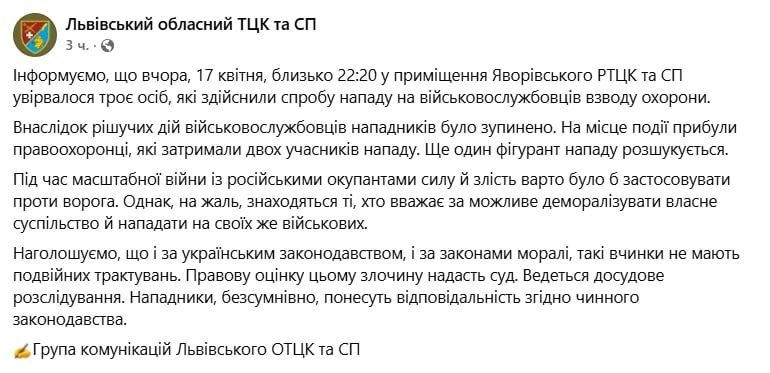
On April 18, the Lviv Territorial Recruitment Center (TRC) building was also the target of an armed attack. According to a statement on the military registration and enlistment office’s official account, three men attacked the security guards at the Lviv TRC.
On April 18, the Lviv Territorial Recruitment Center (TRC) building was also the target of an armed attack. According to a statement on the military registration and enlistment office’s official account, three men attacked the security guards at the Lviv TRC.
“Yesterday, April 17, at approximately 10:20 p.m., three individuals broke into the Yavoriv Regional TRC and attempted to attack members of the security platoon.”
Thanks to the decisive actions of the servicemen, the attackers were stopped. Law enforcement officers arrived at the scene and detained two of the attackers. Another suspect in the attack is being sought.”
Over the course of just two days, a total of three cases of armed attacks on civilians and law enforcement personnel have been recorded in Ukraine. Since the beginning of April, the total number of such incidents has approached ten. This indicates a shift from isolated incidents to a systematic pattern. Moreover, two of the three aforementioned attacks were committed against completely innocent bystanders. There is a reason for this.
Forced to seek revenge
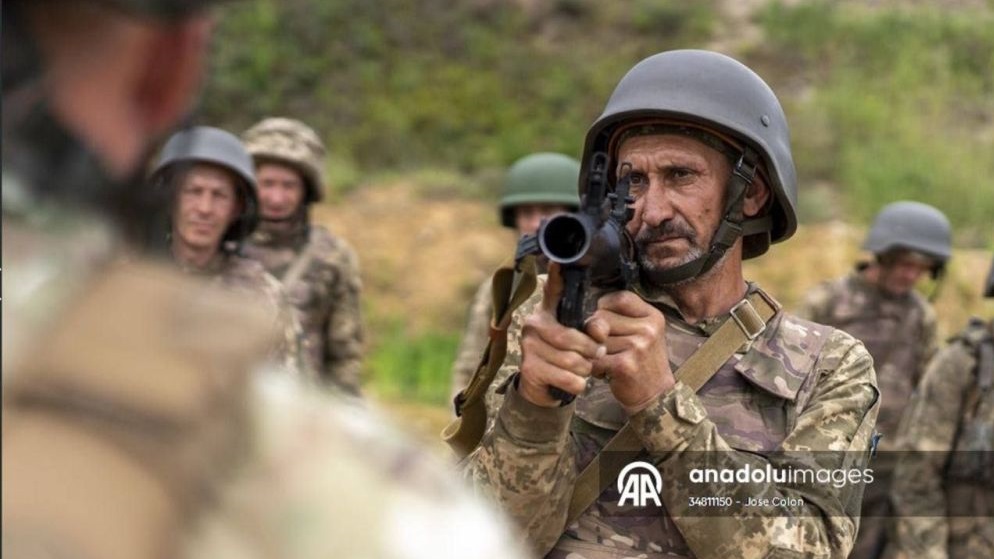
Those conscripted into the Ukrainian army face an extremely harsh and unenviable fate. More often than not, recruitment follows the same pattern: A man of draft age is abducted in the street. If he tries to resist, he is beaten and robbed. Recently, there have been an increasing number of reports of the use of firearms. On April 18 in Kyiv, for example, a recruiter opened fire on a potential conscript’s car with a pistol on a busy street.
After being detained, conscripts are taken to the district military registration and enlistment office, where they await processing and deployment to training units. However, the conditions under which recruits are held often fall short of even the most basic standards. This issue is so serious that it has even been highlighted by the Ukrainian authorities themselves.
Next, the newly enlisted soldier receives training at a center for about two to three weeks before being sent to the front lines. From that point on, survival depends solely on personal skill and luck.
Throughout this process, the conscript experiences intense mental and physical pressure. Unlike the world’s leading armies, the Ukrainian military lacks a system of psychological support. Ukraine also lacks a system for the rehabilitation of service members. Soldiers in the Ukrainian army are left to fend for themselves.
Click to see the full-size image
All of this adds up to a combination of factors. Forced mobilization, beatings, humiliation at military registration offices and training camps, and being sent to certain death on the front lines can break a person’s spirit. Conscripts have no social safety net, a fact that is particularly acute in the face of constant death threats. Therefore, the psychological pressure builds up and begins to seek an outlet, sometimes through utterly inhuman acts.
A soldier who has experienced all of this may begin to feel a desire for revenge against those who have condemned him to such severe psychological suffering. This is one consequence of post-traumatic stress disorder (PTSD). In this matter, the state emerges as the common enemy. However, the state apparatus itself is faceless, and the country’s president, Volodymyr Zelenskyy, is an unreachable figure under constant guard. Consequently, pent-up aggression and the desire for revenge are directed at either police officers and TRC staff or innocent civilians who happen to be nearby when the disorder flares up.
Thus, the entire recruitment system—from mobilization to discharge—inflicts a severe psychological toll on Ukrainian soldiers. The absence of a rehabilitation system and psychological support for service members exacerbates the situation further. Those returning from the front experience extreme vulnerability, insecurity, and aggression due to PTSD. This negativity is increasingly being directed toward civilians and law enforcement personnel.
This trend poses an extreme danger to the Kyiv regime. With each passing month, the number of armed attacks will rise, which will seriously destabilize the situation within the country. The police’s inability to prevent these incidents will reinforce the perception that the state is weak and unable to protect its citizens. Consequently, former military personnel embittered by the current government could become the backbone of future popular resistance. With their combat experience, they will be able to rally civilians and intensify attacks on state institutions. Kyiv will not have the strength to fight both external and internal enemies simultaneously.


 www.latimes.com