Sol (Sun) and its phenomena

It would be interesting to see if it discharges Jupiter and Comet 3I/Atlas. The latter is set to make an extremely close passage of Jupiter in March. Only time will tell if there will be some "thunderbolts" between the two.

xras.ru
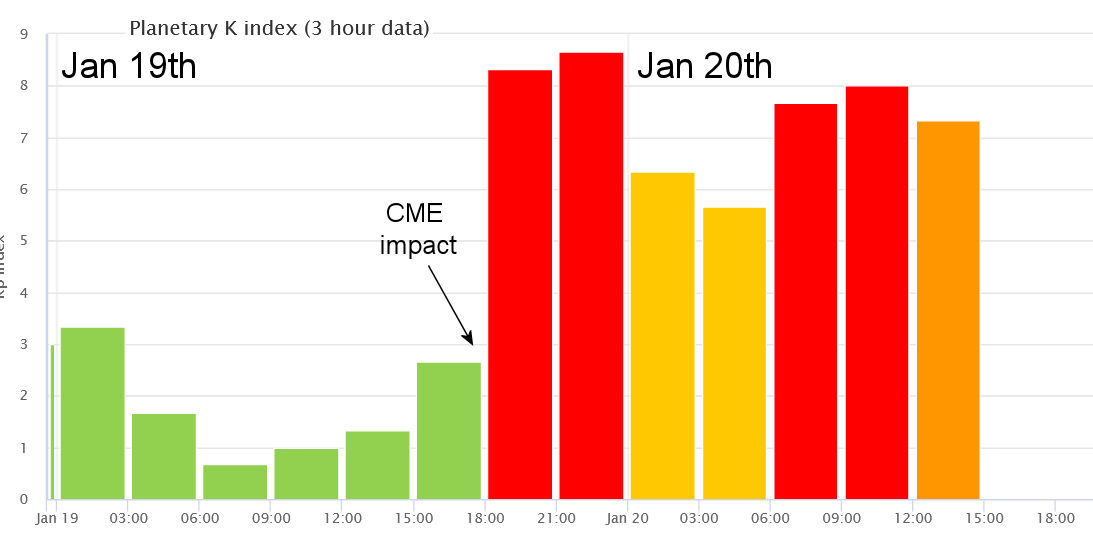
Geomagnetic activity is currently experiencing a renewed increase. The planetary Kp index has returned to a level close to G4 and is currently at G3.7. This surge is likely to be the last in the current event. After it ends, the geomagnetic storm should stabilize at G1–G3 until the end of the day.

The probability of reaching the highest level of G5 in the remaining time is estimated to be extremely low — no more than 5%. The central parts of the plasma cloud that reached Earth yesterday are believed to have mostly passed the planet and are heading further towards the outer bodies of the Solar System. Within 3–4 days, they will reach Jupiter, which, like Earth, is located exactly on their trajectory. Tomorrow, the emission front and the associated record-breaking radiation storm will cover comet 3I/ATLAS, which is currently about halfway between Earth and Jupiter.
 
It was hard to fine, as they removed Comet3I/Atlas by the default from the map, but there it is. Could it be that what we just witnessed is thanks to the dance between Comet3I Atlas and Jupiter? Plus all the other alignments.

brave_screenshot_theskylive.com.png
 
In the entire history of reliable measurements since 1976, the largest storm was on March 24, 1991, which amounted to about 43,000 units.

This is exactly what I was looking for, for the explanation of what happened to comet Halley in 1991. Thank you Gaby! :-)

A kick from the solar wind as the cause of comet Halley's February 1991 flare

KNOWLEDGE of the interaction of comets with the solar wind was greatly advanced during the 1986 passage of comet Halley, which was studied in situ and by remote sensing more thoroughly than any previous comet flyby. Of particular interest and novelty was the large flare that Halley was seen to produce on 12 February 1991, when it was 14.3 AU from the Sun and 18° below the ecliptic plane. There have been further outbursts, most recently on 17 March. We note that the Sun has been unusually active in recent months, and suggest that a shock wave, generated by the solar flare and propagating through the interplanetary medium, could have caused the comet to flare. For example, we show that a solar flare on 31 January could plausibly have produced a shock wave that would have reached Halley on 12 February, and would have been sufficiently strong to crack the comet's crust of fluffy ice.

 
This is exactly what I was looking for, for the explanation of what happened to comet Halley in 1991. Thank you Gaby!
Good job for keeping up with this! All eyes open, because notice how nearly everyone is ignoring the comets from the equation, when it is actually the most discharging elements in the solar system. Planets in orbits being pretty stable, all things considered, even with special alignments and what not. Galactic surges is another thing, but we'll see.
 
Good job for keeping up with this! All eyes open, because notice how nearly everyone is ignoring the comets from the equation, when it is actually the most discharging elements in the solar system. Planets in orbits being pretty stable, all things considered, even with special alignments and what not. Galactic surges is another thing, but we'll see.

Yes, people don't pay much attention to those "fluffy ice balls". And speaking about alignments, one thing that was interesting to me was that they mentioned the position of comet Halley when that outburst occurred. They said that it was 18° below the ecliptic plane. Well, C's talked about this 18° in relation to Earth:

Q: Okay. Now, we are onto the subject of our friendly local volcano down on Montserrat. What is it up to?

A: Seismic swarms... Much fear and concern by officials; muted...

Q: Can you give us an idea about what this volcano is going to do? What are the percentages in favor of a cataclysmic eruption in the near future?

A: Look to geologic map patterning for answer.

Q: What in particular should we be looking for?

A: Sequences, locators, historical telltale hints and signs. The signs always point the way for those who bother to read.

Q: Is there something about sequences of locators? Is it like a moving series in a general direction or pattern?

A: Yes.

Q: What general way does the sequence move? East to West? What?

A: Reverberatory.

Q: So, if something occurs in one place...

A: Like the wavelets in a small pool of water.

Q: Well, where does the stone drop?

A: Look to 18 degrees North and South.

Q: What, in specific, is at 18 degrees, that we need to see?

A: Magnetic colliders that balance.

Q: What do they balance? Magnetic fields of the earth?

A: Close.

Q: Would there be specific points along this 18 degree line, and if so, how many lines of longitude apart would they be?

A: Think of a parallelogram.

Q: What is this parallelogram going to tell us?

A: Cosmic "puncture points."

Q: You mean like cosmic windows?

A: Closer.

Q: And these parallelograms are located along the 18 degree lines of latitude.

A: Yes.

Q: And these parallelogram windows... do they straddle this line, or are they above or below it?

A: Near, as measured on the surface.

Q: Where do they originate from? Within the globe, or externally?

A: Both, as in positive/negative charge.

Q: What is within the globe, the positive or negative?

A: Think of static electricity to "ground" your answer.

Q: How many of these parallelograms are there along this 18 degree line of latitude?

A: Four shooting energy bars.

Q: Where are they shooting energy to, space?

A: And back.

Q: Okay...

A: Like a double double-helix, centered at core of the planet.

Q: Do you mean a double helix that winds from the core and touches the surface at the outer turns and then winds back again?

A: Need not "wind." The "strands" can be perfectly straight in orientation.

Q: Well, I thought that a helix implied a spiral shape... Are the ends of it at the core and go to the surface, not winding around the surface...

A: Close. Do not you see Laura. If you were to draw this correctly, you would unite the very core of any sphere with all of creation?

Q: Well, I am having a hard time creating a mental image here!

A: We will represent it for you. {Planchette inscribes four lines from center of board to each of four corners and back.} Now, geometrically expand and interpolate.

Q: So, you have four lines leading out from the center. And each line represents a 'double helix.'

A: Close.

Q: So, this line is really a double line...? How do we include the hydrogen bonds?

A: Bonds are not necessary, as we are not speaking of DNA.

Q: So, it does have a positive and negative line?

A: Yes.

Q: Is this just lines, or conduits of energy, or is it segmented in some way?

A: Conduit which radiates cosmic balancing principle.

Q: Okay, and each point where these conduits reach the surface, expresses as a parallelogram shaped area on the surface?

A: Close.

Q: And all of these double lines, or conduits, come out in the general area of 18 degrees of latitude.

A: Yes.

Q: So, those are the points we are looking for to find activity, to then relate to other points around the globe?

A: In cyclical sequence. Your "El Nino" ties into this too! Why do you think the ocean water warms up so much, where it does, and cyclically at regular intervals?

Session 22 August 1997


Perhaps just as Earth has these four cosmic puncture points at 18 degrees, the Sun also have them, and perhaps that outburst of energy of the Sun happened at the moment that the comet Halley reached one of them and made a connection with the Sun.

So perhaps it is not just about 2D alignments but 3D as well. Perhaps some other comet is discharging the Sun right now at one of those cosmic puncture points at 18 degrees.
 
Back
Top Bottom