Sol (Sun) and its phenomena

Despite his size AR 4294 is still quiet for now.
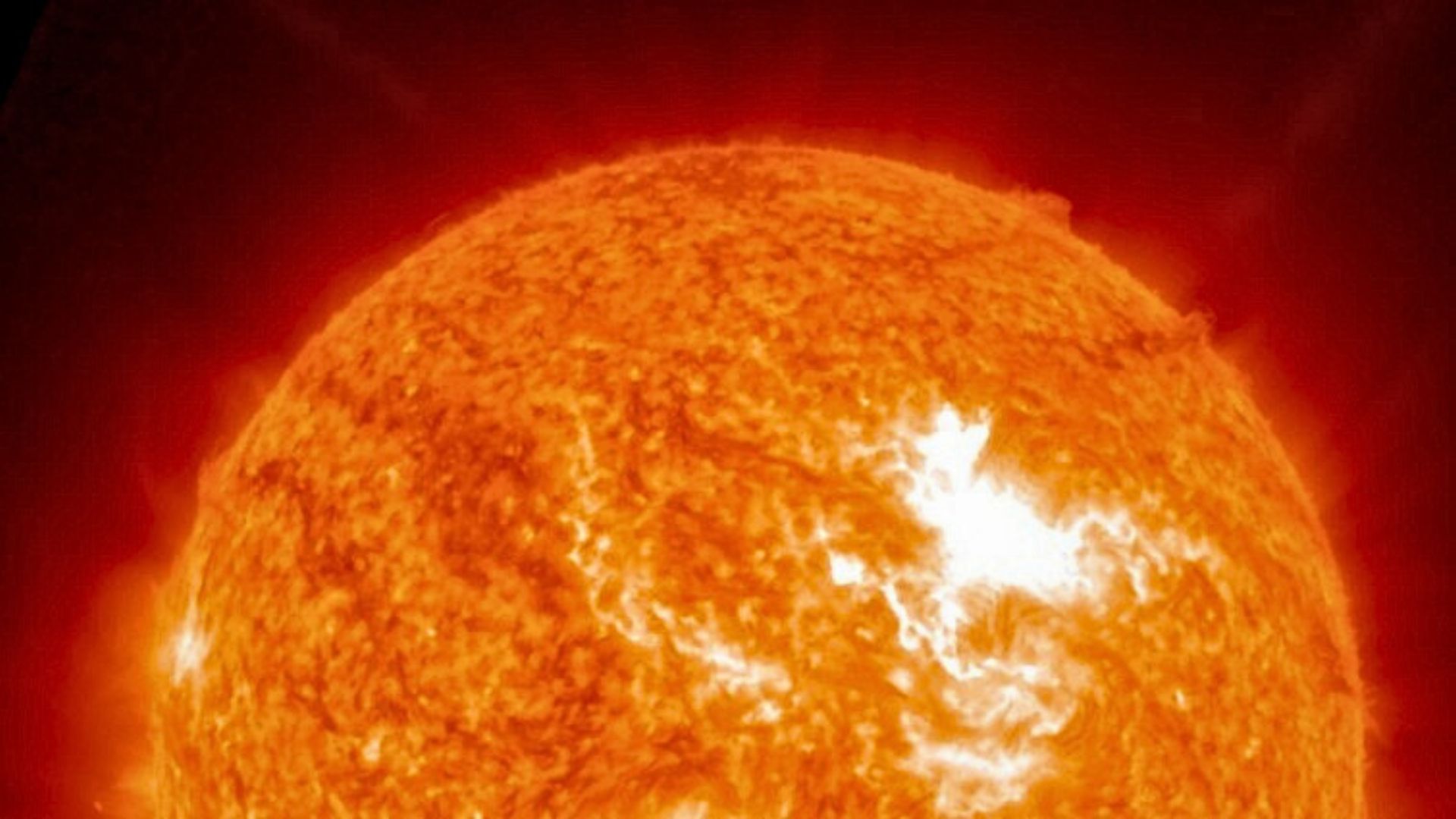
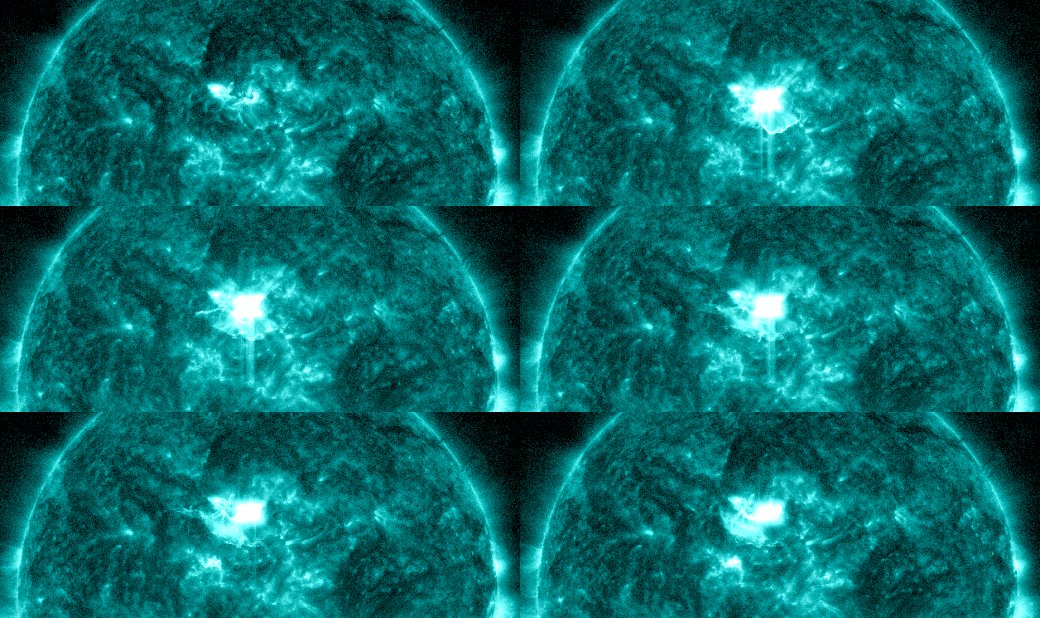
Newly named sunspot AR 4295 (old AR 4274) already produced an X1.9 flare during the night.

1764570610592.png


And a new active region has been spotted erupting shortly after the previous X flare, from spaceweather forum:

1764570908298.gif
 
Completely insane activity! December might become a record in the history of solar physics!!

The highest level X flares have resumed on the Sun.

xras

Early this morning at 05:49 Moscow time, a new X1.9 event was recorded on the northeastern edge of the Sun after a two-week hiatus (since November 14). For science, the whole situation seems, in a sense, completely insane, since the explosion on the side of the star facing Earth was again produced by the same single region on the Sun (No. 4274), which has essentially been single-handedly generating all the extreme solar activity over the past two months.

It was this active center that, in the second half of October, in times that now seem infinitely distant, hit the interstellar object 3I/ATLAS with plasma emissions as it flew past the Sun. It also “terrorized” the Earth in the first half of November, when, after six months of calm on the Sun, it produced five X-class flares at once. It was here that the two largest flares of the year occurred, X5.1 on November 11 and X4.0 on November 14, after which, due to the Sun's rotation, the active center moved to the opposite side of the Sun behind the western horizon for two weeks. And today, after the active region passed over the far side and returned to Earth's field of view on the left edge, a new X-level explosion occurred on the very first day.

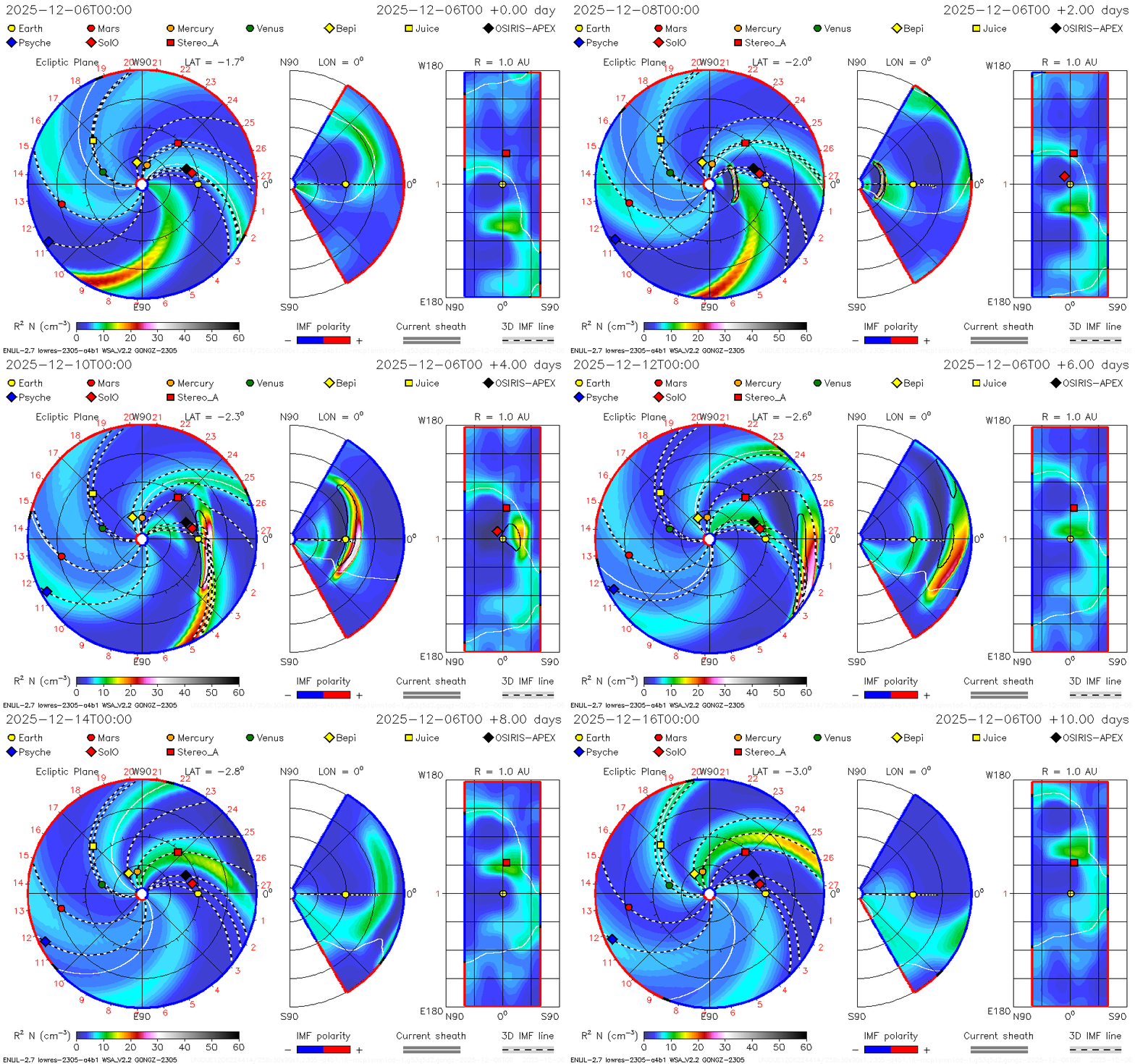
Due to its current location, the event has almost no chance of affecting the Earth with plasma shocks. At this point, we can note the exceptional beauty of the flare, accompanied by large ejections of matter, which looked particularly impressive from this viewing angle. However, the further forecast for the coming week based on nighttime observations looks very negative. It is clear that during its stay on the far side of the Sun, the active center has fully preserved its frankly inexplicable, bottomless reserves of energy and, having lived on the Sun for two months already, is unlikely to suddenly disintegrate in the next three to four days.
After this time, that is, approximately on Thursday, December 4, the region will enter the zone of influence on Earth and begin to hit the Earth with plasma clouds. An additional negative factor is the presence of a second large active region, No. 4294, in the southern hemisphere of the Sun, which appears to be the largest this year. If explosions begin there as well (despite its size, it has not yet shown extreme activity), then, to put it mildly, the beginning of December 2025 may well go down in the history of solar physics.

Video in original quality (6 MB) — link.
 
came across this on a spaceweather forum
quite revealing in some ways

<<Airbus says that flights will be disrupted after it requested immediate modifications to thousands of its planes.

The plane manufacturer says it has found that intense radiation from the Sun could corrupt data crucial to flight controls.>>


and here is the link from the discussion thread on spaceweather live disussion forums disussing this.

 
The largest complex of sunspots has formed on the Sun this year.


brave_screenshot_t.me.png


xras.ru

The southern group of sunspots, which reached the Earth two days ago, has reached its largest size this year. The total area of the complex, measured at the beginning of the day, is 1,600 units, which is still about 60% of the size of the largest groups of spots in the 21st century (values of about 2,800 units), but already one third more than the previous record of the year of 1,200 units, achieved in May 2025 (region No. 4079).

No hard feelings for NOAA, but as usual, the Russians say as it is, because they're less ponerized:

Weak-minded NOAA astronomers responsible for assigning numbers to groups of spots, obviously struggling with panic in their ranks, today made an attempt to "mitigate the shock" and divided this complex into three groups of spots at once. The single area of the complex was divided in the catalog between three numbers: 4296 (left spots), 4294 (central spots) and 4298 (right spots), as a result of which the central group 4294 lost a significant share of its legal area, lost weight in the catalog to 1,100 units, and now formally occupies only the second place of the year. However, few doubt that tomorrow she will regain the lost ground, although perhaps the fight is not over yet and NOAA has already prepared a new pair of numbers for a retaliatory strike. However, all these actions do not affect the objective total size of the group.

The most important mystery of the last two days is the silence of this group, which in terms of incomprehensibility has already equaled the equally fundamental problem of the silence of the universe. Group 4274, currently located in the north of the Sun (today it received the number 4299), produced a new X flash today, having an official area of only 100 (!) units, and during the last passage past the Earth produced 5 X flashes, having an area of 1100. Formed in the north, the largest spot complex of the year with an area of 1,600, which is in question, has been marked by only one weak C-level outbreak over the past day. It is unclear what the energy stored here is used for, which at such a size should be huge. There are actually two options here. Either there is a serious plan to go down in history and energy is being accumulated for a super explosion, or we don't even know... There are big and kind people, let's assume that a big and kind spot has formed on the Sun. Let's, in general, believe in the second option and also send rays of goodness back to the Sun)
 
The largest complex of sunspots has formed on the Sun this year.


View attachment 113952

xras.ru


No hard feelings for NOAA, but as usual, the Russians say as it is, because they're less ponerized:
It's a huge alignment and soon it will point directly at our planet.

If world leaders were human, they would already have all those responsible for electrical infrastructure on high alert, to be able to salvage something in case of a direct hit high power.

The perfect geo-effective alignment and size are very impressive.

hmi200.gif
 
This promises to be exciting, whether if the sun goes quiet or if it shoots energy at us, it's equally amazing.

Sunspot group 4294 became the second largest in the last 10 years

brave_screenshot_t.me.png


xras.ru

A giant complex of sunspots, consisting of three groups 4294, 4296, and 4298, which appeared a few days ago on the southeastern edge of the Sun, continues to break records. The total area of the complex, which, despite its artificial division into three numbers in the catalog, represents a single structure from a physical point of view, exceeded 2,000 units this morning and amounted to 2,200 units. This is already approaching record values, observed only a few times in the 21st century. For comparison, the area of sunspot group No. 486, which in October-November 2003 produced a series of the largest flares of the current century, was 2,600 units.

For the central group of the complex, numbered 4294, an area of 1,450 units was measured this morning, which already makes it the second largest individual group observed on the Sun since 2015. A larger active region, numbered 3664, was observed only once during this period, in May 2024, and it was this region that caused the strongest magnetic storm in 20 years.

Against this backdrop, the main mystery remains the inexplicably low level of observed solar activity. The graph of solar flares after yesterday's X-class flare, to which this complex of sunspots has no relation, stubbornly continues to draw a straight line. It should be noted that the basic physics of solar flares is based on very simple principles. Flares are simply a way for the Sun's atmosphere to get rid of excess energy that accumulates in large active centers. Why this normal mechanism fails in this case remains unclear. Either for some reason the area does not generate energy, which seems unlikely given its size, or, as noted earlier, this energy is currently being actively accumulated. It should be noted that the enormous size and relatively simple linear structure of the complex should contribute to the formation of giant stable electric currents, which are precisely the main mechanism of energy accumulation in the solar corona.

At this point, it can be noted that the sunspot complex is young and has formed in its current size over the past three weeks, mainly while located on the far side of the Sun. In mid-November, when this side of the Sun was turned towards Earth, the first barely discernible spots were just beginning to appear here. It can also be said with a high degree of certainty that the complex has not yet produced any major flares. While it was on that side of the Sun, no signs of major explosions were observed in this part of the star. In this sense, the issue of the absence of strong flares in this group is broader than the problem of the last few days and, apparently, applies to its entire existence. If we side with the energy accumulation hypothesis, this leads to some unpleasant conclusions.

There is essentially no forecast for the coming days. In simple terms, a “black swan” has formed on the Sun. The scenario that it will pass in such a size from edge to edge majestically and silently, as it looks now, and the scenario of a series of the largest X10-X20 flares in a decade in such a situation are equally probable and equally unpredictable. All that remains is to observe.
 
For those with an access to a small telescope with the appropriate solar filter (ask your astronomy club nearby if there is), this group of sunspots is a nice spectacle to observe. It should be visible to the naked eye at sunset.
 
Despite the grandiosity, it's very quiet.

The sunspot complex 4294-4296-4298, which entered the Earth-facing side of the Sun a week ago, is currently passing the central meridian, and in the next three days it will pose the maximum danger to the Earth. The total area of the complex still exceeds the psychologically significant mark of 2,000 millionths of the solar hemisphere, which makes it one of the largest in the current century. The key element of the structure is the central group of spots No. 4294, whose area (about 1300 square meters) is the largest in 2025 and the second largest in the current solar cycle after the 3664 area observed in May last year.

The area 4294 and the area 4296 located to its left have the Beta-Gamma-Delta magnetic classification in the catalog, the highest level corresponding to the maximum potential of flare activity. The area 4298 located on the right is marked as Beta, that is, it is considered to be of limited danger. Despite all these record—breaking areas and the "threatening" magnetic classification, as well as the fact that mathematical models daily give an almost one hundred percent probability of M-level outbreaks and 20-50% of X-level outbreaks, not a single (!) M or X outbreak has been registered in the last 5 days, since the beginning of December. The area is silent. An increased background of thermal X-ray radiation is recorded, indicating a continuous release of energy and heating of the plasma, but the mechanism of accumulation of this energy remains unclear.

Among the distinctive features, one can note the relatively low dynamics of the spots observed here — with the exception of continuous local rearrangements, the global structure of the complex has hardly changed over the past few days. At the same time, this stability of the global structure may explain the absence of large-scale outbreaks of the X10 category, but it does not answer why there is no response even to local changes in the form of outbreaks of M and the lower boundary of X. There is a feeling that energy from all local points immediately "leaks" into a global reservoir, and this whole structure works only to fill it.

The most unfavorable scenario in such systems is the unexpected formation of a new large spot in the center of the group. Its appearance, as a rule, destroys the stable magnetic configuration of the region, triggering an avalanche-like process of its explosive restructuring. Sometimes such a trigger can be the rapid expansion of an existing spot. In general, it remains to be expected that nothing like this will happen over the next three days, and then the group will shift from the zone of direct geo-effective impact to the zone of tangential impacts. With such a size, the consequences can still be significant, but at least it will be possible to avoid the dubious honor of witnessing the rewriting of historical records.
 
An interesting follow up from November's solar flares. They're pushing for all aircraft to be properly equipped for detecting "Ground Level Events" which happen when the sun shoots proton winds that reach Earth within minutes at the speed of light.


Radiation levels in Earth's atmosphere rose to the highest level in nearly two decades in November after a rare solar super-flare pummeled the planet with high-speed particles from the sun. The solar flare, an extremely bright flash of light, erupted from the AR4274 sunspot on Nov. 11. Classified as a powerful X5.1, the flare followed a series of milder flares and coronal mass ejections (CMEs) that treated skywatchers to mesmerizing aurora displays as far south as Florida.

Apart from being the most intense solar flare of 2025 to date, the X-class flare also unleashed a stream of high-speed protons and other energetic particles toward our planet, something very few solar flares do. This year, about 20 X-flares hit Earth  — but only the one from Nov. 11 was accompanied by the high-speed proton stream. That day, when Earth-based monitors began showing elevated radiation levels, researchers released several stratospheric balloons with sensors to see how radiation levels evolved throughout the atmosphere.

They found that at altitudes where most commercial aircraft travel — around 40,000 feet (12 kilometers) — radiation briefly rose to levels ten times higher than the normal cosmic-ray-related background. If a pregnant woman were to be exposed to such radiation levels for more than 12 hours, she would have exceeded a limit officially considered as safe for a fetus. Fortunately in this case, the worst was over in about two hours, according to Benjamin Clewer, a space weather researcher at the University of Surrey in the U.K. "Typically, these events peak right at the beginning and that might only last about half an hour," Clewer told Space.com. "In this case, the event officially finished in 15 hours, but only the first two hours were significant."

CMEs also expel clouds of energetic particles into interplanetary space. Those particles, contained in clouds of magnetized plasma, take days to reach the planet. The protons unleashed by a solar flare, however, travel at nearly the speed of light and arrive within minutes, Clewer said.

When those energetic protons hit the top of Earth's atmosphere, they interact with molecules of air, triggering showers of secondary, less energetic particles including neutrons, muons and electrons. Such particles constantly trickle down onto Earth's surface as a result of the battering our planet experiences due to cosmic rays that arrive from the most distant parts of the galaxy. But when a stream of solar protons hits, radiation levels on Earth's surface and around the planet suddenly spike. The phenomenon is called a Ground Level Event (GLE) and is rather rare. In fact, since measurements began in the 1940s, only 77 such GLEs have been registered, according to Clewer.

Scientists don't understand why some solar flares cause GLEs and some do not and therefore cannot predict when a spike in radiation occurs.

"We don't understand the physics of it that well as to why some solar flares eject these really high speed particles and other ones don't," said Clewer, whose team made measurements of the event that revealed its intensity.

The GLE on Nov. 11, however, was only a mild example of what the sun is capable of. The most intense GLE ever detected happened in 1956 and was sixty times more intense. Even stronger ones, over a thousand times as intense as the Nov. 11 GLE, are possible, as evidenced by radioisotope studies in tree rings.

The GLEs are not only potentially dangerous for human health (in addition to the risk to unborn babies, radiation exposure increases the risk of cancer in all humans), they can also wreak havoc with aircraft electronics.

Only two weeks before the Nov. 11 GLE, a JetBlue Airbus traveling over Florida experienced a sudden loss of altitude that was later attributed to possible malfunctions of onboard electronics caused by high-energy particles from space. Researchers are concerned that a full-on GLE could make aircraft electronics go haywire en masse, increasing the risks of dangerous situations aboard hundreds or perhaps even thousands of planes. The JetBlue incident resulted in multiple injuries to passengers that required medical care.

"The pilots could have different alarms going off in the cockpit at the same time," Clewer said. "They might be having to turn off and reset different bits of equipment. In the worst case scenario, they might have to fly manually."

The researchers are campaigning for all aircraft to be equipped with radiation monitors to help pilots understand what's going on. During severe radiation events, radio links that allow communication with ground control are likely to be disrupted too, preventing the pilots from learning about the cause of the problems. Because GLEs come suddenly and can't be predicted, many aircraft will be caught in those events mid-air.

"If you're in the air and still can communicate with air traffic, you could descend to a lower altitude or change your latitude," Clewer said. "But there is a likelihood that the pilots won't be able to talk on the radio and have to do all the other mitigations on top of that."
 
Back
Top Bottom