Sol (Sun) and its phenomena

Of interest, the aurora intensity coming from big cities which are not favorable to seeing this phenomenon. There was nothing supra-ordinary made by the sun. Overall, it seems to me that it's from this end (Earth) that favored all of this.

The geomagnetic situation is showing signs of stabilizing

After two days of intense magnetic storms, the geomagnetic situation has begun to show signs of steady stabilization. Currently, the interplanetary magnetic field induction has dropped sharply; its high value was the main factor causing geomagnetic indices to move from the green to the red zone. Elevated solar wind speeds still persist, but this factor alone now has only a limited impact.

The recent storm had two peaks: from March 20 to 21 and from March 22 to 23, reaching a strong G3 level in both cases. Each peak resulted in very intense auroras, the lower limit of which, according to some reports, extended to latitudes of about 50 degrees. A significant number of reports came from major cities, despite the strong artificial light typically present in such places. On the night from Sunday to Monday, the aurora was even photographed in Moscow on several occasions.

Лаборатория солнечной астрономии (xras.ru)


brave_screenshot_t.me.png
 
It started a bit again but it looks like things are calming down. It was intense.

K-index 2026-03-23
 
It started a bit again but it looks like things are calming down. It was intense.
Yeah, and it looks like it was favored also from "Earth's end", i.e. field is weaker.

Here's an update for today:

Space weather on March 24, 2026 — outraged

During the day, there were residual spikes from the geomagnetic event that began last weekend. At the moment, the speed of the solar wind remains elevated (about 600 km/s versus the typical 300-400 km/s). The temperature is slightly elevated. The remaining parameters (density and magnetic field) returned to normal. This still retains the potential for minor disturbances.

In terms of flare activity, there are several medium-sized groups of spots on the Sun, but with minimal signs of "life". This is enough so that the background level of hard radiation from the Sun does not fall too low, but no more. There are no flashes, in fact.

In general, there is a feeling that the current situation (neither here nor there) will freeze for the whole week.

Laboratory of Solar Astronomy (xras.ru ) (Лаборатория солнечной астрономии (XRAS) )
photo_2026-03-24_06-22-00.jpg
 
It was prolonged, for sure.

brave_screenshot_t.me.png


The geomagnetic storm, which lasted nearly a week, has ended

A fairly prolonged surge in geomagnetic activity, which began on March 20 (last Friday), appears to have finally come to an end. The day before yesterday, the event had a brief false finish when solar wind parameters seemed to start dropping rapidly, but ultimately remained at elevated levels for another two days.

The event was a combination of the effects of a coronal hole and several medium-sized plasma clouds reaching the planet, and it had been predicted in advance. Its expected intensity was also reported to be quite significant—the strongest in two months (which turned out to be the case)—as well as a duration of about a week (which again roughly matched reality). There was a relatively small error in the timing of the disturbances’ onset—they began about half a day late, resulting in a minor surge of activity not on the Sun, but in forums and chat rooms. [:lol:]

At this moment, absolutely all solar wind parameters have returned to the normal range. The probability of weak surges remains, but now at the usual everyday level. Today is likely the last day when a brief echo is still possible. Starting tomorrow, the forecast is already completely green.

Лаборатория солнечной астрономии (xras.ru)
 
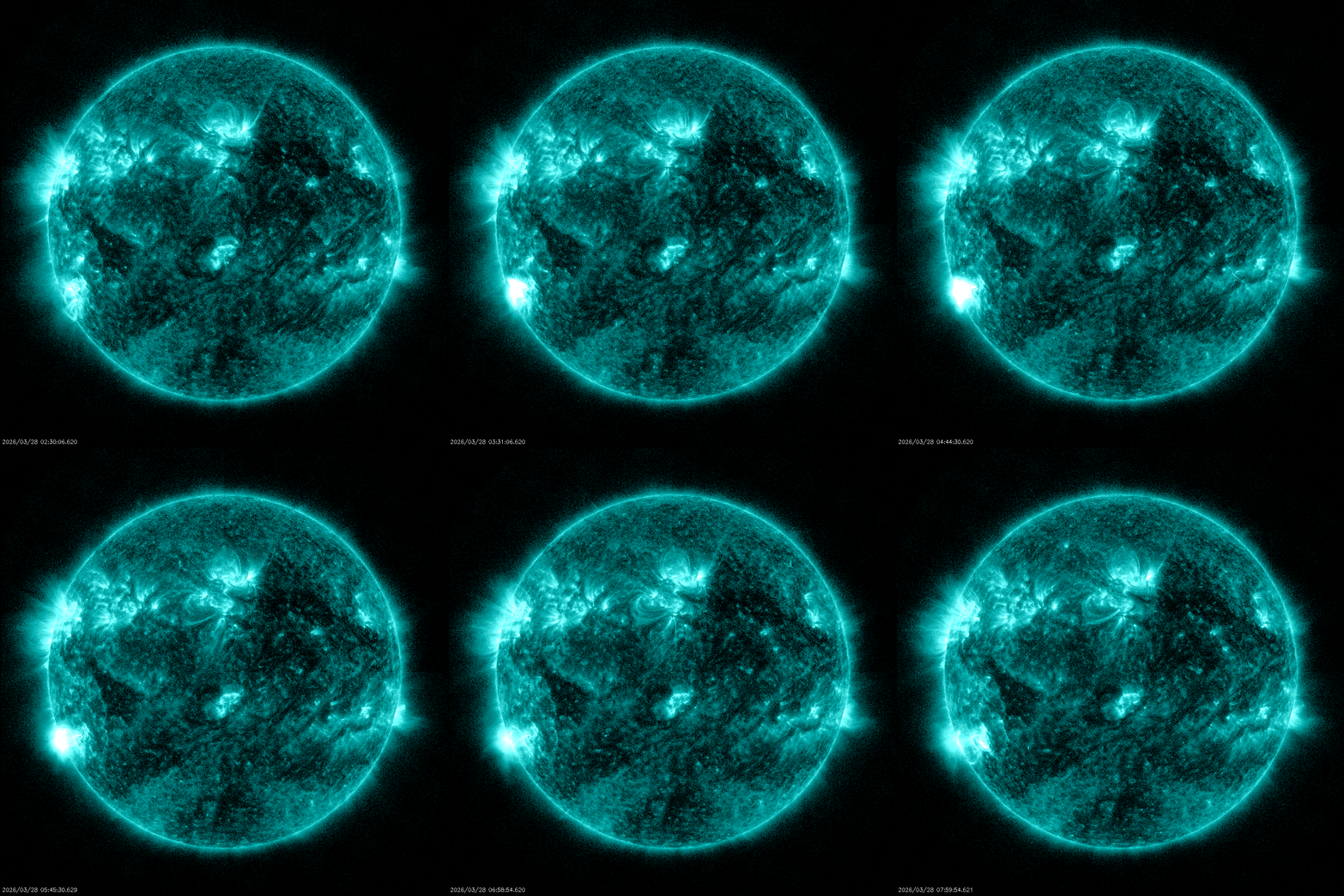
Nothing to worry about yet, it's far to the northeast of the sun, but an impulsive nearly M4 flare occurred on the sun this morning.

1774512430221.png


Comment from spaceweatherlive forum about this "new" sunspot AR4403:

Good M3.93 flare with a CME from this region!

A reminder that the main sunspot in this region has already seen 70+ M flares, as its the same strong blue spot that originally emerged when it became AR4366 2 full rotations ago!

This time it's already giving us a better show than last rotation when it was 4378(had no M flares), and the fact it's throwing fast CMEs with an M class is very promising! As 4366 I remember we got an X4 that barely caused a CME at all 😅 so its good to see "magnetic caging" not be an issue!

And for a few days we'll get to "see" the full farside sunspots (source):

1774512824416.png


1774512839217.png


Humanity will see the entire Sun for several days

The Solar Orbiter spacecraft, belonging to the European Space Agency and orbiting the Sun, has emerged on the opposite side of its orbit from Earth. This means that at the moment, humanity can observe the entire Sun - both its side facing Earth and the opposite one.

This geometrically precise configuration will persist for several more days, and then gradually begin to dissipate as the spacecraft starts to overtake Earth. Nevertheless, a significant portion of the solar surface invisible from Earth can still be observed for several months. By the end of spring, about 2/3 of the reverse side will still be accessible. By the end of summer, the spacecraft will finally catch up with Earth, position itself between it and the Sun, and will see the same thing as terrestrial telescopes.

As an interesting fact, it can be noted that neither the flares nor the spots observed by the spacecraft during this period will be included in the global catalogs. Only events recorded on the side facing Earth will still be entered there. Otherwise, the number of flares in the catalogs during this period would have doubled, which could subsequently lead to confusion in assessing solar activity, creating the illusion that it had briefly increased by 100%.

In the pictures: at the top - the Sun as seen from Earth (HMI telescope on SDO), at the bottom - the reverse side of the Sun as seen by Solar Orbiter (PHI instrument).

Current data from Solar Orbiter are available on the project website.

Solar Astronomy Laboratory (xras.ru)
 
The main threat here is to the Artemis mission to the moon scheduled in a few days.

photo_2026-03-28_06-54-57 (2).jpg
photo_2026-03-28_06-54-57.jpg


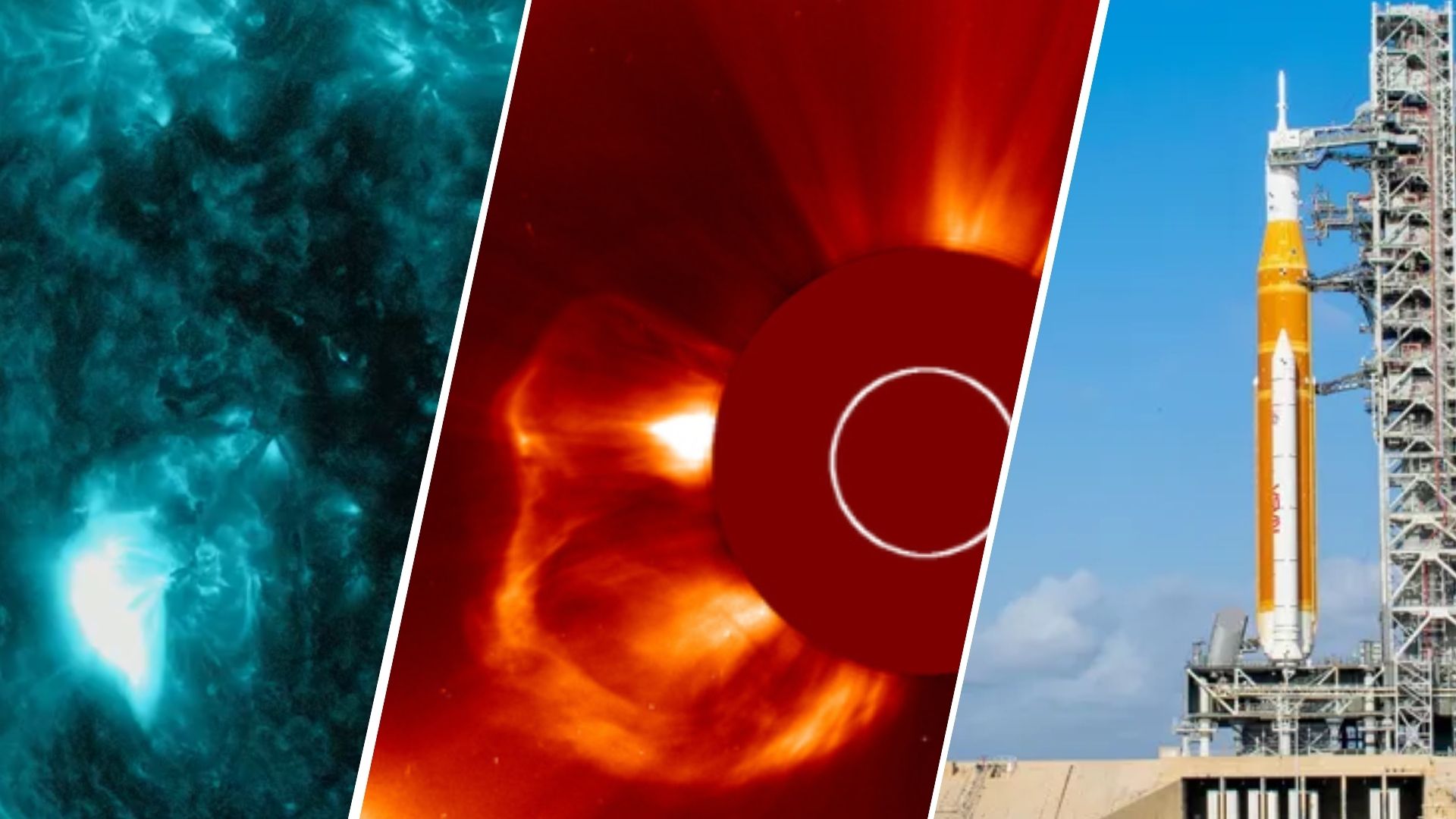
There is a large plasma release in the Sun. There may be an impact on the launch of the lunar mission.

Judging by what the coronographs are sending and the X-ray profiles, a large plasma release is developing on the Sun right now. The event attracts attention, among other things, because on the night of April 1-2, the first manned flight to the Moon since 1972 is planned, in which a crew of four people will go beyond the protective effect of the Earth's magnetic field for the first time in more than half a century. Unlike near-Earth orbits, where only secondary manifestations of space weather are possible (fluctuations in the magnetic field, changes in atmospheric density, and an increase in the number of charged particles), in long-range orbits the ship finds itself right inside a cloud of solar plasma that envelops the planet for several days. In this regard, solar activity will be monitored especially closely in the coming days. The last known case of postponing the launch of a deep space mission occurred in November last year, when NASA, according to a statement released by the agency. (NASA's ESCAPADE Launch Shifted, Now Targeting Nov. 13 ) postponed the launch of the ESCAPADE satellites to Mars due to solar activity.

At the moment, the answer to the question of whether plasma can come to Earth is more likely "no" than "yes". The center of the cloud, according to the data that is already available, moves away at an angle of about 60 ° from the direction to the Earth and, moreover, is noticeably shifted downwards. With such initial data, only edge touches of the outermost peripheral parts of the plasma cloud are possible. Let's see what the calculation shows. At the same time, according to some signs, a systemic increase in activity is beginning in the Sun, which may continue throughout the next week. If it becomes clear that this is the case, then this factor will have to be taken into account.

Today we will publish the calculation of plasma motion.

Laboratory of Solar Astronomy (xras.ru ) (Лаборатория солнечной астрономии (XRAS) )
 
The main threat here is to the Artemis mission to the moon scheduled in a few days.
There seem to be a few variables in the next few days that would bring your research to fruition. ☀️

Well Well, hello there Major Solar Flare. X 1.3 Sunday Night
Mar 29, 2026
Solar Weather Updates.. Solar flares and sunspots..Volcano and earthquake updates.

HOW TO SEE THE ARTEMIS CREW CAPSULE: If all goes according to plan, NASA will launch the giant Artemis II rocket on April 1st, propelling astronauts to the Moon for the first time since the Apollo era. Using backyard telescopes, amateur astronomers may be able to see the crew capsule en route. Get ready now by logging into the JPL Horizons app for an ephemeris of the departing spacecraft. Here are some simple instructions.

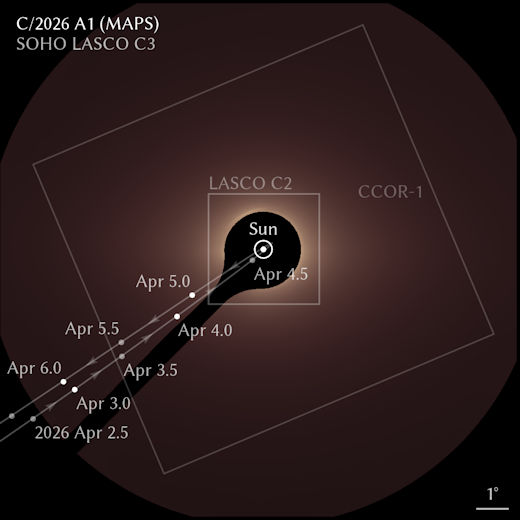
SUNGRAZING COMET UPDATE: Sungrazing Comet MAPS (C/2026 A1) is getting very close to the sun. On April 4th it will skim just 160,000 km (0.23 solar radii) above the sun's surface--a true death dive. The event will be invisible from Earth, but space-based coronagraphs will be able to see what happens:


Astronomer Qicheng Zhang of Lowell Observatory in Flagstaff, Arizona, created this diagram. "It shows the trajectory of Comet MAPS through the SOHO/LASCO and GOES-19/CCOR-1 fields of view," says Zhang. "The comet approaches the sun from the lower left and will also depart to the lower left, if it survives perihelion (closest approach to the sun)."

"Even if the comet's nucleus fully disintegrates right now, the remnant will still rapidly brighten in the final hours as intense solar heating turns the dust into a trail of glowing gas," he continues. "In that case, a peak brightness around magnitude −2 would occur about ten hours before perihelion (Apr 4 ~04 UT)."

In 2011, Comet Lovejoy (C/2011 W3) skimmed the sun at about the same distance and survived. It became a spectacular sight for weeks. Could the same thing happen to Comet MAPS?

"I'm pessimistic," says Zhang. "Images from the James Webb Space Telescope suggest that the nucleus of Comet MAPS is only ~0.4 km in diameter, which is on the lower side of estimates for Comet Lovejoy. Whether any of the comet still exists after April 4th remains to be seen."

Stay tuned!

AI review
Active solar activity, specifically Solar Energetic Particles (SEPs) from flares or coronal mass ejections (CMEs) during the Solar Cycle 25 maximum, could delay the Artemis II launch. These events create high radiation levels that pose significant health threats to astronauts traveling beyond Earth’s protective magnetic field.
Aerospace Global News +3

Key solar factors that could prevent or delay launch:
  • High-Risk Solar Activity: The Sun is currently experiencing a peak in solar activity (through mid-2026), increasing the likelihood of powerful, unpredictable eruptions.

  • Radiation Threats: Solar particle events can cause dangerous radiation doses, with potential to damage onboard Orion spacecraft electronics—similar to the power anomalies seen during Artemis I.

  • Safety Monitoring: NASA experts are actively monitoring the Sun 24/7. High sunspot activity, especially on the Sun's Earth-facing side, could force a postponement to protect the crew from high-energy radiation, says Phys.org and The Times of India.
    NASA Science (.gov) +5

    If such events are forecasted, the launch window might be shifted to avoid maximum exposure periods, as discussed in a report from Space.com.


Trending content

Back
Top Bottom