Sound Bowls, Crystal Healing, Sound Alchemy

lucid_dolphin

The Force is Strong With This One
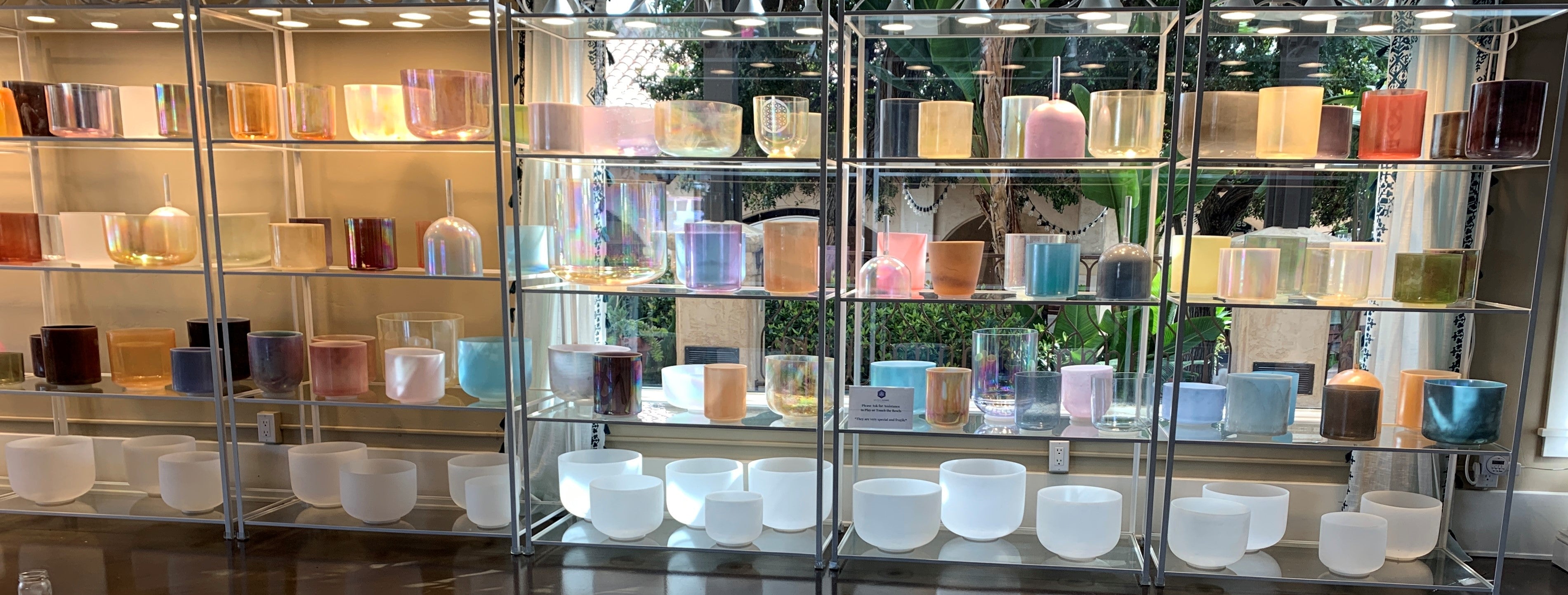
I have been researching crystal healing bowls. How do you feel about them?

I see them as biomedical devices. The high quality ones that can create a healing vibration to heal at a cellular and DNA level are extremely expensive. It does matter what quartz the bowl is made from and whether it has gold or amethyst.

But perhaps users out there have had experiences with less expensive bowls?

For example here are extremely expensive, but they work. I've noticed plants like them, and diseases do not like them.

Do you think the bowls of Tibet are better?

Screen Shot 2022-10-03 at 1.11.40 PM.png
 
And also it's a shame because so many practitioners of the healing arts like Reiki do not have the money to have a true biomedical device level healing tool. So when some people walk away with the impression of energy healing that it's a show using some props...in some ways it is because the average healer cannot afford the healing equipment to really affect DNA.

We can try and send the intention to hopefully have the person find the tools it would take to balance out *remove* the illness at a medical facility, sound healing temple, gym, etc. But sometimes it is an imitation of what we could do at a higher level.
 
Hi lucid_dolphin,

Have never used bowls, and I haven't read much about them.. but thanks for opening this thread. It reminded me of this one, have you had a chance to read it? maybe there's a related mechanism.. not sure, just speculating.
 
Hi , in this YouTube video (link)

ENQUÊTE: MUSIQUE ET FRÉQUENCES - Investigation Hypnose (INVESTIGATION: MUSIC AND FREQUENCIES - Investigation Hypnosis)​

, from a french collective hypnosis research channel; one participant say that for healing purposes the level of precision of the sound required for the healing to occur is extremely high. He also put emphasis on the person using e.g. bowls, who's connection to higher realm/density need to be pure and that the bowl in itself is just a tool.
He describes the healing process under hypnosis and see wawes that needs to cross eatch others perfectly, FWIW.
 
Hi , in this YouTube video (link)

ENQUÊTE: MUSIQUE ET FRÉQUENCES - Investigation Hypnose (INVESTIGATION: MUSIC AND FREQUENCIES - Investigation Hypnosis)​

, from a french collective hypnosis research channel; one participant say that for healing purposes the level of precision of the sound required for the healing to occur is extremely high. He also put emphasis on the person using e.g. bowls, who's connection to higher realm/density need to be pure and that the bowl in itself is just a tool.
He describes the healing process under hypnosis and see wawes that needs to cross eatch others perfectly, FWIW.
I appreciate your thoughtful reply. I was hoping for this kind of discussion when I had joined the forum. But it seems to be all about Russia and Ukraine now? I realize the conflict is affecting many members of this forum directly, and that's important.
 
This thread was opened up about a year ago, and there does not seem to have been any interest or much follow-up by our members.

- Is it because this technique is somewhat irrelevant or not useful?
- Is it because it's been discussed somewhere else? (the search tool has not produced much results)
- Does any member have knowledge or experience regarding this they would like to share?

There is a person in Montreal who offers group events to immerse in vibrational sounds as a therapeutic method. Sometimes with vibrational chant, mediation, or with an energetic healer as a guess. It does seem interesting to investigate, but my time and health are quite limited at the moment, and I would prefer to not waste too much of them by being misguided. I want to focus on the most beneficial techniques for the moment until I get better. Otherwise, if this does have proven benefits, I'll be more than happy to pursue more research on the subject and share it with the group.
 
tibet esotericism: this is an interesting text as it describes a site in tibet related to helpers awaiting the need to intervene. it reminds me of the cass “help is under way” which newer arrives...
 
I was hoping for this kind of discussion when I had joined the forum.
Hi. Being a guitar player, this topic absolutely interests me. At a certain Decibel level even an amped electric guitar changes character and effect on the body depending on the tone, so I wonder if the loudness of the bowls might also be a thing.

The bowls are somewhat portable devices - are they Mono frequency? Would a single bowl be for affecting one chakra? Would a set of seven be required for a truly broad spectrum approach? How do the effects of metal vs glass bowls differ? Two bowls of differing frequencies would create different wave pattern interactions and perhaps even the positioning of the bowls would be crucial in relation to the subject.

I view the cathedrals and theaters that had massive pipe organs and tuned acoustics as similar healing venues or hospitals of a sort that had impact multiple levels of existence.

Is the shape and resonance of the bowls as important as the actual frequencies and harmonics being generated? Interesting questions to ponder.
 
I have attended a sound therapy / relaxation session in a group setting a few times with Tibetan (metal) bowls, and sometimes also vocals and other instruments like koshis. Once also at a workshop where we got to play around with them.

I feel that they can get me into a quite deep meditative state, sometimes with vivid images during them, like a semi-dream state. I've even felt physical sensations on parts of my body once.

Can't really speak of any potential healing or long term effects, and I haven't studied the subject in depth, but overall the experience has been pleasant and relaxing if nothing else.

To contrast I once attended a "sound therapy" session at a church with planetary gongs and other instruments like pipe organs and violins. The music was incredible discordant and unharmonious and I started to feel a sensation of panic creeping up on me, like I needed to get out of there. Unfortunately I was in the middle of a full church bench, and I couldn't easily walk out. So I focused on my breathing, and eventually the feeling subsided.
 
This thread was opened up about a year ago, and there does not seem to have been any interest or much follow-up by our members.

- Is it because this technique is somewhat irrelevant or not useful?
- Is it because it's been discussed somewhere else? (the search tool has not produced much results)
- Does any member have knowledge or experience regarding this they would like to share?

There is a person in Montreal who offers group events to immerse in vibrational sounds as a therapeutic method. Sometimes with vibrational chant, mediation, or with an energetic healer as a guess. It does seem interesting to investigate, but my time and health are quite limited at the moment, and I would prefer to not waste too much of them by being misguided. I want to focus on the most beneficial techniques for the moment until I get better. Otherwise, if this does have proven benefits, I'll be more than happy to pursue more research on the subject and share it with the group.

Sound and music can definitely be healing. However, the usual warnings against dissociation during meditative states applies, especially when there are other people around who may be dissociating and attracting all kinds of critters. Getting a good sense of the person leading the sessions and staying in the body are probably key. The good old 'Awareness is a shield and armour' principle.

I recently read an account of the possibilities of one particular sound-healing approach that is grounded in neuroscience, the Tomatis method. It's described in Norman Doidge's book The Brain's Way of Healing.

He tells the story of Will, who was born premature, leading to many medical complications. On top of the early medical trauma, he was then severely injured by the MMR vaccine, though Doidge doesn't make the connection. He would bite himself until he bled, walked on tip-toes, was incommunicative (both speaking and listening), did not play with toys, did not sleep, couldn't hold objects, was unable to process normal stimuli, a had lot of frustration and anger. In short, he was regarded as autistic, and the medical system basically told his parents that he would only develop to the mental age of a two-year-old. But they didn't give up.

His parents took him to a Tomatis specialist in Toronto, Paul Maudale, who determined that Will did not have autism, but rather the peripheral symptoms of autism. The doctor had Will start a listening program featuring Mozart and also his mother's voice reading nursery rhymes, filtered in a very particular way that stimulates the brain by way of the ear. He also listened to Gregorian chants.
WILL RESPONDED PRO FOUNDLY TO THE listening therapy: he slept better, spoke, formed closer emotional connections, and was able to regulate his emotions. At that point he had finished his fifteen-day passive phase. Paul said that Will would need six weeks for his brain to consolidate his gains. His development would continue, but as he started to communicate for the first time, he would also develop new frustrations. Paradoxically, this change would be a sign of progress.

When the family returned to Britain, Will continued to develop. He got up to twenty-two words, his sleep was now “fantastic,” his appetite improved, and many of his unusual symptoms vanished. He was no longer squashing himself underneath weights, running around tables, looking at objects from different angles, or opening andclosing doors. Toys he had never played with were now being used appropriately.

Six weeks later, in May 2011, they returned to Toronto for a second fifteen-day visit, to begin the active phase. Will listened to filtered music again, but also to his own filtered voice while he spoke or sang. Over the fifteen days his vocabulary grew, he was able to communicate better, and he became calmer. Because he could communicate his emotions and thoughts, he didn’t rage or bite himself when frustrated, and Liz [his Mom] could now reason with him. He progressed to role-playing and pretend play, and his imagination flourished. Sound stimulation had so awakened his brain that he developed a sense of smell for the first time.

But as Paul had predicted, he was often frustrated. Two to three days into his second treatment phase, having begun communicating, he suddenly expressed intense annoyance and threw tantrums whenever his parents couldn’t immediately understand him. Having tasted communication, he wanted as much as possible. Then after a month, his frustration diminished as quickly as it had begun.

“Paul said he would be speaking in sentences by Christmas,” says Frederick [his Dad], “and literally a week before Christmas, he did.”

Paul had developed a portable Electronic Ear, called the LiFT (for Listening Fitness Trainer), and he gave Liz one to take home to England. Paul kept in touch by Skype, modifying Will’s program as needed. In late 2012 speech and language therapists inEngland declared Will’s language, speech, and comprehension to be age appropriate fora four-year-old. In eighteen months, with Paul’s help, he had moved through more than four years of language development, because in fact, at four, he read and comprehended at a six-year-old’s level. Frederick marveled the day Will read the word scientist, thinking, “Two years ago he couldn’t speak!” In September the pediatric consultant in the U.K. apologized, saying that she had “got it totally wrong,” and she admitted that Will’s progress completely blew her away and that she would now direct other children like Will to listening therapy.


[...]


Prematurity, even without oxygen deprivation, contributes to fewer connections between neurons because a rapid increase in the branching of fetal neurons normally occurs in the last third of pregnancy—the period when most premature babies are extruded from the womb. The problem is that mainstream physicians have no training in using mental activity or sensory stimulation to “hook up” disconnected neurons and help them mature, training that would take advantage of the fact that “neurons that fire together wire together.” It took experts like Alfred Tomatis and Paul Madaule to devise ways of stimulating neurons to fire and wire to connect, because everyday experience—of which Will had plenty—is insufficient to do so. Before he could make use of everyday experience to mature, he had to pass through the steps I have described: in the first few days he required appropriate neurostimulation, which turned on the parts of his brain that neuromodulate arousal. He got the neurostimulation and began to sleep properly. This state of neurorelaxation allowed him to accumulate energy so that he was soon able to make huge leaps in language development and sensory discrimination, a sign of neurodifferentiation.

I found a practitioner nearby and am thinking of trying it out for my own nervous system issues - it works with adults as well as children.
 
I have a cousin who is going to Tomatis for a couple of months now. It doesn't seem to do anything positive to him. The method was recommended to them by some friends who said that it helped their daughter. Perhaps it only works for some cases? His mother put the headphones on herself to hear the sounds and she said that it felt horrible and that it's no wonder why her son was not happy listening to it.
 
I have a cousin who is going to Tomatis for a couple of months now. It doesn't seem to do anything positive to him. The method was recommended to them by some friends who said that it helped their daughter. Perhaps it only works for some cases?

Yep, it's not a magic bullet. From Doidge's book:

Paul Madaule has found that listening therapy can help about two-thirds of children with autism who come to the Listening Centre. "Help means improvements ranging from [miraculous] to a more modest but very welcome improvement that permits the child to make better use of existing therapies, and to participate more in school and in social and family life, in such a way that he or she is far more regulated, self-aware, and independent. Generally, the younger the child with autism is when therapy begins, the better. Ongoing yearly "boosts" are helpful, and often the children themselves ask to go back to the center, saying, as one child did, "I need the music again, to calm down inside."

Two-thirds for autism is pretty good, I'd say. There's also evidence for help with dyslexia, ADD/ADHD, and others.

His mother put the headphones on herself to hear the sounds and she said that it felt horrible and that it's no wonder why her son was not happy listening to it.

Interesting. In the book the music is described as screechy, with heavy filtration to get the right frequencies. As far as I can tell, the music is also attuned to the specific needs of the patient. So that's not a surprising response from the mother... it's not the usual Mozart session.
 
Back
Top Bottom