The Crystal Palace in London is the one World Fair that DID exist. MJF did a fine recap above. Notice how the Cs made reference to a Crystal Palace in relation to Alice through the looking glass, even though there's no reference of a Crystal Palace in the original books.
A recap of related sessions where they made this reference
July 18th, 1998
A: The planet has been enshrouded with EM grid.
Q: (T) Are these the ley lines?
A: No.
Q: (L) Are they artificially generated?
A: Contoured.
Q: (L) They are artificially contoured. What is the result of this shrouding?
A: Manipulated for use by 3rd/4th Consortium.
A: You are dancing on the 3rd density ballroom floor. "Alice likes to go through the looking glass" at the Crystal Palace. Atlantean reincarnation surge brings on the urge to have a repeat performance.
Q: (T) The Atlanteans who have reincarnated are getting ready to do the same thing they did before with the crystals. So, this is an Atlantean type thing that is being done now? Different equipment, but the same type of thing?
A: All lessons must be learned before you can move onto bigger and better things.
Q: (L) Is that a general statement about the Atlanteans repeating the lessons, or that once we learn this lesson, we can move onto bigger and better things in counteracting this grid?
A: All that is present and future too.
December 5th, 1998
Gaby - it is a long time ago since I looked at the issue of what the C's had meant by their statement that "You are dancing on the 3rd density ballroom floor. "Alice likes to go through the looking glass" at the Crystal Palace. Atlantean reincarnation surge brings on the urge to have a repeat performance."
I must admit that I am still puzzled by the C's reference to the "Crystal Palace". You will note that they put the term in capital letters making it a reference to something specific rather than generic. Did they mean the huge glass complex created for the World Fair in London or something more subtle perhaps? By making references to "Alice" and "through the looking glass", did they intend us to focus on Lewis Carroll and his famous works Alice in Wonderland and Through the Looking Glass? If so, why did they also refer to "dancing on the 3rd density ballroom floor" and to an Atlantean reincarnation surge bringing on an urge to have a repeat performance?
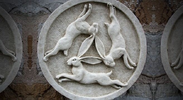
The C's have mentioned in the past to look for a triplicative connecting clue profile following the Third Man theme:
A: Laura, my dear, if you really want to reveal "many beautiful and amazing things," all you need to do is remember the triad, the trilogy, the trinity, and look always for the triplicative connecting clue profile. Connect the threes... do not rest until you have found three beautifully balancing meanings!!
In various threads I have looked at what the C's might have meant by "Alice likes to go through the looking glass" at the Crystal Palace." In researching into the matter and trying to find a "triplicative connecting clue profile", I came up with a possible link or clue in mirrors or crystal lenses.
Oddly enough. football or soccer may provide a starting point here. Crystal Palace is today the name of an English Premier League football club that won the prestigious FA Cup last year. I myself support one of their arch South London rivals called Charlton Athletic. There is little love lost between the two sets of supporters, which dates back many years ago when my club shared the Crystal Palace ground for four difficult seasons with their not so wonderful supporters. However, the football link in this case actually involves a third London club and that club is called Fulham FC who play at a place called Craven Cottage (see more below on this) and here the link with Lewis Carroll begins to surface since Craven Cottage is in fact the remains of what was once a grand Victorian villa that was owned for a few years by the Victorian novelist and statesman Lord Edward Bulwer-Lytton.
His name may be familiar to you since he featured in Laura's piece on the Undergrounders:
Many of the core ideas stem from fictional accounts of the hollow Earth, often presented in the guise of factual accounts, the line between fact and fiction deliberately blurred. Edward Bulwer-Lytton, an English Rosicrucian, wrote [Vril:] The Coming Race in 1871, which tells of a beautiful inner-Earth-dwelling race, the survivors of an ancient cataclysm, who travel in “air-boats” using “vril” energy. Agartha was first mentioned by Louis Jacolliot in 1873, and its alleged underground theocracy which controlled world events on the surface was first described in detail by Joseph-Alexandre Saint-Yves d’Alveydre. Both were occultists.
Bulwer-Lytton was not just any Rosicrucian since he was in fact considered to be the head of the order in England, although he always denied this. However, he was also the head of another secret society, one which went by the strange title of the
Orphic Circle. This secret society had a number of very distinguished patrons who included, inter alios, author and statesman
Benjamin Disraeli who was the then Prime Minister of England and Bulwer-Lytton's boss (since the latter was the Colonial Secretary in Disraeli's cabinet), famous novelist
Charles Dickens (who was also a leading spiritualist) and
Lewis Carroll (satirical writer, Oxford don and first rate mathematician).
Lewis Carroll moved in various notable social circles including the
Pre-Raphaelite art movement headed by John Ruskin and Dante Gabriel Rossetti. He was also an early member of the
Society for Psychical Research. What most biographies seem to leave out though, is that he was also involved with the Theosophy movement that brought him into contact with the likes of
Madam Helena Blavatsky (the author of
'The Secret Doctrine')
One of the places where the Orphic Circle was alleged to meet for channelling sessions was Craven Cottage and here we may find a strange link with dancing. There is very little on record that points to the existence of the Orphic Circle. However, what there is mainly stems from the memoirs of a fascinating woman who apart from being a professional stage dancer, singer and actress who performed on the London stage was also a talented and renowned trance medium and spiritualist who would even come to the attention of President Abraham Lincoln as well as the leader of the Theosophist movement Madam Blavatsky who thought she was the best that she had ever seen. The two women were well acquainted and Britten, who would go on to become one of the leading spiritualist advocates and practitioners of the 19th century, would be heavily involved with the Theosophists in the early days of that movement until she fell out with Blavatsky and subsequently broke all links. Britten as a writer, orator and spiritualist had an influence on Abraham Lincoln’s presidential re-election in 1864 via her
‘Coming Man’ speech.
1, Emma Hardinge Britten - the Esoteric Alice
Emma Hardinge Britten (maiden name Emma Floyd) was according to some the esoteric 'Alice in Wonderland' as opposed to the real model for Alice in Wonderland who was
Alice Liddell. In an academic work by
Robert Mathieson on Emma Hardinge Britten, Mathieson commented on her links with the Orphic Circle and Lord Edward Bulwer-Lytton. If Lewis Carroll was a Rosicrucian and member of the Orphic Circle, as many have suggested, he would have known Bulwer-Lytton well and would almost certainly have come into contact with Emma Harding Britten, possibly during some of her trance sessions for the Circle or for the Theosophists. Mathieson also makes reference to
Frederick Hockley, a Rosicrucian who was the most well known English occultist of the first half of the 19th Century. Mathieson shows that Emma Hardinge Britten knew Hockley well and was even allowed to use his 'sacred mirrors' for vision trances to contact guiding spirits (who in her own words were extraterrestrial and not human). Hockley also kept important papers in what he called his "Crystal Manuscripts". These manuscripts may have been made available to Bulwer-Lytton and the information in them and his own Rosicrucian knowledge, when taken together with what he may have learned from the trance medium sessions with the Orphic Circle, could have formed the basis of the ideas he wished to get across when writing his book
'Vril: The Coming Race'. So, her we get our first reference to mirrors as well as crystals.
Britten developed a reputation for her abilities as a spiritualist or trance medium/clairvoyant during her early years. This may have brought her to the attention of the Orphic Circle. To establish this link, I would refer to an article written by
David Charles Manners in 2017, which describes his ancestor
Charles Thomas Pearce's involvement in the Orphic Circle and names Edward Bulwer-Lytton as a member as well as quoting directly from Britten.
Although she does not name them specifically, Britten had this to say about the Orphic Circle in 1887:
“When quite young, in fact, before I had attained my thirteenth year, I became acquainted with certain parties who sought me out and professed a desire to observe the somnambulic faculties for which I was then remarkable. I found my new associates to be ladies and gentlemen, mostly persons of noble rank, and during a period of several years, I, and many other young persons, assisted at their sessions in the quality of somnambulists, or mesmeric subjects....
I should have known but little of its principles and practices, as I was simply what I should now call a clairvoyant, sought out by the society for my gifts in this direction, had I not, in later years, been instructed in the fundamentals of the society by the author of ‘Art Magic’. When modern spiritualism dawned upon the world, for special reasons of my own, the fellows of my society gave me an honorary release from every obligation I had entered into with them except in the matter of secrecy. On that point I can never be released and never seek to be; but in respect to the statements I am about to make, my former associates . . . not only sanction, but command me to present to the candid enquirer [. . . the substance of the article to which these two paragraphs are an introduction.”
She subsequently added:
‘[They] claimed an affiliation with societies derived from the ancient mysteries of Egypt, Greece and Judaea’, whose ‘beliefs and practices had been concealed from the vulgar by cabalistic methods.’
This last reference may also establish a link with the Rosicrucians, a group that also claims a derivation from the ancient mystery schools of Egypt, Greece and Judaea (ref. their Manifesto known as the
Fama Fraternitas).
Craven Cottage
One possible meeting place for the Orphic Circle, where they could conduct their ceremonial and practical rituals involving clairvoyants or trance mediums was Craven Cottage in Fulham, North London (the Cottage still stands and now forms part of the Fulham Football Club’s stadium). Bulwer-Lytton owned or rented the property between 1840 and 1846. He held sumptuous parties there where guests included Louis Napoleon (the deposed Emperor of France) and Benjamin Disraeli. Robert Browning the famous poet would also spend time recuperating there after an illness. The spiritualist, Samuel Carter Hall, confirmed in his memoirs that séances were definitely held there. He recalled that a young French clairvoyant, Alexis Didier, performed his mesmerism there only days after arriving in England in 1844. Craven Cottage had some odd features that may have made it ideal for such performances. These were a room referred to as ‘the Robbers Cave’, which had a doorway in the ceiling and the door into the library (known as the Egyptian Hall) had ancient Egyptian style pillars on either side. Craven Cottage was in fact a large rural residence and not a small cottage despite the name. Laurence Hutton in his description of the Cottage in his ‘Literary Landmarks of London’ described it as follows: “It stood in 1885, a picturesque ruin, and must have been, in its day a very remarkable specimen of fantastic architecture, embracing the Persian, Gothic, Moorish and Egyptian styles.” This would make it the perfect setting for rituals harking back to earlier times and ancient traditions. Whether Emma Britten performed any of her trance medium sessions for the Orphic Circle there is not known but there is every likelihood that she did.since she was already 17 years old when Bulwer-Lytton first moved into Craven Cottage. One researcher, Mark Demarest (who had access to the Emma Hardinge Britten Archive), has argued that Craven Cottage did serve as the backdrop for the Circle events described in her biography Ghost Land (see more below on this).
Craven Cottage in the 19th Century
Quoting from the
Georgian Group Journal Volume XIX:
"In 1805 the cottage had been bought by Walsh Porter, who lived only another four years afterwards but made extensive and expensive changes to the house. With the help of the young architect Thomas Hopper, he converted the central reception room into an ‘Egyptian Hall’ picking up on the evidence for ancient Egyptian temple decoration which had come to light during the recent Napoleonic invasion of Egypt. The columns, inward-tapering doorways and walls were decorated with mythical beasts, hieroglyphics and lotus leaves. Stranger still, the drawing shows palm trees on delicate trunks, their leaves touching the ceiling. By one door was ‘a movable camel in bronze’ and draping another was a curtain painted as a tiger skin, held up by a life-sized female figure in bronze."
A sketch of the ‘Egyptian Hall’ at Craven Cottage
For more on the Orphic Circle see my article
Dancing in Wonderland at post:
Alton Towers, Sir Francis Bacon and the Rosicrucians
Sacred Mirrors as Psychomantiums
What it appears the Orphic Circle were doing was using a special mirror (perhaps one of Frederick Hockley's sacred mirrors) as a Psychomantium and employing a highly psychic person such as Emma Hardinge Britten to act as a conduit to gain the information they wanted. A similar practice was also employed by Elizabethan magus Dr John Dee and his scryer/medium Edward Kelley. Here is what the C's said about psychomantia in the session dated 17 January 1997:
A: Time to consider construction of psychomantium. [MJF: A Kozyrev mirror may be a modern version of the same device]
Q: (Laura) What is a 'psychomantium?'
A: Chamber for viewing other realms, possible futures and entities residing in other densities. Need clear depth... such as large, polished mirror on stand, which can be adjusted as to angle... walls must be completely covered in black, so as to eliminate reflection... soft, low, indirect lighting.
Q: (Laura) Wasn't it Dr Moody that did the life-after-death thing? (Terry) He's got a room with the mirror with the black velour walls and the comfortable chair that you can look in the mirror without seeing yourself...
A: Yes, and it is real and it works. In the clear depths, you can even see us, on occasion!
Q: (Terry) This psychomantium, isn't it in essence a way of opening up a doorway to other realities and other levels and densities?
A: Yes.
Q: (Terry) It's going to vary from person to person... (Laura) OK, what advantage is there to using a psychomantium to using the board, I mean, is it going to replace the board?
A: No. Visualizations clarify and unite images.
Q: (Laura) Ok, what images would we wish, or would be suggested to unite and clarify, and particularly in the term unite? You've used the term 'unite' on a number of occasions, and in unusual ways.
A: Anything and everything in transcripts, for example... and all else.
Q: (Laura) Okay, so we would be able to see all of the things told about in the transcripts. Would we also be able to, by seeing a 4th density reality, be able to generate some sort of unification between ourselves, in some sense, and this new reality? [MJF: This may be highly significant to the origins of Lewis Carroll’s book Through the Looking Glass – especially if he had witnessed something like this first hand with the Orphic Circle or possibly elsewhere - see below.]
A: Yes.
Q: (Laura) Is this part of the way and means of bonding oneself to 4th density reality.
A: Helps.
Q: (Laura) Can one also use this to visit other parts of the globe in real time?
A: Yes.
Q: (Terry) Visit the past and the future? [MJF: This can therefore be said to be a form of time travel (to possible futures though) and might be highly significant in that it may have allowed the Orphic Circle to access future scientific advances and concepts such as the matter/anti-matter universes and free energy (“vril”).]
A: Yes.
I would like next to quote directly from Robert Mathieson's article ‘Extracts from ‘The Unseen Worlds of Emma Hardinge Britten: Some Chapters in the History of Western Occultism’, which was published in the Theosophical History Occasional Papers Volume IX (2001)
The Orphic Circle and its members.
From the scant information that Louis de B_ gave in Ghost Land and his other writings, together with the little that Emma Hardinge Britten mentioned elsewhere, it appears that the Orphic Circle had existed for some years before 1835, and that its organization had some features characteristic of Freemasonry: It met as a lodge presided over by a Grand Master and its members were sworn to secrecy. Unlike English Freemasonry, but like some kinds of European Freemasonry, the Orphic Circle admitted women as well as men to membership. During its lodge meetings the members practiced astral travelling as well as the invocation of spirits into mirrors and crystals, carrying out both activities within a ritual practice that owed something to Renaissance high magic, and entailed the use of both hymns and specially prepared fumigations. However, it was not the members themselves who travelled in spirit on the astral plane, or who saw and heard spirits in the mirrors and crystals; that was the work of young clairvoyants (also called somnambules or lucides, as in France) who had been thrown into trance by currents of animal magnetism that were produced and directed by members of the Orphic Circle (and perhaps also by the specially prepared fumigations). Moreover, the spirits in question were not, for the most part, spirits of the dead, but rather spirits that had never been incarnated in any human body. [MJF: Which raises a big red flag and may suggest they were in contact with Orion STS entities].
In Ghost Land several members of the Orphic Circle are mentioned by pseudonym. In addition to John Cavendish Dudley, who was its Recording Secretary, they are the “venerable” Lord Vivian (also called Lord V_ ), the Circle‘s Grand Master; Lord L_ ; Sir Thomas L_; Sir Peter S_; and Sir James M_(who in the same passage published elsewhere is named Mr. B_ and Mr Barton). Another member, unnamed, is ― “a fine old French gentleman [...] a poet improvisatore and divine harpist.”
Finally, there is one mention of a Mr. H. It is found in a long description of a meeting of the Orphic Circle that took place a number of years after the other meetings described in Ghost Land, sometime in the early 1850s. Although the members and clairvoyant seers present at that meeting are not named, Chevalier Louis is clearly one of them, and another is an unnamed young woman who can only be Emma herself. At that meeting they both saw in a mirror, among other things, two spirits who displayed to them a book that is surely meant to be Art Magic, as yet unwritten. She then informed him that:
"She had seen these spirits before, had been told that they were planetary spirits, the guardians of a mirror belonging to a friend whom she occasionally visited, and that the book which they thus presented was one which for ages they had been endeavouring to inspire some earthly scribe to write. She added, “These spirits seemed, when first I saw them at my friend Mr. H.‘s, to beseech me to write that book; but it now appears as if they had transferred their plea to you, and I cannot but think the vision is significant of the prophecy that you are destined to write it.”
The mirror gazer named Mr. H. is certainly also the unnamed “successful Adept of the present generation” who received from a “Planetary spirit – the guardian of his mirror” a particular short treatise and ritual about “the best method of divination, also of receiving communications from spirits” which is published in Art Magic. This treatise allows us to determine the identity of Mr. H., establishing beyond any question that he is Frederick Hockley, arguably the most important occultist of the early nineteenth century*. As it happens, the text published in Art Magic is almost the same as a text received by one of the young clairvoyant women employed by Hockley, who transcribed it in his private notebooks (his “Crystal Manuscripts”, as they have come to be called). Although Hockley allowed almost no one to see his Crystal Manuscripts under any circumstances, he did on one occasion allow one of his friends, the occultist F. G. Irwin, to copy this particular text. Most of Hockley’s Crystal Manuscripts have been lost, but Irwin‘s copy of this text survives and has been published.
Since Mr. H. is Frederick Hockley (1808-1885), the Orphic Circle will necessarily have included some of the gentlemen and gentlewomen of his acquaintance who are known to have shared his interest in crystal and mirror-gazing. The careful research of Joscelyn Godwin has shed a good deal of light on most of these people, among whom were the following (listed in order of their death):
John Varley (1778-1842), an artist and astrologer;
Marguerite, the Countess of Blessington (1789- 1849);
Philip Henry, the Earl of Stanhope (1781-1855);
Lord Edward Bulwer-Lytton (1803-1873) the author of Zanoni and other novels:
Richard James Morrison (1795-1874), otherwise the astrologer Zadkiel;
Alexander William, the Earl of Crawford (1812-1880), otherwise the Master of Lindsay;
Richard F. Burton (1821-1880), the renowned explorer and translator.
It does not take much imagination to identify the individuals in this list whose names may have inspired the other pseudonyms in Ghost Land, especially if one doesn‘t worry too much about their titles, and also remembers that Ghost Land cannot be taken as an accurate chronicle of anyone‘s true history or whereabouts at any particular time. Mr B_ or Mr. Barton suggests Richard F. Burton; Sir James M_, Richard James Morrison; Lord L_, Edward Bulwer-Lytton or the Master of Lindsay; and Sir Peter S_, Philip Henry Stanhope. The “venerable” Lord V_ (or Lord Vivian) may be an older man, like Varley (although Varley had no title) or the adjective “venerable” may be a title of the Orphic Circle’s Grand Master, as it is in the Order of the Elect Cohens. As for the “fine old French gentleman [...] harpist”, if he is not a complete fiction, he may owe something to memories of the foremost French practitioner of magical mesmerism, Jules Dupotet de Sennevoy (1798-1881), who was in London, and patronized by Lord Stanhope, during the years 1837-1839.
In 1887 Emma Hardinge Britten refers to a rule of the Orphic Circle that its members should never be:
“...named, until they passed from earth to the higher life. It is in virtue of this last clause that I am at liberty to say that Lord Lytton, the Earl of Stanhope, and Lieut. Morrison (better known as “Zadkiel” and the author of “Art Magic” belonged to this society.”
As these three names are on the above list, the quoted words confirm, though only in a general sort of way, the conclusions that followed from our identification of “Mr. H” as Frederick Hockley.
*That Frederick Hockley and Emma Hardinge Britten (“EHB”) were indeed friends is suggested by two pieces of data that happen to have survived: sometime before 1870 Hockley allowed EHB to use some of his consecrated mirrors for visionary purposes; also, Hockley owned a copy of the first edition of Ghost Land with a letter from the authoress (EHB) inserted inside it.
Conclusion
So, we see from the above extracts that the Orphic Circle had existed for some years prior to 1835 and that its organisation had some features that were characteristic of Freemasonry. They also practiced astral travelling as well as the invocation of spirits into mirrors and crystals. The latter practice involving the use of scryers, or clairvoyants to invoke spirits is reminiscent of Dr John Dee’s sessions with the scryer/trance medium Edward Kelley, which involved the invocation of angels through the medium of a special crystal or mirror. Let us recall here what the C’s said of these sessions that involved direct contact with 4th density beings:
Q: I don't know what will happen here... Oh, John Dee supposedly had a vision of the Angel Uriel who gave him a highly polished black stone which was convex, and into which he gazed to communicate with other realms. This sounds very much like a psychomantium. Okay, these beings would appear on the surface of the stone and reveal all the secrets of the future. This was not an imaginary stone because it now resides in the British Museum. However, he later hooked up with Edward Kelly who was, apparently, a complete con-artist. What kind of beings did Dee and Kelly conjure through their polished stone?
A: Fourth Density.
Q: STS or STO?
A: Both.
However, in Emma Hardinge Britten’s case, she tells us that the spirits in question were not, for the most part, spirits of the dead, but rather spirits that had never been incarnated in any human body. This suggests that they may have been the same sort of 4th density beings that John Dee had communicated with. If so, were they STS or STO or both as in John Dee’s case?
As for dancing on the 3D ballroom floor and going through the looking glass at the Crystal Palace, it is certainly possible that Emma Hardinge Britten, who was a stage trained dancer, could have danced at the Crystal Palace either professionally in a performance or perhaps socially with leading members of the Orphic Circle in a ballroom setting since the exhibition centre was subsequently used for mass entertainment. In the central transept was a 4,000-piece Grand Orchestra built around the 4,500-pipe Great Organ. There was also a concert room with over 4,000 seats that hosted successful Handel Festivals for many years. The performance spaces hosted concerts, exhibits, and public entertainment, which could have included presumably a ballroom for dancing. That being said, I think it unlikely that any sessions of the Orphic Circle involving Emma Harding Britten would have taken place at the Crystal Palace, as it was far too public a space for the purposes of a secret society conducting occultic rituals.
However, where the C's speak of "
dancing on the 3D ballroom floor", I suggest that they are being metaphorical here, as the activity of dancing lends itself to metaphor (see, for example,
28 Metaphors for Dancing where it discusses 28 metaphor linked with dancing). Perhaps they were suggesting that mankind (or the Forum in particular) is just biding or idling away its time dancing on the 3D ballroom floor as entertainment or food for 4th density STS beings when it should really be preparing itself instead for the upcoming transition to 4D.
*************************************************
Besides Frederick Hockley's 'sacred mirrors', there is yet another mirror that Lewis Carroll seems to have had a direct experience with, one which appears to have had such a profound impact on him whilst he was still young and impressionable that it challenged his view of reality so much so that it inspired him to write Alice in Wonderland and Through the Looking Glass.
2. Alice goes through the Looking Glass at Hickleton Hall
It appears that Carroll may have received the original inspiration for Through the Looking Glass when, as a young student, he acted as a mathematics tutor to Emily Wood, the daughter of wealthy landowner Sir Charles Wood, the owner of Hickleton Hall, where he may well have met a seven year old blonde girl called Mary Ann Heath who had accompanied her father Robert Heath and mother on a visit to Hickleton Hall in August 1851. English writer and researcher Graham Phillips argues that Carroll may have seen Mary Heath's tulpa (a supernatural projection or copy of one's self) in the mirror at Hickleton Hall in Yorkshire, as Phillips claims to have done himself in the curiously named 'Alice Room' at the Victorian era Hoar Cross Hall in Staffordshire, where the mirror now resides.
Tulpas
So, what is it about ghostly mirrors? The Japanese have a name for these kind of mirror related spectral images and call them
Tulpas. A Tulpa is a concept originally deriving from ancient Tibet, which was adopted into Japanese Shinto beliefs. In Japanese tradition, mirrors are revered and are thought to have the power to capture one's essence. Japanese mythology is filled with tales of sorcerers using magic mirrors to create supernatural copies of themselves. Although such Tulpas are tied to the mirrors, they can appear elsewhere in the building in which a mirror hangs. They are also said to act as site guardians, to protect tombs or temples. Japanese Shinto shrines called
jinja are believed to house
Kami - elemental and ancestral spirits. The most hallowed part of the shrine is the
honden, a separate sanctuary containing a scared mirror, a
shinkyo, in which
kami are said to reside. In Shinto belief, a kami from one shrine can be copied in the form of a
bunrei, meaning divided spirit. Shinto priests perform a special ritual known as
kanjo where they duplicate the spirit from one shrine by cloning its essence into a second
shinkyo mirror so that a copy is made to be housed in a further shrine where the mirror is taken. The ancient Celts had a similar tradition where they believed that mirrors, in their case made from polished bronze, could capture the human essence.
A Tulpa is in essence, therefore, a phantom image manifested by the power of human thought or intense emotion, which may equate with the C's reference to spirit reflections and thought forms (see below). Gifted children are sometimes believed to unwittingly create them to act out their fantasies as mischievous spirits (like a psychic clone if you like or a computer copy from an original human template), which may suggest they could be a poltergeist phenomenon too. See also
Tulpa - Wikipedia. Quoting from one section of that Wikipedia entry:
"Somer et al. (2021) described the Internet tulpamancer subculture as being used to "overcome loneliness and mental suffering", and noted the close association with reality shifting (RS), a way of deliberately inducing a form of self-hypnosis in order to escape from current reality into a pre-planned desired reality or "wonderland" of chosen fantasy characters."
Hmmm....
"... escape from current reality into a pre-planned desired reality or "wonderland" of chosen fantasy characters". I wonder where we may have encountered that idea before?
Curiously, the mirror that once stood in the drawing room of Hickleton Hall in Yorkshire exactly matches the illustration of the mirror shown in Carroll's famous book. In the story, Alice clambers on to the mantlepiece of a fireplace in a drawing room before she steps through the mirror. It is known that Carroll was staying at Hickleton Hall in 1851 as an in-house tutor where he initially began working on both Alice in Wonderland and Through the Looking Glass in tandem. As stated above, the mirror now resides in the 'Alice Room' at the Victorian era Hoar Cross Hall in Staffordshire (a county with more than its fair share of ancient monuments, legends and strange mysteries), which today is a luxury health resort. People have claimed from Victorian times even to this present day to have seen a young blonde girl aged about seven dressed just like Alice in Wonderland both in the mirror and in other rooms of the house.
So who was the young girl in the mirror who may have inspired Lewis Carroll long before Alice Liddell (who most people think was the model for Alice in Wonderland) was born? The answer to the girl's identity is that she was not Emily Wood* the eleven year old daughter of wealthy landowner Sir Charles Wood, the owner of Hickleton Hall in 1851, who was tutored by Lewis Carroll whilst he was a young student at Oxford University on sabbatical, but rather a seven year old, blonde girl Mary Heath who had accompanied her father Robert Heath and mother on a visit to Hickleton Hall in August 1851, when her father, an industrialist, had gone there to discuss mining rights with Sir Charles. Carroll was known to have made preparatory notes and drawings for his two Alice stories whilst staying at Hickelton Hall. Mary Heath lived with her parents at nearby Biddulph Grange in Staffordshire, which has one of the most remarkable and strange gardens in the whole of England - and thereby hangs a tale for it turns out that Mary Heath was a gifted psychic who seems as a child to have found something there of such great significance (MJF: a green stone that may have been a cutting from the Grail and was once possessed by Mary Queen of Scots) that it inspired the creation of a secret society. Graham Phillips and his friend Andrew Collins discovered during their researches that Biddulph Grange had been the centre of an occult society called the Meonia or Fire Phoenix group led by Mary Heath. This strange group had links with other occult groups and movements of the late 19th century in England including the Pre-Raphaelite painters (who Lewis Carroll knew - see above) and the Rosicrucian orientated Hermetic Order of the Golden Dawn, which included renowned occultist Aleister Crowley in its ranks.
*Emily Wood married in 1864 and went to live with her husband at Hoar Cross Hall, which is how the mirror got there.
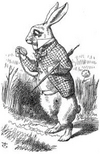
However, is there anything else to support the theory that a young Mary Heath was the real life model for Alice in Wonderland rather than Alice Liddell (whose father was Carroll's boss as the Dean of Christ Church College, Oxford)? Well, yes there is. In Alice in Wonderland, when the White Rabbit, who Alice had followed into Wonderland, first speaks to Alice, he calls her "Mary Ann" four times yet no character of that name appears in the story and to this day it goes unexplained why the rabbit addressed Alice by that name. However, it so happens that Mary Heath's full name was Mary Ann Heath and she would go on to have her own very interesting life story, which in some ways may have been every bit as bizarre as that of Alice in Wonderland. Indeed, she would go on to become a major player in esoteric circles in the same way that Carroll himself would via the Orphic Circle.
As a final point, this concept of Tulpas may link with things the C's said in the previous session on 13th May 2023:
Q: (L) .... Well, then that leads to the next question: Did Alexandra David-Néel create a thought being of her own?
A: No.
Q: (L) What was that?
A: She added energy to an elemental being, something like a nature creature.
Q: (L) And this leads obviously to the next question: When we're doing spirit release, we come across all kinds of really bizarre things. I mean, just like thought forms that come and attach and even thought forms that are created by the individual. Are these thought forms like discrete beings that have intelligence, autonomy, and persistence?
A: Some are. And some "die" after being disconnected from the source of energy.
Q: (L) Okay. If we encounter a thought form-type critter that has come and attached to an individual, is that thought form-type critter something that has been created by some other individual in the same way that some of the ones that we have encountered are created by that individual person?
(Andromeda) Right. Like created by a thought loop or strong emotion and/or a split-off part of their personality?
A: Some yes. Others are gathered energies of place or object.
Q: (L) Place or object. So you're saying that objects can... What kind of objects?
A: Trees, for one.
Q: (L) So natural objects?
A: Yes.
Q: (L) So natural objects can concentrate energy such that it forms a thought form?
A: Yes.
Q: (L) Okay. And places also?
A: Yes. And some places respond to activities of humans and 2D creatures.
So, we have encountered yet another strange mirror and also another Victorian secret society.
Lewis Carroll admitted himself that he was inspired to write
Alice in Wonderland as described below:
Hidden meanings:
Many people believe that the books also contain hidden meanings on a much deeper level, like the promotion of drug use, or an attempt to mock the political situation. However, most of these allegations rely on speculations and interpretations. We have no definite ‘proof’ that Carroll meant anything at all with his stories, except to amuse his child friends.
Carroll himself wrote the following to a friend in America, when being asked about the meaning of his poem ‘The Hunting of the Snark’:
“I’m very much afraid I didn’t mean anything but nonsense. Still, you know, words mean more than we mean to express when we use them; so a whole book ought to mean a great deal more than the writer means. So, whatever good meanings are in the book, I’m glad to accept as the meaning of the book.”
(source: Collingwood, “The Life and Letters of Lewis Carroll”)
This comment is also applicable to Carroll’s Alice stories. In the article ‘
Alice on the Stage‘, he told us about how he expanded the original tale for publication:
[…] many more [fresh ideas] added themselves when, years afterwards, I wrote it all over again for publication: but (this may interest some readers of ‘Alice’ to know) every such idea and nearly every word of the dialogue, came of itself. Sometimes an idea comes at night, when I have had to get up and strike a light to note it down–sometimes when out on a lonely winter walk, when I have had to `top, and with half-frozen fingers jot down a few words which should keep the new-born idea from perishing–but whenever or however it comes, it comes of itself. I cannot set invention going like a clock, by any voluntary winding up: nor do I believe that any original writing (and what other writing is worth preserving?) was ever so produced. If you sit down, unimpassioned and uninspired, and tell yourself to write for so many hours, you will merely produce (at least I am sure I should merely produce) some of that article which fills, so far as I can judge, two-thirds of most magazines–most easy to write most weary to read–men call it ‘padding’, and it is to my mind one of the most detestable things in modern literature. ‘Alice’ and the ‘Looking-Glass’ are made up almost wholly of bits and scraps, single ideas which came of themselves.
Therefore, any theories that claim Carroll’s ‘Alice’ books have one integral, underlying meaning should be taken with a grain of salt.
Given what the C's have said about channelling and how they had inspired Baum's The Wizard of Oz, could the C's have inspired Lewis Carroll to write the Alice stories by planting ideas in his mind? If so, there is even more reason to read the stories with an open mind to see what riches they may be hiding by way of allegory.
But there is yet a third mirror or lens which may help to explain the C's statement "You are dancing on the 3rd density ballroom floor. "Alice likes to go through the looking glass" at the Crystal Palace" and this mirror is one that is enticingly called "Alice".
***************************************************
3. The ALICE Experiment
Curiously, One of the key monitoring devices used at the
Large Hadron Collider in Cern, Switzerland is called '
ALICE' (see image below). I don't think this use of that name is mere coincidence either given that the scientists are using ALICE to investigate the world of sub-atomic particles and possibly, by extension, hyperdimensional physics.
See:
ALICE experiment - Wikipedia
Quoting from the Abstract: (JACoW):
The ALICE experiment is a complex hardware and software device, monitored and operated with a control system based on WinCC OA. ALICE is composed of 19 detectors and installed in a cavern along the LHC at CERN; each detector is a set of modular elements, assembled in a hierarchical model called Finite State Machine. A 3-D model of the ALICE detector has been realized, where all elements of the FSM are represented in their relative location, giving an immediate overview of the status of the detector. For its simplicity, it can be a useful tool for the training of operators. The development is done using WinCC OA integrated with the JCOP fw3DViewer, based on the AliRoot geometry settings. Extraction and conversion of geometry data from AliRoot requires the usage of conversion libraries, which are currently being implemented. A preliminary version of ALICE 3-D is now deployed on the operator panel in the ALICE Run Control Centre. In the next future, the 3-D panel will be available on a big touch screen in the ALICE Visits Centre, providing visitors with the unique experience of navigating the experiment from both inside and out.
Since the Collider has been used to investigate the sub-atomic universe and, therefore, the underlying nature of matter, I just wonder if this is what the C's had in mind. Bear in mind that the C's once said that the famous disappearances in the Bermuda Triangle were caused by the unstable operation of the 5000 ft crystal pyramid built by the Atlanteans and now submerged 300 miles off the coast of Florida. These disappearances result from a hole being literally blasted in the fabric of space/time by power generated by the pyramid. Are the experiments at CERN just replicating this on a smaller scale perhaps?
Overall view of the ALICE detector
It's a little bit like a "crystal palace" when you think about it. For more on this see:
ALICE experiment - Wikipedia and
ALICE opens its new nerve centre.
As to dancing around on the ballroom floor, it is strange that one of the sculptures found at CERN is that of the Hindu deity Shiva who can be seen dancing.
The Shiva statue at CERN, known as Nataraja, is a 2-meter-tall bronze statue that symbolizes the cosmic dance of creation, preservation, and destruction. It was unveiled on June 18, 2004, as a gift from the Government of India to honor the long-standing relationship between India and CERN. The statue is located between CERN's Buildings 39 and 40 and has become one of the most photographed and talked-about landmarks on campus. The statue's design includes elements such as a damaru (drum) for creation, fire for destruction, and an abhaya mudra for protection. It also features a dwarf figure called Apasmara, symbolizing the destruction of ignorance by knowledge. The statue serves as a source of inspiration for CERN scientists and scholars, representing the blend of faith and science in the study of subatomic particles.
The artwork is thus an artistic metaphor for CERN’s study of the “
cosmic dance” of subatomic particles. In Hinduism, Nataraja is a depiction of the god Shiva as the cosmic dancer. The god, who danced the universe into existence, preserves it, and will one day destroy it, is a symbol of
shakti, or life force.
Conclusion
I have discussed above three (triplicative) connecting clue profiles producing what I hope are three balancing meanings to the C's statement that may be worth pursuing in a future session if you or Laura are so minded.
However, I am conscious that there may still be a further meaning that has eluded me and I say this because there is an alternative version of this particular statement in some versions of the transcripts that could cast a very different light on the matter, one which may be entirely personal to Laura. The alternative version reads as follows:
A: You are dancing on the 3rd density ballroom floor. "AK likes to go through the looking glass" at the Crystal Palace. Atlantean reincarnation surge brings on the urge to have a repeat performance.
Now "AK" may well stand for Alice Knight, Laura's late mother. If this was the original notation it would certainly have interesting implications for what the C's meant here since I understand that Laura's mother was a keen ballroom dancer who may have visited several dancing establishments in Florida during her youth, one of which may possibly have had a name that alluded to a "crystal palace". Moreover, the term "looking glass" is often used in connection with the world of spying and espionage, as exemplified by author John le Carré in the title of his book "The Looking Glass War", which was a Cold War era espionage novel. Given Laura's kidnapping by a naval officer friend of her mother, who seems to have been connected with US Naval Intelligence and indirectly with agents from, I believe, MI6 acting apparently on behalf of "supremely powerful STS forces" who tried unsuccessfully to program her, could the C's have intended something quite cryptic by this statement, something which may entail a matter known only to Laura?
Continued in Part 2