Watch the skies and land and oceans

Storm blasts Hawaii with 70-mph winds, 30 inches of rain and a foot of mountain snow

mmmmm
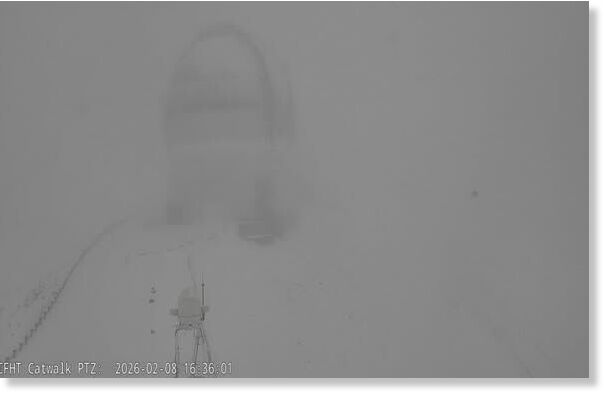
Snow on the summit of Mauna Kea

A storm moved over Hawaii this past weekend, causing flooding, knocking down trees and power poles and dumping a foot of snow on the island's mountaintops.

On Monday morning, every spot in the state was under a flood watch, with widespread wind advisories and winter storm warnings on the mountains of Mauna Kea and Mauna Loa.

AccuWeather Meteorologist Alex DaSilva said that a stalled front draped across the Hawaiian Islands, combined with a slow-moving area of low pressure, led to major flooding and near-hurricane-force wind gusts.

Hawaiian Electric warned customers to prepare for extended power outages Sunday night, after power was restored to 45,000 customers lost power earlier in the day. As of Sunday night, 19,000 customers were still in the dark.

Winds gusted over 70 mph on the islands of Maui and Moloka'i, with gusts over 60 mph on Oahu, Lanai and the Big Island. Rainfall amounts exceeded 30 inches at Laupahoehoe on the Big Island, with 23.22 inches at Waikamoi on Maui.


mmmmm
All public schools, and the University of Hawaii, were closed on Monday, Hawaii News Now reported.

Flooding was reported on several roads.

"The road to the summit [of Mauna Kea] is closed," the Center for Maunakea Stewardship posted on Facebook Sunday night. Webcams on the summits continued to show snow early Monday morning. The winter storm warning issued by the National Weather Service called for up to a foot of snow.

"Although the storm will move out after Monday," DaSilva added, "Western portions of the island chain will have to be on alert for the possibility of heavy rain this weekend as an area of low pressure moves to the west."

It snows in Hawaii?

Snow in Hawaii is not as unusual as many might think. The Big Island summits of Mauna Kea and Mauna Loa, home to research facilities, both rise above 13,000 feet, higher than the tallest points in 44 U.S. states.

Because of their high elevations, the mountains in Hawaii routinely get snow during the fall, winter and spring. Snow isn't officially measured in the state, but on average for the last 20 years, 25 to 30 winter weather advisories are issued for the peaks each year.

The earliest winter weather advisory in the fall during the last 20 years was on Oct. 13, 2014; the latest was in spring on June 8, 2018.

AccuWeather
 
● Morocco
Catastrophic floods ⛈️ in northern #Morocco. More than 150,000 people have been evacuated.

● Japan
A fireball (bright meteor) was observed in the Kanto region, Japan 🇯🇵 (09.02.2026)

● Spain
Two-story building collapses due to storm in the town center of Alcalá de los Gazules, Cádiz, Spain 🇪🇸 Several residents evacuated after the incident February 9, 2026

● Brasil
Heavy rain caused flooding in Ribeirão Preto, São Paulo, Brazil 🇧🇷 (07.02.2026)
 
● Portugal

Roads destroyed by torrential rains. Footage of severe damage from extreme rainfall in Portugal, tied to a series of powerful storms (including Storm Kristin, Leonardo, and Marta) that hit the Iberian Peninsula in late January and early February 2026

● Brazil
This evening, multiple people were rescued from their cars as severe flooding hit Avenida dos Democráticos, Bonsucesso — Rio de Janeiro, Brazil.

● Italy
Chaos on the streets of Milan as protestors demonstrate against Israel's inclusion into the Olympic Winter Games.

● Indonesia
A continuous slow-moving landslide in Padasari, Tegal, Central Java, Indonesia, has forced over 2,400 people to evacuate. At least 464 homes have been damaged, and authorities are assisting with relocation and safety measures. The ground movement is still active, so residents remain at risk.

● Jamaica
The region of Jamaica was shaken by a preliminary M5.5 earthquake adjusted to M5.0

M 5.0 - 84 km ENE of Manchioneal, Jamaica
2026-02-10 08:18:17 (UTC)
18.239°N 75.501°W. 10.0 km depth
USGS earthquake alert
 
From The Watchers, It's Mambo cold in Alaska 🥶

By Rishav Kothari, Wednesday, February 11, 2026

Extreme Cold Warnings and Blizzard Warnings remain in effect across northern and western Alaska on February 11, 2026, with the National Weather Service forecasting wind chills as low as −57°C (−70°F) along the Arctic Coast and Brooks Range and wind gusts up to 105 km/h (65 mph) on St. Lawrence Island. Air temperatures near −46°C (−50°F) combined with increasing winds are expected to intensify frostbite risk across the North Slope, while snowfall of 7–15 cm (3–6 inches) and visibility reductions to 400 m (0.25 miles) or less are forecast in parts of western Alaska through early February 12.
Extreme Cold Warnings remain in effect across the Arctic Coast, Arctic Plains, and the Brooks Range of northern Alaska, according to advisories issued by the National Weather Service (NWS) Fairbanks office. The warnings cover locations including Utqiagvik, Prudhoe Bay, Deadhorse, Point Hope, Anaktuvuk Pass, and sections of the Dalton Highway.

Wind chills are forecast to reach as low as −57°C (−70°F), with ambient air temperatures near −46°C (−50°F). NWS Fairbanks states that exposed skin may develop frostbite in as little as five minutes under such extremely cold conditions. Increasing winds Tuesday into Wednesday are expected to intensify the wind chill threat before temperatures slowly moderate.

A separate Extreme Cold Warning remains in effect for Arctic Village until 06:00 AKST on February 11, where wind chills as low as −57°C (−70°F) are also forecast.

Blizzard Warnings are active across western Alaska, including the Kuskokwim Delta Coast and Nunivak Island, where winds are forecast to gust up to 65 km/h (40 mph) with additional snowfall up to 2.5 cm (1 inch) through 03:00 AKST on February 11. Whiteout conditions are possible, and travel may be very difficult and potentially life-threatening in exposed areas.

Across Eastern Norton Sound, the Yukon Delta Coast, the Lower Yukon River, and St. Lawrence Island, Blizzard Warnings remain in effect into early February 12. Snow accumulations of 7–15 cm (3–6 inches) are forecast for portions of Norton Sound and the Yukon Delta Coast, with wind gusts up to 90 km/h (55 mph) in some areas and up to 105 km/h (65 mph) on St. Lawrence Island. Visibility may be reduced to 400 m (0.25 miles) or less during periods of blowing and falling snow.

News across much of Southcentral Alaska as a vigorous upper-level shortwave lifted northward across the Kenai Peninsula and Cook Inlet. Anchorage recorded 7.9 cm (3.1 inches) of snowfall by 16:37 AKST on February 10 with light snow ongoing during the afternoon. Visibility remained below 1.6 km (1 mile) at times across the Western Kenai Peninsula, including Kenai Airport.

Snowfall is forecast to intensify again during the evening hours, with an additional 3–10 cm (1–4 inches) across Anchorage and surrounding areas. Localized higher totals remain possible depending on band placement. Winter Weather Advisories remain in effect for the Susitna Valley, the Western Kenai Peninsula, Turnagain Pass, and the northern Copper River Basin, including Paxson and Thompson Pass.

Snow is forecast to transition to a more showery regime on February 11 as colder air advects inland from the southwest. Snowband placement remains uncertain due to the potential development and track of a secondary low-pressure system.

1770807433006.png


Across Southwest Alaska, a large Bering Sea low continued to move slowly northwest of the Pribilof Islands on February 10. Blizzard conditions persisted along the Kuskokwim Delta Coast, including the Bethel area, as strong winds combined with falling and blowing snow. The Winter Weather Advisory for the Pribilof Islands remained in effect through the evening.

Temperatures behind the associated frontal boundary are forecast to rise to between −2 and 0°C (28 to 32°F), remaining near or below the freezing point across most of the region.

Snow showers are expected to persist through February 11, with gusty winds maintaining localized areas of blowing snow. Coastal impacts are forecast to remain limited due to extensive sea ice and shorefast ice coverage.

Conditions are forecast to quiet down across Southcentral Alaska on February 12–13 as the next Gulf low tracks into the eastern Gulf and Southeast Alaska. Tightening pressure gradients between the Gulf system and inland high pressure are expected to produce gusty gap winds through favored passes.

A new low-pressure system is forecast to enter the eastern Bering Sea before moving inland across Southwest Alaska and the Alaska Peninsula between February 14–17. Moderate to heavy snowfall is forecast for much of Southwest Alaska, while rainfall is expected across portions of the Alaska Peninsula. The surface low is forecast to consolidate in the northern Gulf by February 15, increasing snowfall potential across inland Southcentral Alaska.

References:

1 Blizzard Warning – NWS – February 10, 2026

2 Extreme Cold Warning – NWS – February 10, 2026

3 Area Forecast Discussion – NWS – February 10, 2026


Meanwhile


● Madagascar

Cyclone Gezani Leaves Death and Destruction in Toamasina, Madagascar 🇲🇬

• At least 20 people killed after Cyclone Gezani struck.
• 19 injured and nearly 1,500 evacuated, authorities report.
• The disaster comes just 10 days after another deadly storm hit the country.

● Russia

Russian 'Doomsday Radio' station shows anomalous activity 23 coded messages in a single day — an absolute record, according to internet users tracking the station The latest transmission included the words 'Caucasus' and 'Pimply' Should we expect something big?

An unusual sunrise surprises Moscow residents. When they woke up in the morning, Muscovites were treated to a colorful spectacle in the sky, somewhat reminiscent of post-apocalyptic scenes. But meteorologists have a much more prosaic explanation for this whim of nature. The cause is the scattering of sunlight in the atmosphere and the low position of the Sun.
Screenshot_20260211-142451_X.jpg


M 5.6 - 250 km SE of Okhotsk, Russia
2026-02-11 06:29:50 (UTC)
57.899°N 146.486°E. 10.0 km depth
USGS earthquake alert
Strongest in 126 years
The earthquake was the strongest to hit this part of ru.png Russia since at least the beginning of the previous century (our records start in 1900). No other quake of equal or greater strength had occurred near the present epicenter since then. Volcanodiscovery

● Iran

On February 11, 2026, during official demonstrations marking the 47th anniversary of the Islamic Revolution in Iran, protesters burned an effigy or figure of "Baal."
The Full Baal Burning Video in Iran Iranians burned a Baal statue and an image of Jeffrey Epstein. "We, the monotheists of the world, by the help of God, will bring down the worshipers of Baal, the worshipers of Satan, and the arrogant oppressors."


● Brazil

Maximum alert in Brazil: 17 states are in danger with rainfall of up to 100 mm per day and winds of 100 km/h, and Inmet (National Institute of Meteorology) is already predicting blackouts, falling trees, flooding, and severe risk in several regions under the influence of the South Atlantic Convergence Zone (ZCAS)
People electrocuted in the flooded streets of Copacabana.
 
Already mentioned here but another article about the flood which happened in Portugal the 6. They seems to go from one storm to the next.

Portugal flood February 2026


Portugal hit by worst floods in decades as Storm Marta loom​

Boat evacuations in Alcácer do Sal followed the Sado River overflow, leaving one person dead during Portugal’s seventh storm this year. Another system, Storm Marta, is due on Saturday with winds up to 120 km/h and waves reaching 13 metres.

Emergency teams patrolled Alcacer do Sal by boat, rescuing residents after the seventh storm to hit the Iberian Peninsula this year. A 78-year-old woman was taken to safety as the Sado river overflowed, pushing water through the town centre. One death has been confirmed nationwide.

The country is still recovering from last week’s storms, which killed five people and cut power to tens of thousands. Authorities issued their highest flood alert for the Tagus near Santarem, calling it the worst threat in almost 30 years.

A new storm, called Marta, is set to hit Portugal on Saturday, bringing heavy rain, winds up to 120 km/h and waves reaching 13 metres. Weather alerts are in place as flood-hit areas brace for renewed river overflows.
 
Back
Top Bottom