Watch the skies and land and oceans

Storm blasts Hawaii with 70-mph winds, 30 inches of rain and a foot of mountain snow

mmmmm
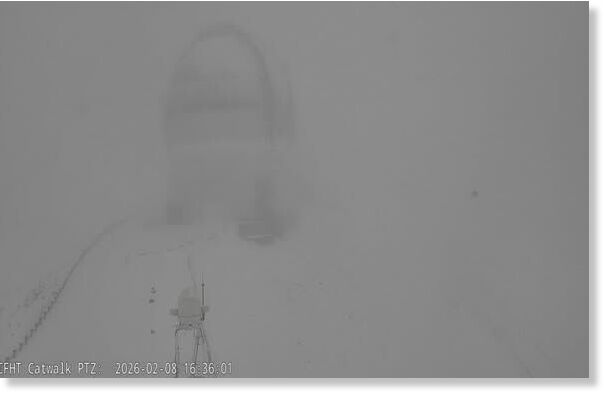
Snow on the summit of Mauna Kea

A storm moved over Hawaii this past weekend, causing flooding, knocking down trees and power poles and dumping a foot of snow on the island's mountaintops.

On Monday morning, every spot in the state was under a flood watch, with widespread wind advisories and winter storm warnings on the mountains of Mauna Kea and Mauna Loa.

AccuWeather Meteorologist Alex DaSilva said that a stalled front draped across the Hawaiian Islands, combined with a slow-moving area of low pressure, led to major flooding and near-hurricane-force wind gusts.

Hawaiian Electric warned customers to prepare for extended power outages Sunday night, after power was restored to 45,000 customers lost power earlier in the day. As of Sunday night, 19,000 customers were still in the dark.

Winds gusted over 70 mph on the islands of Maui and Moloka'i, with gusts over 60 mph on Oahu, Lanai and the Big Island. Rainfall amounts exceeded 30 inches at Laupahoehoe on the Big Island, with 23.22 inches at Waikamoi on Maui.


mmmmm
All public schools, and the University of Hawaii, were closed on Monday, Hawaii News Now reported.

Flooding was reported on several roads.

"The road to the summit [of Mauna Kea] is closed," the Center for Maunakea Stewardship posted on Facebook Sunday night. Webcams on the summits continued to show snow early Monday morning. The winter storm warning issued by the National Weather Service called for up to a foot of snow.

"Although the storm will move out after Monday," DaSilva added, "Western portions of the island chain will have to be on alert for the possibility of heavy rain this weekend as an area of low pressure moves to the west."

It snows in Hawaii?

Snow in Hawaii is not as unusual as many might think. The Big Island summits of Mauna Kea and Mauna Loa, home to research facilities, both rise above 13,000 feet, higher than the tallest points in 44 U.S. states.

Because of their high elevations, the mountains in Hawaii routinely get snow during the fall, winter and spring. Snow isn't officially measured in the state, but on average for the last 20 years, 25 to 30 winter weather advisories are issued for the peaks each year.

The earliest winter weather advisory in the fall during the last 20 years was on Oct. 13, 2014; the latest was in spring on June 8, 2018.

AccuWeather
 
● Morocco
Catastrophic floods ⛈️ in northern #Morocco. More than 150,000 people have been evacuated.

● Japan
A fireball (bright meteor) was observed in the Kanto region, Japan 🇯🇵 (09.02.2026)

● Spain
Two-story building collapses due to storm in the town center of Alcalá de los Gazules, Cádiz, Spain 🇪🇸 Several residents evacuated after the incident February 9, 2026

● Brasil
Heavy rain caused flooding in Ribeirão Preto, São Paulo, Brazil 🇧🇷 (07.02.2026)
 
● Portugal

Roads destroyed by torrential rains. Footage of severe damage from extreme rainfall in Portugal, tied to a series of powerful storms (including Storm Kristin, Leonardo, and Marta) that hit the Iberian Peninsula in late January and early February 2026

● Brazil
This evening, multiple people were rescued from their cars as severe flooding hit Avenida dos Democráticos, Bonsucesso — Rio de Janeiro, Brazil.

● Italy
Chaos on the streets of Milan as protestors demonstrate against Israel's inclusion into the Olympic Winter Games.

● Indonesia
A continuous slow-moving landslide in Padasari, Tegal, Central Java, Indonesia, has forced over 2,400 people to evacuate. At least 464 homes have been damaged, and authorities are assisting with relocation and safety measures. The ground movement is still active, so residents remain at risk.

● Jamaica
The region of Jamaica was shaken by a preliminary M5.5 earthquake adjusted to M5.0

M 5.0 - 84 km ENE of Manchioneal, Jamaica
2026-02-10 08:18:17 (UTC)
18.239°N 75.501°W. 10.0 km depth
USGS earthquake alert
 
From The Watchers, It's Mambo cold in Alaska 🥶

By Rishav Kothari, Wednesday, February 11, 2026

Extreme Cold Warnings and Blizzard Warnings remain in effect across northern and western Alaska on February 11, 2026, with the National Weather Service forecasting wind chills as low as −57°C (−70°F) along the Arctic Coast and Brooks Range and wind gusts up to 105 km/h (65 mph) on St. Lawrence Island. Air temperatures near −46°C (−50°F) combined with increasing winds are expected to intensify frostbite risk across the North Slope, while snowfall of 7–15 cm (3–6 inches) and visibility reductions to 400 m (0.25 miles) or less are forecast in parts of western Alaska through early February 12.
Extreme Cold Warnings remain in effect across the Arctic Coast, Arctic Plains, and the Brooks Range of northern Alaska, according to advisories issued by the National Weather Service (NWS) Fairbanks office. The warnings cover locations including Utqiagvik, Prudhoe Bay, Deadhorse, Point Hope, Anaktuvuk Pass, and sections of the Dalton Highway.

Wind chills are forecast to reach as low as −57°C (−70°F), with ambient air temperatures near −46°C (−50°F). NWS Fairbanks states that exposed skin may develop frostbite in as little as five minutes under such extremely cold conditions. Increasing winds Tuesday into Wednesday are expected to intensify the wind chill threat before temperatures slowly moderate.

A separate Extreme Cold Warning remains in effect for Arctic Village until 06:00 AKST on February 11, where wind chills as low as −57°C (−70°F) are also forecast.

Blizzard Warnings are active across western Alaska, including the Kuskokwim Delta Coast and Nunivak Island, where winds are forecast to gust up to 65 km/h (40 mph) with additional snowfall up to 2.5 cm (1 inch) through 03:00 AKST on February 11. Whiteout conditions are possible, and travel may be very difficult and potentially life-threatening in exposed areas.

Across Eastern Norton Sound, the Yukon Delta Coast, the Lower Yukon River, and St. Lawrence Island, Blizzard Warnings remain in effect into early February 12. Snow accumulations of 7–15 cm (3–6 inches) are forecast for portions of Norton Sound and the Yukon Delta Coast, with wind gusts up to 90 km/h (55 mph) in some areas and up to 105 km/h (65 mph) on St. Lawrence Island. Visibility may be reduced to 400 m (0.25 miles) or less during periods of blowing and falling snow.

News across much of Southcentral Alaska as a vigorous upper-level shortwave lifted northward across the Kenai Peninsula and Cook Inlet. Anchorage recorded 7.9 cm (3.1 inches) of snowfall by 16:37 AKST on February 10 with light snow ongoing during the afternoon. Visibility remained below 1.6 km (1 mile) at times across the Western Kenai Peninsula, including Kenai Airport.

Snowfall is forecast to intensify again during the evening hours, with an additional 3–10 cm (1–4 inches) across Anchorage and surrounding areas. Localized higher totals remain possible depending on band placement. Winter Weather Advisories remain in effect for the Susitna Valley, the Western Kenai Peninsula, Turnagain Pass, and the northern Copper River Basin, including Paxson and Thompson Pass.

Snow is forecast to transition to a more showery regime on February 11 as colder air advects inland from the southwest. Snowband placement remains uncertain due to the potential development and track of a secondary low-pressure system.

1770807433006.png


Across Southwest Alaska, a large Bering Sea low continued to move slowly northwest of the Pribilof Islands on February 10. Blizzard conditions persisted along the Kuskokwim Delta Coast, including the Bethel area, as strong winds combined with falling and blowing snow. The Winter Weather Advisory for the Pribilof Islands remained in effect through the evening.

Temperatures behind the associated frontal boundary are forecast to rise to between −2 and 0°C (28 to 32°F), remaining near or below the freezing point across most of the region.

Snow showers are expected to persist through February 11, with gusty winds maintaining localized areas of blowing snow. Coastal impacts are forecast to remain limited due to extensive sea ice and shorefast ice coverage.

Conditions are forecast to quiet down across Southcentral Alaska on February 12–13 as the next Gulf low tracks into the eastern Gulf and Southeast Alaska. Tightening pressure gradients between the Gulf system and inland high pressure are expected to produce gusty gap winds through favored passes.

A new low-pressure system is forecast to enter the eastern Bering Sea before moving inland across Southwest Alaska and the Alaska Peninsula between February 14–17. Moderate to heavy snowfall is forecast for much of Southwest Alaska, while rainfall is expected across portions of the Alaska Peninsula. The surface low is forecast to consolidate in the northern Gulf by February 15, increasing snowfall potential across inland Southcentral Alaska.

References:

1 Blizzard Warning – NWS – February 10, 2026

2 Extreme Cold Warning – NWS – February 10, 2026

3 Area Forecast Discussion – NWS – February 10, 2026


Meanwhile


● Madagascar

Cyclone Gezani Leaves Death and Destruction in Toamasina, Madagascar 🇲🇬

• At least 20 people killed after Cyclone Gezani struck.
• 19 injured and nearly 1,500 evacuated, authorities report.
• The disaster comes just 10 days after another deadly storm hit the country.

● Russia

Russian 'Doomsday Radio' station shows anomalous activity 23 coded messages in a single day — an absolute record, according to internet users tracking the station The latest transmission included the words 'Caucasus' and 'Pimply' Should we expect something big?

An unusual sunrise surprises Moscow residents. When they woke up in the morning, Muscovites were treated to a colorful spectacle in the sky, somewhat reminiscent of post-apocalyptic scenes. But meteorologists have a much more prosaic explanation for this whim of nature. The cause is the scattering of sunlight in the atmosphere and the low position of the Sun.
Screenshot_20260211-142451_X.jpg


M 5.6 - 250 km SE of Okhotsk, Russia
2026-02-11 06:29:50 (UTC)
57.899°N 146.486°E. 10.0 km depth
USGS earthquake alert
Strongest in 126 years
The earthquake was the strongest to hit this part of ru.png Russia since at least the beginning of the previous century (our records start in 1900). No other quake of equal or greater strength had occurred near the present epicenter since then. Volcanodiscovery

● Iran

On February 11, 2026, during official demonstrations marking the 47th anniversary of the Islamic Revolution in Iran, protesters burned an effigy or figure of "Baal."
The Full Baal Burning Video in Iran Iranians burned a Baal statue and an image of Jeffrey Epstein. "We, the monotheists of the world, by the help of God, will bring down the worshipers of Baal, the worshipers of Satan, and the arrogant oppressors."


● Brazil

Maximum alert in Brazil: 17 states are in danger with rainfall of up to 100 mm per day and winds of 100 km/h, and Inmet (National Institute of Meteorology) is already predicting blackouts, falling trees, flooding, and severe risk in several regions under the influence of the South Atlantic Convergence Zone (ZCAS)
People electrocuted in the flooded streets of Copacabana.
 
Already mentioned here but another article about the flood which happened in Portugal the 6. They seems to go from one storm to the next.

Portugal flood February 2026


Portugal hit by worst floods in decades as Storm Marta loom​

Boat evacuations in Alcácer do Sal followed the Sado River overflow, leaving one person dead during Portugal’s seventh storm this year. Another system, Storm Marta, is due on Saturday with winds up to 120 km/h and waves reaching 13 metres.

Emergency teams patrolled Alcacer do Sal by boat, rescuing residents after the seventh storm to hit the Iberian Peninsula this year. A 78-year-old woman was taken to safety as the Sado river overflowed, pushing water through the town centre. One death has been confirmed nationwide.

The country is still recovering from last week’s storms, which killed five people and cut power to tens of thousands. Authorities issued their highest flood alert for the Tagus near Santarem, calling it the worst threat in almost 30 years.

A new storm, called Marta, is set to hit Portugal on Saturday, bringing heavy rain, winds up to 120 km/h and waves reaching 13 metres. Weather alerts are in place as flood-hit areas brace for renewed river overflows.
 
Still in Portugal:

Highway viaduct collapses in Portugal after a dam break during violent storms.​


Portugal fllo February 2026 - viaduct collapses

2026-02-26 - The Iberian Peninsula has been facing several depressions these last few days, causing significant rain and flooding. The Portuguese highway section where this viaduct was located had been closed to traffic.

A viaduct on the A1 highway, which connects Lisbon to Porto, partially collapsed Wednesday evening, February 11th, near Coimbra (central Portugal) following a dam break on the right bank of the Mondego River, with no casualties announced by the Portuguese Minister of Infrastructure.

The highway section where this viaduct was located had been closed in both directions after the partial rupture of a dam on Wednesday afternoon. The collapse occurred a few hours later.

"The speed and violence of the waters... it's an absolutely abnormal situation," declared the Portuguese Minister of Infrastructure, Miguel Pinto Luz, who went to the scene overnight from Wednesday to Thursday, specifying that it will likely take "weeks for this infrastructure to be operational again."

Around fifteen trucks loaded with rock have been mobilized to consolidate the breach. The dam break comes after the passage of deadly storms which have hit Portugal for two weeks, causing significant damage."20% of the average rainfall for Portugal for a whole year!"

A train also derailed Wednesday evening after hitting debris that fell onto the track near Abrantes with no casualties.
Several railway lines remain suspended in Portugal.

After the passage of depressions Kristin, Leonardo and Marta, Portugal is once again on alert this week facing risks of flooding and overflowing rivers due to heavy rains.

Source
 
In France Nils storm is pouring a lot of water on the country.

Under the rain and wind: why storm Nils is causing so much worry in these 43 departments.​

Nils strom hit France February 2026


For several days, the sky has left little respite for a large part of the territory. But with the arrival of storm Nils, the situation takes on an extra dimension. This Thursday, February 12th, 43 departments are placed on yellow alert for rain-flooding, and the west and southwest are among the most exposed areas.

The Gironde, Landes, Charente-Maritime, Dordogne, Lot-et-Garonne, or even Haute-Garonne are directly concerned. These territories, already marked by repeated rainy episodes since the beginning of the week, have soils saturated with water. When precipitation continues on ground gorged with moisture, runoff becomes faster and the risk of localized flooding increases.

Brittany is not spared. The Côtes-d’Armor, Finistère, Ille-et-Vilaine and Morbihan are also on the list of departments placed on yellow alert. In these sectors, the combination of heavy rain and winds linked to storm Nils reinforces the feeling of instability. Rivers can react quickly, and some low-lying areas remain under surveillance.

Further south, the Pyrénées-Atlantiques, Hautes-Pyrénées, Tarn and Tarn-et-Garonne are also concerned. In these departments, the terrain can accentuate the effects of precipitation, favouring greater accumulation of water in certain valleys.

This yellow alert, active from midnight and maintained throughout the day on February 12th, calls for prudence without necessarily announcing an extreme scenario. It nevertheless signals a real risk of local difficulties: submerged roads, flooded cellars, traffic slowdowns.

Storm Nils isn't just rain. Sustained gusts accompany the turbulent passage, which can weaken trees already soaked with water. Residents are invited to limit their movements, secure outdoor objects and carefully follow the evolution of the forecasts throughout the hours.
Source

Looking at Windy.com we can see the big perturbation coming from the Atlantic.

Windy.com


Perhaps it have something to do with all the recent Sun activity as it charged the Earth ?
 
Perhaps it have something to do with all the recent Sun activity as it charged the Earth ?

Without forgetting changes at Earth's inner core. Let's zoom out to see this storm system better (thanks to my loved ones in Costa Rica who served as a reminder):

Here's the "atmospheric river" affecting the Iberian peninsula and France. On the other side of the river, my mom is enyoing one of the coldest summers in Costa Rica. I dropped nearly to 12 degrees Celsius in the capital this month. It's cold for Costa Rican standards.


It's a real atmospheric river that will affect us until the end of the week, with a series of disturbances. It originates in the Caribbean, with a significant amount of precipitable water.

We can expect frequent rainfall totals of 100 to 200 mm, particularly in the southwest, west-central, and western Massif Central regions, the east-central region, the western slopes of the Morvan, the western slopes of the Vosges, and western Corsica.

River flooding, overflowing, and localized flooding are to be expected.

Translated with DeepL.com (free version)
 
There is indication of temperature shifts in the Pacific portraying a shift beginning from La Nina to El Nino conditions. In the SE US we have had colder and drier weather.

Currently, ENSO is in a La Nina state, but the forecast through summer 2026 is indicative of the opposite, El Nino state. Impacts to North American weather patterns will be noticeable.

This has been a rather weak La Nina episode, which despite its limited power has helped to carve out the shape of North America's pressure patterns through the winter and set the stage for occasional arctic outbreaks, especially across the North-Central U.S. The atmosphere is complex and there are other factors involved at shorter "sub-seasonal" time ranges -- like the state of the stratospheric polar vortex -- but what we have seen so far this season has approximated to idealized wintertime La Nina patterns.

La Niña remained comparatively weak through late 2025, shaping early-winter circulation without evolving into a strong basin-wide cooling. In early January 2026, sea-surface temperature anomalies across the central and eastern equatorial Pacific are rising quickly as the cold pool erodes west-to-east—classic structural decay.

Subsurface observations show a growing warm reservoir in the western Pacific pushing eastward. That warm pool undermines the ocean–atmosphere feedbacks that sustain La Niña. Practically, La Niña is no longer the dominant driver it was only weeks ago.

Seasonal systems increasingly hint at El Niño development in the second half of 2026. Confidence in timing and amplitude remains moderate, but precursor signals—subsurface warmth, easing trades, and evolving Pacific pressure patterns—align with an El Niño trajectory. If realized, it would complete a rapid ENSO flip within roughly two years.
 
● China
A 1,200-year-old camphor tree in Shaoshan, Xiangtan, Hunan Province, began to spontaneously combust, emitting large amounts of smoke.

Huge sinkhole opens up on the Shanghai Metro, Jiamin line, in Shanghai, China 🇨🇳February 12, 2026

● Indonesia
Mount Semeru erupts in Java, Indonesia Today, February 13, at around 1:45 p.m. local time, the volcano erupted, spewing pyroclastic flows (gases, ash, and rocks) descending 3 km.

Violent storm hits the Pakansari area, Cibinong, in the Bogor district of West Java, Indonesia 🇮🇩
Strong winds and heavy rain limited drivers' visibility, blew construction materials into the air, and caused many trees to fall.
February 12, 2026

● Chile earthquake
M 6.2 - 32 km SW of Ovalle, Chile
2026-02-12 13:34:31 (UTC)
30.801°S 71.445°W. 36.9 km depth
USGS earthquake alert
 
If we go into an ice age, look like problems with "green energy" have been underestimated:

De-Icing Wind Turbines in Sweden


Wind power generation in Finland plummeted at the beginning of 2026 due to an exceptionally cold winter. Ice accumulation on wind turbine blades drastically reduced their operation, as many sites are not equipped with de-icing systems suitable for very low temperatures. As a result, production fell from approximately 9,433 MW to just 430 MW – about 5% of the wind farm’s nominal capacity.

This drop in production coincided with an increase in electricity demand due to the cold weather, leading to significant spikes in energy prices, sometimes among the highest of the winter. Consumers reported very high bills and increased pressure on the electrical grid.

This event, which is not unique, highlights a vulnerability of climate-dependent renewable energies. How did all the experts and politicians fail to consider this while spending enormous sums on these foolish projects? Considerable amounts of money while hardship grows in Europe? Why were all scientists who had been warning for years about the importance of the sun in the climate deliberately ostracized and ignored?

Will they now advocate for a balance between green objectives and grid reliability? Will these imbeciles from the “dummy factory” finally realize that intermittent source projects need backup production capacity?
Source

A post with more details:

Wind Turbines Freeze in Finland: Gas at $738, Electricity at €350 as Arctic Cold Returns to Europe​

Wind turbines are freezing in Finland as gas prices soar to $738 and electricity reaches €350. Arctic cold has returned to Europe and already covered Finland, where a new temperature record for this winter was recorded in the south – minus 31.5 degrees Celsius. Under these conditions, wind turbines are icing over, and wholesale gas prices in the country have exceeded $700 per thousand cubic meters, while electricity costs €350 per MWh.

“In southern Finland, the temperature record for this winter was broken last night. In Lappeenranta, minus 31.5 degrees Celsius was recorded at nine o’clock in the morning,” reports Yle. The publication notes that it was even colder in Lapland – overnight temperatures ranged from -30 to -35 degrees. “In central Finland, the weather was milder: temperatures remained between 15 and 20 degrees below zero. This is due to denser cloud cover than in the rest of the country,” Yle added. Freezing temperatures and a lack of wind are impacting wind farms.

According to operator Fingrid, for example, wind power generation capacity dropped to 119 MW on January 30th afternoon. This represents only 8% of total production. “In many regions, ice is accumulating on the blades of turbines in wind farms. Combined with weak winds, this situation has significantly reduced the country’s wind fleet capacity,” writes Kauppalehti. They emphasized that icing on turbines is a common winter hazard in Nordic countries, but it is much more severe this season than in previous years.

The cold snap and decreased wind power production are impacting gas and electricity prices. According to the NordPool exchange, the average daily wholesale cost of electricity in the country will reach €247 per MWh on January 30th, peaking at €351 per MWh during peak hours. Its rates, according to EEX, climbed to $738 per thousand cubic meters on January 29th.

The situation is similar in the Baltic states, where wholesale electricity is trading at an average of €204 on January 30th, and gas at $643. This is twice as expensive for electricity and one-and-a-half times more expensive for gas than, for example, in Germany.

As EADaily reported earlier, by rejecting Russian gas, the Baltic states and Finland have become a “gas corner” of Europe, completely dependent on LNG supplies, and are forced to pay the highest prices for gas in the European Union during cold weather. The gas shortage in Ukraine is only exacerbating the situation. The Inčukalns storage facility has already used all the gas pumped last year and switched to older reserves.
Source

New solutions are put in place but it will not change the existing stock and Is it reliable in the long term and prolonged/extreme cold?

While ice can cause headaches for wind farm operators, the industry has developed numerous solutions to prevent its formation or melt it away.

Modern wind turbines are equipped with de-icing technologies deployed from wind farm control rooms. These include heating systems within the blades such as circulating warm air, mechanical de-icing devices and fluids, and blade vibration systems.

A Swedish company, Skellefteå Kraft, was the first to coat blades with a thin layer of carbon fiber that is heated when ice threatens.

Nordex, another manufacturer based in Germany, offers “cold climate packages” which they claim can reduce energy losses by up to 80% in icing conditions.

Writing for the scientific news site The Conversation, aerospace engineering professor Hui Hu points out that most strategies aimed at preventing ice on wind turbine blades come from aviation.

But as the wind industry grows, more and more investment is being dedicated to optimizing these backbones of the energy transition.

“If (ice) persists, plants are normally shut down and a service company goes on site to perform de-icing,” explains SWEA. In these rare situations, helicopters may be dispatched to de-ice the turbines.
Source
 
Back
Top Bottom