View attachment 117712
This image shows how the difference between incoming and reflected shortwave energy — absorbed solar energy — can be compared to emitted longwave radiation to determine Earth’s net change in energy. (Image credit: NASA’s Scientific Visualization Studio)
The rising sea surface temperatures is from inner core dynamics. Cloud formation is being driven by cometary dust and cosmic rays as well. And at some point, these last two factors will favor global cooling that will help balance things up.
The results, published Feb. 22 in the journal
Geophysical Research Letters, confirm that some processes in the climate system are missing from the models. The simulations underestimated the amount of energy that Earth absorbed from the sun, particularly
between 2010 and 2024, when satellite data shows that Earth's energy budget was completely out of whack.
"Their analysis is solid and straightforward," said Yuan, who was not involved in the study. "They analyzed different emission scenarios and none can fully simulate the observations. They find a failure of models to capture the strong increase in [Earth's energy imbalance]."
This failure suggests that the models are missing hidden mechanisms that are reducing the amount of energy Earth radiates into space. Climate models account for greenhouse gases, but they may not capture the effect that rising surface temperatures have on clouds and other elements that regulate how much energy escapes into space, according to the study.
If the sharp increase in Earth's energy imbalance since 2010 is due to cuts in aerosol emissions, the rate of increase should decline as aerosol levels stabilize, Yukimoto said. If, instead, the increase is from clouds reacting to rising surface temperatures, Earth's energy imbalance could grow bigger and warm the planet faster than greenhouse gases alone could. But "our results contradict this," Yukimoto said.
The rising sea surface temperatures is from inner core dynamics. Cloud formation is being driven by cometary dust and cosmic rays as well. And at some point, these last two factors will favor global cooling that will help balance things up.
Many scientific observations are based on flawed or misguided models that have been in use for generations and do not allow for proper analysis, sometimes resulting in conveniently erroneous findings.
I’m not sure if this article has already been discussed, though I haven’t come across it; please accept my apologies in advance if that is the case
Scientists Remap Earth’s Gravity
An uncommon way of looking at the world reveals the evolution of a deep gravity hole beneath Antarctica.
An unusual way of mapping Earth’s gravity suggests that a “gravity hole” beneath Antarctica is even deeper than the gravity hole beneath the Indian Ocean, which scientists have long considered the deepest. The strength of Earth’s gravity at its surface varies across different regions, and a gravity hole marks a place where it is weaker than average.
(el mapeo usado) It is a standard used by many experts who study Earth’s gravity and in satellite engineering, where it is necessary to take into account variations in Earth’s gravity because they cause oscillations in an orbit.
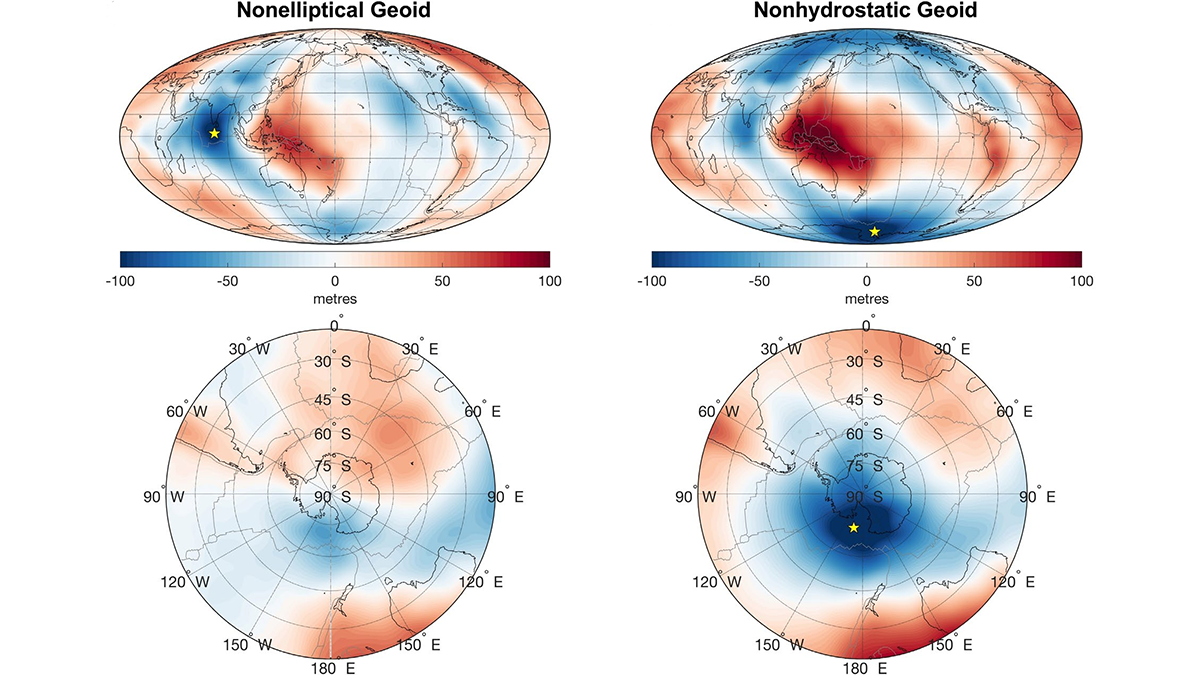
Instead of using the standard reference ellipsoid, the team of geophysicists Petar Glišovic and Alessandro Forte from the Geomagnetism Team at the Institute of Earth Physics in Paris reformulated the spatial configuration of the geodynamic model —mapping of Earth’s gravity— by eliminating the flattening caused by the Earth’s daily rotation; they used an ideal hydrostatic ellipsoid, assumed that the Earth behaves like a fluid at rest, and considered only the ‘non-hydrostatic’ forces —the repulsion and attraction of the mantle—, which provided a new perspective on the analysis and synthesis in their conclusions.
The research found that, when applying this geodynamic approach—based on the Antarctic Geoid Low (AGL)—to the Ross Sea in Antarctica, a deep ‘gravity hole’ emerges; as Alessandro Forte puts it, ‘a very broad and gentle depression in the Earth’s gravitational field’ - This ‘zone’, which exceeds the Indian Ocean minimum in terms of non-hydrostatic anomaly, is the deepest long-wavelength gravitational depression on the planet; that is, the point of weakest gravity due to the distribution of mass within the Earth, and it is assumed and revealed to be caused by deep flows in the mantle.
This research also confirms and expands the concept of non-uniform gravity, showing how internal processes spanning millions of years shape this variation and highlighting the
AGL as a prime example of these most significant anomalies on the planet.
The research found that by switching to a more geodynamic, rather than hydrostatic, model, the team discovered that the gravitational anomaly known as the
Antarctic Geoid Low (AGL), located over the Ross Sea, reveals a deep “gravity well”. According to Alessandro Forte:
“a very broad and gentle depression in the Earth’s gravitational field”.
This gravitational phenomenon exceeds in magnitude another depression known as the Indian Minimum, which could be observed using traditional models. The Antarctic anomaly – which is non-hydrostatic – contains the d
eepest long-wavelength gravitational depression on the planet, that is, the point of weakest gravity due to the distribution of mass within the Earth, and it is assumed and revealed that this is caused by deep flows in the mantle.
The unconventional geoid in the latest study, however, is based on an ideal “hydrostatic ellipsoid”
in which fluids are at rest. By subtracting this hydrostatic ellipsoid from the gravity data, the researchers created a
“nonhydrostatic” geoid that accounts for deviations between observations and these ideal conditions. This method allowed the researchers to study the mantle structure near the AGL, which appears almost insignificant in the usual model. The data were based in part on the latest measurements from the
GRACE (Gravity Recovery and Climate Experiment) satellites—and by this measure the AGL, beneath the west of Antarctica near the Ross Sea,
is markedly deeper than the IOGL.
(...) the AGL has existed for at least 70 million years and that it moved from beneath the South Atlantic Ocean to its present location between 50 million and 30 million years ago, when a rapid redistribution of Earth’s mantle mass caused the planet’s axis of rotation to shift.
In particular, the changes in the mantle seem to have involved the interplay of the sinking of tectonic slabs beneath Antarctica and buoyant upwellings of rock from the boundary of Earth’s mantle and its core, “much like the circulation in a lava lamp, but on a timescale of tens of millions of years,” Glišović said.
Importantly, the changes in the gravity hole beneath Antarctica over the past 77 million years may have encouraged the growth of that continent’s ice sheets. Glišović stressed that it’s only a hypothesis but that the permanent glaciation of Antarctica happened about 34 million years ago, which coincided with the structural changes of the AGL.
This phenomenon is due to key processes that intensified it:
-
The subduction of cold, dense tectonic plates beneath the deep mantle of Antarctica.
-The rise of hot, less dense material from the core-mantle boundary,
‘like a stream in a lava lamp’.
Although this gravitational force is small, it is measurable and can have a particularly significant impact on the oceans.
This less dense material reduces local gravity, creating a “depression” in the surface of the geoid—the shape of the sea defined by gravity—reaching 130 metres below mean sea level in the Ross Sea.
(Counterintuitively, regions of weak gravity cause depressions in the ocean: With less gravitational force pulling water to the area, water flows away to regions of higher gravity.)
What happens is that water flows from areas of weaker gravity towards areas with stronger gravitational pull. This means that the sea level around Antarctica is considerably lower than it would otherwise be, creating a unique boundary condition for the continent’s edges. A truly favourable situation.
This research has managed to turn back time using various methods, including up-to-date 3D tomographic images of the Earth’s interior, running physical equations on computers, and reconstructing tectonic plates by varying their viscosity profiles with the help of seismographs, which, according to Forte, he describes as: “Seismic waves provide the ‘light’ that illuminates the planet’s interior.” By reconstructing the movement of the mantle over the last 70 million years, he makes projections back and forth in time, observing the displacement of the poles, rotational bulges and the distribution of mass, and recalculates current geoid anomalies, as relatively small loads in the mantle can cause a significant displacement of the poles that affects the planet’s moment of inertia.
"What surprised me most is how coherent the long-term story appears to be. The gravity low is not a random, short-lived feature," Forte said. "In our reconstructions it persists through much of the last ~70 million years,
but its strength and geometry evolve in ways that are consistent with major reorganizations of the flow of rocks deep beneath Antarctica."
That persistence is what makes the finding so intriguing. The Antarctic gravity low appears to have intensified around the same time
Antarctica transitioned into a permanently ice-covered continent about 34 million years ago. The timing suggests a potentially testable hypothesis: long-wavelength changes in Earth's gravity field could subtly alter the baseline of regional sea level, potentially influencing ice-sheet boundary conditions.
The study not only recalculates anomalies in ocean behaviour, revealing its dynamics, but also demonstrates that relatively small, persistent loads on the mantle can have significant effects on gravity, sea level and the planet’s equilibrium. In the words of scientist Alessandro Forte: it is a “
window into the Earth’s deep movements”, revealing how the planet’s interior can redefine gravity and, in the process, alter the global climate. " .

cassiopaeatranscripts.org
Q: (Gaby) TES (The Ethical Skeptic) has a hypothesis based on these blobs and posits that Earth's core and mantle dynamics drive periodic rotational instabilities, leading to true polar wander events.
[Background info: Exothermic Core-Mantle Decoupling - Dzhanibekov Oscillation (ECDO) Theory:
Exothermic Core-Mantle Decoupling - Dzhanibekov Oscillation (ECDO) Theory
A: Partly involved, yes.
Q: (Gaby) He claims that a weakening of the core mantle magnetic coupling causes heat from the Earth's core into the mantle, excluding these blobs. This makes the rest of the mantle denser than the blobs, contributing to:
• Loss of current influence in the position of our geographic North Pole
• Increase in sea surface temperature and in the Earth's axis of rotation
• Shift in the planet's rotation around its maximum axis (the denser mantle)
Increasing the chances of a True Polar Wander event with an axis of gyroscopic moment based upon the African blob.
A: Very close!
In this regard, the hypothesis of the Exothermic Core-Mantle Decoupling – Dzhanibekov Oscillation theory aligns with the way it addresses changes
in the gravitational field and mantle dynamics, along with their consequences. I also find that there are geophysical events that confirm changes in the axis of rotation, but I am doubt that they could be the same events. Research (AGL) has, so far, identified only one event involving a shift in the Earth’s axis: the True Polar Wander (TPW), which occurred approximately 50 million years ago and involved a lateral reorientation of the Earth’s axis of rotation, coinciding in time with a significant change in AGL evolution when Antarctica was in the South Atlantic.
Otherwise, the conclusions are in line with what is currently happening and what might occur naturally in AGL:
- A gradual decrease in the current influence on the position of the South Geographical Pole
- A rise in temperature in key areas, particularly in the South Atlantic and the Antarctic Peninsula.
- Regarding the change in the planet’s rotation around its axis:
It could be said that the ‘African superplume’ anomaly is opposite to the AGL geoid field; both are driven by deep mantle dynamics, one being of low density (AGL) and the other of high density (African LLSVP).
Bearing in mind that angular momentum may not be as stable as we imagine (?), coupled with the geomagnetic field generated by factors of motion and heat, and as mentioned in this thread, the force of incoming meteorites, this could be the cause of gravitational anomalies and lead to a readjustment of the axis of rotation and magnetic reversal.
To conclude, this Antarctic Geoid Low (AGL) is a factor to be taken into account in a possible orbital aberration; according to the study, this weak gravity has been ‘sinking’ the Antarctic Ocean and pushing sea levels from the core-mantle boundary as a result of thermal decompression that reduces the density of the mantle beneath Antarctica.
It is worth noting here that decompression and earthquakes cause electromagnetic activity and, consequently, openings or windows and phenomena of all kinds, which I see as a way of distorting chronological order of events.
Furthermore, we know that there have been STS-4D manipulations in Antarctica (they practically live there) and there is a large underground base that is surely sustained by thermal energy and unknown technology; one might wonder whether these technologies have encouraged the melting of ice or whether they have served to control erroneous natural movements such as the tilt or deviation of the axis through artificial manipulation. (?)
I see that, quite literally and figuratively, you need to know how to surf to ride the wave; in any case, Forte’s question remains open:
“The aim is to tackle a big question: How is our climate connected to what is happening inside our planet?”

Constraining the long-term evolution of geoid anomalies is essential for unraveling Earth’s internal dynamics. While most studies focus on present-day geoid snapshots, we reconstruct the time-dependent evolution of Earth’s strongest geoid depression, the Antarctic Geoid Low (AGL), over the...

www.nature.com
An uncommon way of looking at the world reveals the evolution of a deep gravity hole beneath Antarctica.

eos.org
A dip in Earth's gravity field beneath Antarctica is helping scientists track deep-Earth changes over tens of millions of years.

www.space.com




 , while the supposed