Watch the skies and land and oceans

It looks to me like the bright lights shining on the building are somehow reflecting up into a thick layer of mist in the sky, it could be a projector, too, but the image looks like the building itself, somewhat distorted.

Yes. I’ve had another look at the video. I’m not convinced it’s a projector on the far right building. What I thought was a projector looks more like some sort of light, a spotlight perhaps. It’s attached to the building and not coming from a room window. Plus the angles don’t seem to line up properly with where the light is pointing and where the lights are in the sky.

It makes more sense if the lights in the sky are somehow an image of the roof of the building that is directly below them.
 
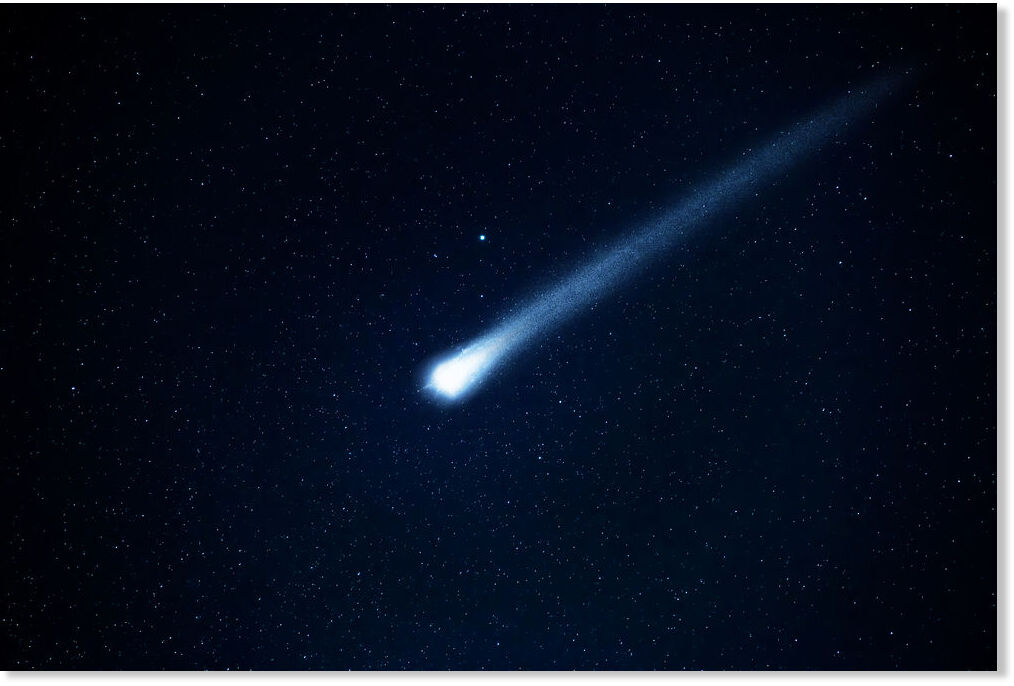
The object first tracked as 6AC4721 has now been confirmed as a comet — an exceptionally early, ground-based catch for a Kreutz-family “sungrazer,” which usually only shows up later in SOHO coronagraph images.

Why this matters: Catching a Kreutz comet this far out means we can watch its evolution for weeks — maybe months — before it dives toward the Sun in early April 2026. That’s a rare opportunity to track how a sungrazer “switches on,” how its coma and tail develop, and whether it can stay intact as solar heating ramps up.

The big question:Most Kreutz comets don’t survive perihelion… but the few that do can become truly spectacular. So for now: cautious excitement, steady monitoring, and lots of fresh data coming in.

Discovery highlights:• Discovered from San Pedro de Atacama (Chile) at the AMACS1 Observatory using a 0.28 m (11") f/2.2 Schmidt + CCD• Found at 2.056 AU from the Sun and 1.433 AU from Earth — reportedly the farthest distance at which a Kreutz sungrazer has ever been discovered• About mag 17.8 at discovery, in the constellation Columba

More updates soon as new images and photometry arrive. ☀️🔭

First picture: Comet Ikeya-Seki as photographed by Roger Lynds from Kitt Peak at dawn on October 29, 1965.

Maps on the trajectory C-2026-A1-MAPS Sungrazing Comet
Deep Dive

The MAPS (Maury, Attard, Parrott, Signoret) program is an independent program to discover near-Earth asteroids using the synthetic tracking technique.

Extraordinary ‘Sungrazer’ Comet Could Dazzle NYC skywatchers With a Stunning Show This Week
Apr 4, 2026
An extraordinary ‘sungrazer’ comet could dazzle NYC skywatchers with a stunning show. Meteorologist Joe Rao joined FOX Weather to provide into the celestial comet that will be visible to the naked eye into the work week.
 
An extraordinary ‘sungrazer’ comet could dazzle NYC skywatchers with a stunning show. Meteorologist Joe Rao joined FOX Weather to provide into the celestial comet that will be visible to the naked eye into the work week.
It didn't made it. Officially, it had a fraction of a percent chance to re-appear on the other side of the sun last night. It was way smaller than predicted and thus, it dived into the sun and that was it. It didn't appear on the other side.
 
Floods in Dagestan, Russia continue
A vehicle swept away by floodwaters on a highway in Makhachkala.


A week on; fresh heavy rainfall and floods return unabated. Dagestan is currently experiencing one of its worst floods in over a century, triggered by record-breaking rainfall that exceeded even pessimistic forecasts and caused widespread infrastructure damage. A state of emergency has been declared in the capital Makhachkala, Khasavyurt, Buynaksk, and multiple districts, with power outages affecting over 327,000 people and over 3,300 residents evacuated from flood zones. Meduza

Regional emergency services have been placed on heightened alert as weather conditions continue to challenge infrastructure. Forecasters had previously warned of strong winds reaching up to 23 m/s alongside persistent rainfall between April 4 and 6.

eUE.webp
 
Floods in Dagestan, Russia continue

I believe the severe flooding in Dagestan

and the regions on the northern side of the Caucasus where caused - by a combination of factors which had their origin in a previous low pressure area affecting the Middle East and later Caucasus during the time of 25-28 March 2026: That primary system created the conditions which lead to the floods on 5 April over Dagestan. The Middle East already had highly unstable weather for weeks - with large "V" thunderstorms and massive rainfalls, and unusual powerful low pressure systems (see 27 March chart)

As that previous low pressure area reached the Caspian sea on 28 March 2026, with its strong rotating powers - which over Dagestan lead to that large amounts of moisture from the Caspian sea were sucked in towards the coastlands to the west and northern Caucasus region. Resulting into lots of rain. So, the soil there must have taken up lots of water back then.

Then came the next low pressure area (5 April)
as a sort of smaller version. It appeared "out of nowhere", meaning, that the unstable area between Turkey and Caspian Sea, sort of "united" into a low pressure system, which started to rotate. With what looks to me like stationary rainfalls, because the disturbances didn't move that much. At least not during 1-2 days. At the same time, once again moisture [fuel] was taken up over the Caspian Sea, driving towards the coast of Dagestan. With its already saturated soil leading to massive floods. After all, the Caucasus then acted like a barrier for the clouds, increasing rainfalls even further.


27march2026.jpg


28march2026.jpg


5april2026.jpg


Below: The low pressure area over Dagestan on 5 April 2026, has moved away eastwards, is now (7 April 2026) stationed as a large diffuse mass of clouds, with rain and thunderstorms stretching from NW India / New Delhi, over Northern Afghanistan to Kazakhstan. So there, in front of the high mountains, a lot of rain should accumulate.

7april2026.jpg
 
Bright fireball seen streaking across afternoon sky in N.J., other eastern states
Updated: Apr. 07, 2026, 5:46 p.m. |Published: Apr. 07, 2026, 3:38 p.m
A bright fireball was spotted in the sky Tuesday afternoon over parts of New Jersey and several other eastern states, including New York and Pennsylvania, according to social media posts and eyewitness reports submitted to the American Meteor Society.

The AMS, which tracks meteors across the globe, received 99 reports of Tuesday’s fireball as of 3 p.m., including 28 from New Jersey. By 4 p.m., the total number of reports rose to 186.


Most of the witnesses reported seeing a bright flash in the sky between 2:35 p.m. and 2:40 p.m., and some reported seeing several green-colored fragments streaking across the sky for several seconds.

On Facebook, several New Jersey residents reported hearing a loud boom and said their house rattled at the time the fireball was zipping across the sky.

Reports came in from various towns and cities in Atlantic, Bergen, Burlington, Camden, Gloucester, Mercer, Middlesex, Monmouth, Morris, Ocean, Somerset, Sussex and Warren counties.

Some witnesses said the flash lasted between 3 and 4 seconds, while others reported the streak of light remaining in the sky as long as 11 to 12 seconds.

On the AMS website, a resident of Neptune Township in Monmouth County reported hearing a “boom” followed by a “rumble.”

A person from Doylestown, Pennsylvania, reported seeing “several small bright spots spitting off and moving separately behind the main fireball.”

In addition to New Jersey, New York and Pennsylvania, reports of meteor sightings were submitted by people in Connecticut, Maryland, North Carolina, Virginia and Washington, D.C.

“It was insanely cool to see,” a resident of Heathsville, Virginia, reported, saying the fireball was moving “from up left to down right” and she heard “a muffled boom.”

“The fireball flashed brightly after 2 to 3 seconds of watching it streak across the sky from left to right,” a woman from Falls Church, Virginia reported. “As the fireball flashed I saw one or two smaller bright pieces break away before it faded away.”

It’s not uncommon for meteors to be streaking across the sky at almost any time of the year, but they are most often spotted at night when the sky is dark.

Fireballs are very bright meteors, and they are sometimes bright enough to be seen during daylight hours.
 

Putin Holds Emergency Meeting as Deadly Dagestan Floods Kill Six | APT
Apr 7, 2026
Dagestan floods 2026, Russia flood news, Putin responds to floods, Caucasus region flooding, record rainfall Dagestan, Russian emergencies, flooding disaster news, Dagestan evacuation, extreme weather Russia, Gedzhukh reservoir breach, natural disaster Russia, infrastructure damage Dagestan, floods kills children, heavy rain Dagestan, Russian state of emergency, Putin emergency meeting, breaking news Russia floods, climate crisis Russia, flooding in March 2026, Dagestan residents affected
 
Stefan Burns comments on the unusual characteristics of the recent Philadelphia fireball event 🤔 , while the supposed NASA report did amount to a hill of beans other than a repost from the AMS data


Did Russian the Bear just make an announcement to the USA?

Gork data on Russian rocket and missile technology.

Q: (L) Okay. Is this Windmill Knight still asking about Object 3I/Atlas?

(Joe) No, that's me.

(L) Oh, that's you. Didn't we already ask about it?

(Joe) No. This object 3I/Atlas, what is it?

A: Wait and see! Hale-Bopp anyone?

Q: (Joe) Cool! It's gonna come and put on a show. Hopefully. The Ukraine conflict doesn't seem like it will end any time soon given that the US and Europe seem unwilling to accept Russia's terms and continue arming Ukraine. How long is this conflict likely to continue?

A: Late this year or early next year, but sudden surprises could be in the works.

Q: (Joe) Can we add in, "Oreshnik, anyone?" to the end of that answer? [laughter] "Oreshnik in Kiev"?

A: Yes

Q: (Joe) Mainly because Putin has actually said... there was a report recently in the past couple of days that hardliners in the Russian government wanted Putin to take out the decision-making centers with Orechnik in Kiev and Putin reportedly said, "Absolutely not! There would be nothing left!"

NASA releases report on fireball spotted in Philly region, April 7, 2026
Event ID 20260407-183400
Date (UTC) April 7, 2026
Time (UTC) 18:34:00
AMS Event 2543-2026
Chicken Little Start Lat/Lon +40.654, -72.747
Chicken Little End Lat/Lon +39.521, -74.349
Chicken Little Altitude 76.8 km → 43.9 km ( 47.7 miles→ 27.3 miles)
Chicken Little Speed 13.5 km/s (30,100 mph)

Other meteor sightings in 2026​

The latest meteor sighting comes after other fireballs have been spotted in other parts of the country, including on the West Coast, in the Midwest and in Texas.

March marked a month full of fireballs lighting up the sky, with sightings of different events reported in California, Nevada, Washington, Oregon, Texas, Ohio, Delaware, Illinois, Indiana, Kentucky, Maryland, Michigan, New York, Pennsylvania, Virginia, the District of Columbia and in Ontario, Canada.

On March 17, a "loud boom" was heard over northeast Ohio after a different, six-ton fireball was spotted in the Northeast U.S. and in Canada, according to USA TODAY's previous reporting. Another meteor, weighing about a ton, left behind a souvenir after traveling across Texas skies on March 21, dropping debris through a local resident's roof and ceiling.
 
Last edited by a moderator:
And now Earth we'll be reaping the consequences of that record heat from 2023, but don't worry, Mother Nature will eventually balance this out.

Back-to-back Amazon droughts trigger record forest stress

Two back-to-back droughts in 2023 and 2024 caused the most severe decline in forest moisture and biomass (the total mass of living vegetation such as leaves, trunks and branches) in the Amazon since 1992, according to a study published in the journal PNAS. And many of the hardest hit areas are unlikely to recover before the next major drought arrives.

Western states face above-normal wildfire threats this summer. New maps reveal which areas are most at risk.

Amid drought and heat waves, April's national wildfire forecast shows that nearly the entire Western U.S. will face an above-normal risk of wildfires at some point in the next four months.

The latest outlook reports that the snow melt-off in the Four Corners region came "not just several weeks or months earlier than normal, but also four to six weeks earlier than the previously recorded earliest melt-off dates." The recent heat wave also desiccated the West. Albuquerque, for example, recorded its earliest ever 90-degree reading on March 21, more than six weeks sooner than its previous earliest date, in 1947. The daily average of 73.1 degrees Las Vegas recorded in March would have broken the city's April record.
XBQ4fUTQ6S7xsL7s9FZAqi-970-80.jpg.webp

Projections for June wildland fire risk from the National Interagency Coordination Center released on April 1, 2026.

Overall, there's been less snowpack and higher temperatures than pretty much any winter on record. It's a situation that climatologists have said would be virtually impossible without climate change, and the maps reflect that reality.

"It doesn't mean that all of these areas are going to burn," said Alastair Hayden, professor at Cornell University and a former division chief in the California Governor’s Office of Emergency Services. Last year, for example, the Pacific Northwest saw an above-normal risk but was largely spared. Local patterns, such as wind and precipitation, play a major role, too. "But, when I look back at the forecast, fires usually tend to be in one of these locations."

The number of acres across the country that have burned through March is already 231 percent of the 10-year average. A wet spring, however, could change everything. It recently rained in Albuquerque where Hurteau is based, and, if it continues, the fire risk could go down dramatically. That's what happened last year.

And not that mainstream science is connecting the dots, but an admission that something is coming out from deep inside Earth:

Non-producing oil and gas wells may emit microbial methane at rates 1,000 times higher than previously estimated

Most methane leaks originate deep underground​

The team collected samples from 401 non-producing wells across the country, particularly in Western Canada where more than 90% of these wells are located. "Non-producing wells" included inactive wells, those that have never produced and those that have ceased production.

"For this study, we looked at chemical properties such as gas composition and stable isotopic signatures, which enable a better understanding of the origins of the leaking methane. This analysis is highly sensitive, and we were able to reliably characterize the origins of emissions from 100 of the 401 wells sampled," said Micucci, study co-author and Postdoctoral Researcher in Civil Engineering.

The researchers showed that most methane leaks typically derive from "thermogenic" sources—usually found in petroleum formations deep below ground, where organic matter derived from ancient life "cooks" under high temperatures. But previous research appears to have underestimated the contribution of microbial methane, which is typically found in shallow formations.

Emissions pathways still unclear​

The researchers said the findings raise new questions about how methane moves underground and escapes through wells.

"Our results raise the question of whether the studied wells were above microbial methane-containing formations, and whether they provide a pathway for this microbial methane to migrate into the atmosphere," Micucci explained.

Kang said she hopes the study provides insights into the "complex nature of the subsurface" and improves ongoing efforts toward mitigating emissions at oil and gas sites.
 
View attachment 117712
This image shows how the difference between incoming and reflected shortwave energy — absorbed solar energy — can be compared to emitted longwave radiation to determine Earth’s net change in energy. (Image credit: NASA’s Scientific Visualization Studio)
The rising sea surface temperatures is from inner core dynamics. Cloud formation is being driven by cometary dust and cosmic rays as well. And at some point, these last two factors will favor global cooling that will help balance things up.

The results, published Feb. 22 in the journal Geophysical Research Letters, confirm that some processes in the climate system are missing from the models. The simulations underestimated the amount of energy that Earth absorbed from the sun, particularly between 2010 and 2024, when satellite data shows that Earth's energy budget was completely out of whack.
"Their analysis is solid and straightforward," said Yuan, who was not involved in the study. "They analyzed different emission scenarios and none can fully simulate the observations. They find a failure of models to capture the strong increase in [Earth's energy imbalance]."
This failure suggests that the models are missing hidden mechanisms that are reducing the amount of energy Earth radiates into space. Climate models account for greenhouse gases, but they may not capture the effect that rising surface temperatures have on clouds and other elements that regulate how much energy escapes into space, according to the study.
If the sharp increase in Earth's energy imbalance since 2010 is due to cuts in aerosol emissions, the rate of increase should decline as aerosol levels stabilize, Yukimoto said. If, instead, the increase is from clouds reacting to rising surface temperatures, Earth's energy imbalance could grow bigger and warm the planet faster than greenhouse gases alone could. But "our results contradict this," Yukimoto said.
The rising sea surface temperatures is from inner core dynamics. Cloud formation is being driven by cometary dust and cosmic rays as well. And at some point, these last two factors will favor global cooling that will help balance things up.

Many scientific observations are based on flawed or misguided models that have been in use for generations and do not allow for proper analysis, sometimes resulting in conveniently erroneous findings.

I’m not sure if this article has already been discussed, though I haven’t come across it; please accept my apologies in advance if that is the case

Scientists Remap Earth’s Gravity

An uncommon way of looking at the world reveals the evolution of a deep gravity hole beneath Antarctica.


1776026526021.png


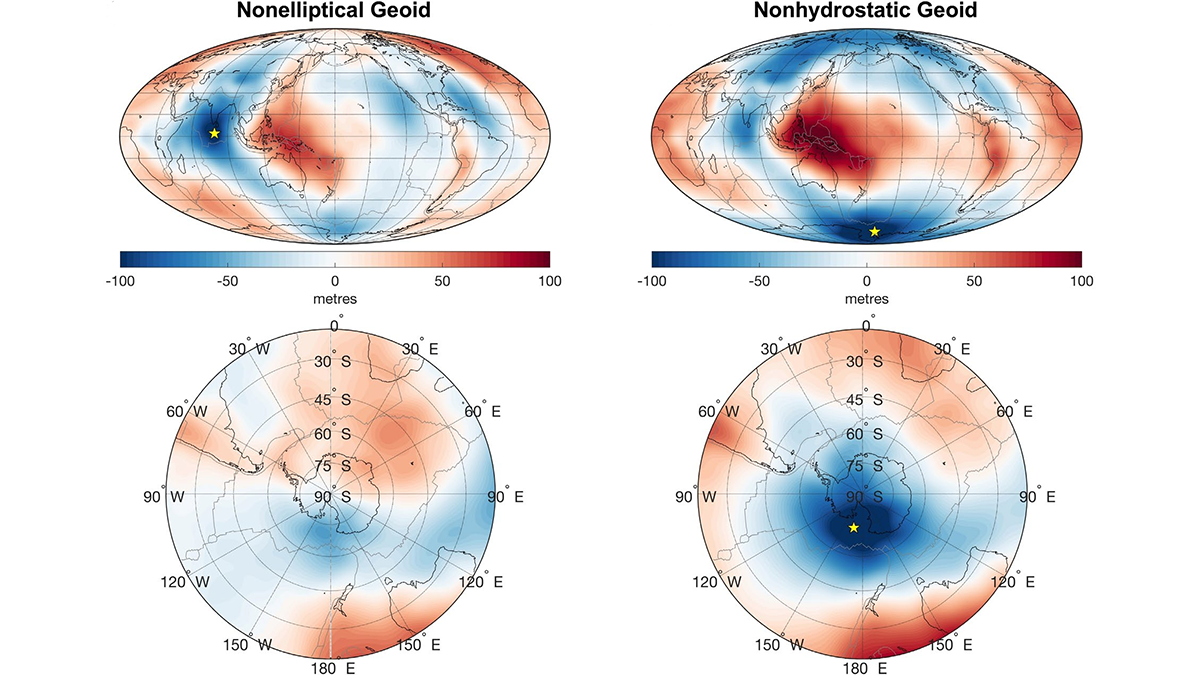
An unusual way of mapping Earth’s gravity suggests that a “gravity hole” beneath Antarctica is even deeper than the gravity hole beneath the Indian Ocean, which scientists have long considered the deepest. The strength of Earth’s gravity at its surface varies across different regions, and a gravity hole marks a place where it is weaker than average.
(el mapeo usado) It is a standard used by many experts who study Earth’s gravity and in satellite engineering, where it is necessary to take into account variations in Earth’s gravity because they cause oscillations in an orbit.
Instead of using the standard reference ellipsoid, the team of geophysicists Petar Glišovic and Alessandro Forte from the Geomagnetism Team at the Institute of Earth Physics in Paris reformulated the spatial configuration of the geodynamic model —mapping of Earth’s gravity— by eliminating the flattening caused by the Earth’s daily rotation; they used an ideal hydrostatic ellipsoid, assumed that the Earth behaves like a fluid at rest, and considered only the ‘non-hydrostatic’ forces —the repulsion and attraction of the mantle—, which provided a new perspective on the analysis and synthesis in their conclusions.
patata.jpg


The research found that, when applying this geodynamic approach—based on the Antarctic Geoid Low (AGL)—to the Ross Sea in Antarctica, a deep ‘gravity hole’ emerges; as Alessandro Forte puts it, ‘a very broad and gentle depression in the Earth’s gravitational field’ - This ‘zone’, which exceeds the Indian Ocean minimum in terms of non-hydrostatic anomaly, is the deepest long-wavelength gravitational depression on the planet; that is, the point of weakest gravity due to the distribution of mass within the Earth, and it is assumed and revealed to be caused by deep flows in the mantle.
This research also confirms and expands the concept of non-uniform gravity, showing how internal processes spanning millions of years shape this variation and highlighting the AGL as a prime example of these most significant anomalies on the planet.
The research found that by switching to a more geodynamic, rather than hydrostatic, model, the team discovered that the gravitational anomaly known as the Antarctic Geoid Low (AGL), located over the Ross Sea, reveals a deep “gravity well”. According to Alessandro Forte: “a very broad and gentle depression in the Earth’s gravitational field”.
This gravitational phenomenon exceeds in magnitude another depression known as the Indian Minimum, which could be observed using traditional models. The Antarctic anomaly – which is non-hydrostatic – contains the deepest long-wavelength gravitational depression on the planet, that is, the point of weakest gravity due to the distribution of mass within the Earth, and it is assumed and revealed that this is caused by deep flows in the mantle.

The unconventional geoid in the latest study, however, is based on an ideal “hydrostatic ellipsoid” in which fluids are at rest. By subtracting this hydrostatic ellipsoid from the gravity data, the researchers created a “nonhydrostatic” geoid that accounts for deviations between observations and these ideal conditions. This method allowed the researchers to study the mantle structure near the AGL, which appears almost insignificant in the usual model. The data were based in part on the latest measurements from the GRACE (Gravity Recovery and Climate Experiment) satellites—and by this measure the AGL, beneath the west of Antarctica near the Ross Sea, is markedly deeper than the IOGL.
(...) the AGL has existed for at least 70 million years and that it moved from beneath the South Atlantic Ocean to its present location between 50 million and 30 million years ago, when a rapid redistribution of Earth’s mantle mass caused the planet’s axis of rotation to shift.
In particular, the changes in the mantle seem to have involved the interplay of the sinking of tectonic slabs beneath Antarctica and buoyant upwellings of rock from the boundary of Earth’s mantle and its core, “much like the circulation in a lava lamp, but on a timescale of tens of millions of years,” Glišović said.
Importantly, the changes in the gravity hole beneath Antarctica over the past 77 million years may have encouraged the growth of that continent’s ice sheets. Glišović stressed that it’s only a hypothesis but that the permanent glaciation of Antarctica happened about 34 million years ago, which coincided with the structural changes of the AGL.
This phenomenon is due to key processes that intensified it:
-The subduction of cold, dense tectonic plates beneath the deep mantle of Antarctica.
-The rise of hot, less dense material from the core-mantle boundary, ‘like a stream in a lava lamp’.
Puntos_Antartic<-indic.webp


Although this gravitational force is small, it is measurable and can have a particularly significant impact on the oceans.
This less dense material reduces local gravity, creating a “depression” in the surface of the geoid—the shape of the sea defined by gravity—reaching 130 metres below mean sea level in the Ross Sea.
(Counterintuitively, regions of weak gravity cause depressions in the ocean: With less gravitational force pulling water to the area, water flows away to regions of higher gravity.)
What happens is that water flows from areas of weaker gravity towards areas with stronger gravitational pull. This means that the sea level around Antarctica is considerably lower than it would otherwise be, creating a unique boundary condition for the continent’s edges. A truly favourable situation.

This research has managed to turn back time using various methods, including up-to-date 3D tomographic images of the Earth’s interior, running physical equations on computers, and reconstructing tectonic plates by varying their viscosity profiles with the help of seismographs, which, according to Forte, he describes as: “Seismic waves provide the ‘light’ that illuminates the planet’s interior.” By reconstructing the movement of the mantle over the last 70 million years, he makes projections back and forth in time, observing the displacement of the poles, rotational bulges and the distribution of mass, and recalculates current geoid anomalies, as relatively small loads in the mantle can cause a significant displacement of the poles that affects the planet’s moment of inertia.
"What surprised me most is how coherent the long-term story appears to be. The gravity low is not a random, short-lived feature," Forte said. "In our reconstructions it persists through much of the last ~70 million years, but its strength and geometry evolve in ways that are consistent with major reorganizations of the flow of rocks deep beneath Antarctica."
That persistence is what makes the finding so intriguing. The Antarctic gravity low appears to have intensified around the same time Antarctica transitioned into a permanently ice-covered continent about 34 million years ago. The timing suggests a potentially testable hypothesis: long-wavelength changes in Earth's gravity field could subtly alter the baseline of regional sea level, potentially influencing ice-sheet boundary conditions.
The study not only recalculates anomalies in ocean behaviour, revealing its dynamics, but also demonstrates that relatively small, persistent loads on the mantle can have significant effects on gravity, sea level and the planet’s equilibrium. In the words of scientist Alessandro Forte: it is a “window into the Earth’s deep movements”, revealing how the planet’s interior can redefine gravity and, in the process, alter the global climate. " .

Q: (Gaby) TES (The Ethical Skeptic) has a hypothesis based on these blobs and posits that Earth's core and mantle dynamics drive periodic rotational instabilities, leading to true polar wander events.
[Background info: Exothermic Core-Mantle Decoupling - Dzhanibekov Oscillation (ECDO) Theory: Exothermic Core-Mantle Decoupling - Dzhanibekov Oscillation (ECDO) Theory

A: Partly involved, yes.

Q: (Gaby) He claims that a weakening of the core mantle magnetic coupling causes heat from the Earth's core into the mantle, excluding these blobs. This makes the rest of the mantle denser than the blobs, contributing to:

• Loss of current influence in the position of our geographic North Pole
• Increase in sea surface temperature and in the Earth's axis of rotation
• Shift in the planet's rotation around its maximum axis (the denser mantle)
Increasing the chances of a True Polar Wander event with an axis of gyroscopic moment based upon the African blob.
A: Very close!
In this regard, the hypothesis of the Exothermic Core-Mantle Decoupling – Dzhanibekov Oscillation theory aligns with the way it addresses changes in the gravitational field and mantle dynamics, along with their consequences. I also find that there are geophysical events that confirm changes in the axis of rotation, but I am doubt that they could be the same events. Research (AGL) has, so far, identified only one event involving a shift in the Earth’s axis: the True Polar Wander (TPW), which occurred approximately 50 million years ago and involved a lateral reorientation of the Earth’s axis of rotation, coinciding in time with a significant change in AGL evolution when Antarctica was in the South Atlantic.
Otherwise, the conclusions are in line with what is currently happening and what might occur naturally in AGL:
- A gradual decrease in the current influence on the position of the South Geographical Pole
- A rise in temperature in key areas, particularly in the South Atlantic and the Antarctic Peninsula.
- Regarding the change in the planet’s rotation around its axis:
It could be said that the ‘African superplume’ anomaly is opposite to the AGL geoid field; both are driven by deep mantle dynamics, one being of low density (AGL) and the other of high density (African LLSVP).
Bearing in mind that angular momentum may not be as stable as we imagine (?), coupled with the geomagnetic field generated by factors of motion and heat, and as mentioned in this thread, the force of incoming meteorites, this could be the cause of gravitational anomalies and lead to a readjustment of the axis of rotation and magnetic reversal.

To conclude, this Antarctic Geoid Low (AGL) is a factor to be taken into account in a possible orbital aberration; according to the study, this weak gravity has been ‘sinking’ the Antarctic Ocean and pushing sea levels from the core-mantle boundary as a result of thermal decompression that reduces the density of the mantle beneath Antarctica.
It is worth noting here that decompression and earthquakes cause electromagnetic activity and, consequently, openings or windows and phenomena of all kinds, which I see as a way of distorting chronological order of events.
Furthermore, we know that there have been STS-4D manipulations in Antarctica (they practically live there) and there is a large underground base that is surely sustained by thermal energy and unknown technology; one might wonder whether these technologies have encouraged the melting of ice or whether they have served to control erroneous natural movements such as the tilt or deviation of the axis through artificial manipulation. (?)
I see that, quite literally and figuratively, you need to know how to surf to ride the wave; in any case, Forte’s question remains open:
“The aim is to tackle a big question: How is our climate connected to what is happening inside our planet?”
🏄‍♂️

 
Back
Top Bottom