Watch the skies and land and oceans

If the guy still relative far away from the Artic Circle claiming that at this time (21 April) the sun isn’t going below -13 degrees… :whistle:

The sun went down to -16.5 degrees below horizon in Ørsta, Norway on 21 April - placing the town well within the astronomical twilight e.g. it is still almost completely dark, especially to the naked eye.

Nevertheless - the margins for dark nights up here are now shrinking very fast for each additional night.
Very interesting! From the same time period, this one was published by NASA (no comment added on the blue aurora):

JPLommamSg6oDhUL8KM8c9-970-80.jpg.webp

A meteor streaks Earthward as aurora light up the skies over Alberta, Canada. (Image credit: Harlan Thomas)

From Calgary, which is way down relatively speaking:

Astrophotographer Harlan Thomas captured a spectacular early morning natural light show on April 20, as a Lyrid meteor photobombed the northern lights above Alberta, Canada.

"The image was taken West of Calgary in an area called Jumping Pound on April 20, 2026 at 4:20 am MDT (1020 GMT)," Thomas told Space.com in an email. "A Coronal Hole High Speed Stream (CH HSS) had arrived the day earlier and the geomagnetic storm continued into the next day."
 
Fireball over Europe was witnessed with three hundred and thirty-one reports

We received 331 reports about a fireball seen over Aargau, Abruzzo, Auvergne-Rhône-Alpes, Île-de-France, Baden-Württemberg, Basel-Landschaft, Bayern, Bern, Bourgogne-Franche-Comté, Campania, Catalogna, Catalunya, Center-Val de Loire, Corse, Emilia-Romagna, Friuli-Venezia Giulia, Genève, Grand Est, Hessen, Lazio, and Liguria on Thursday, April 23rd 2026, around 22:46 UT.

Screenshot 2026-04-24 135357.png
 
Poland struck by meteorite after fireball lights up skies on April 17, impact crater and rock found on April 22
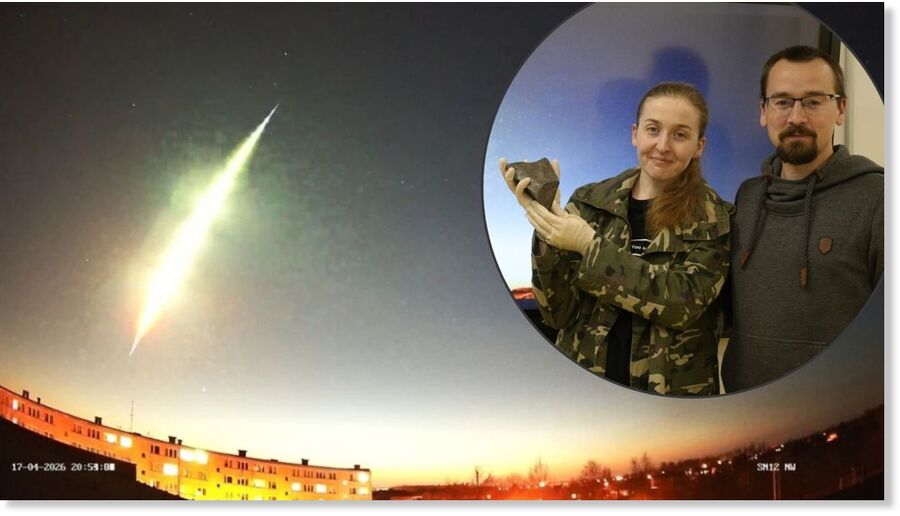
The meteorite was found when two researchers, Anna and Paweł Walczak, spotted a 40-centimeter-deep crater.
The meteorite was found when two researchers, Anna and Paweł Walczak, spotted a 40-centimeter-deep crater. © Koluszkowska Stacja Kosmiczna

Scientists in central Poland have recovered a rare iron meteorite believed to be the remnant of a spectacular fireball that streaked across the sky on April 17.

The 2.9-kilogram meteorite was discovered near Łódź in the village of Zadzim on Wednesday, just five days after it flew over Poland.

The rapid recovery makes it the first iron meteorite in Poland to be found so quickly after an observed fall, and one of only a handful worldwide with a precisely reconstructed orbit, the Skytinel meteor research network said on Friday.


A fireball is an exceptionally bright meteor that forms when a meteoroid enters Earth's atmosphere, often culminating in a meteorite impact.

Using observational data, experts at Skytinel were able to determine not only the atmospheric path of the object but also its previous orbit around the Sun, allowing them to narrow down the impact zone.
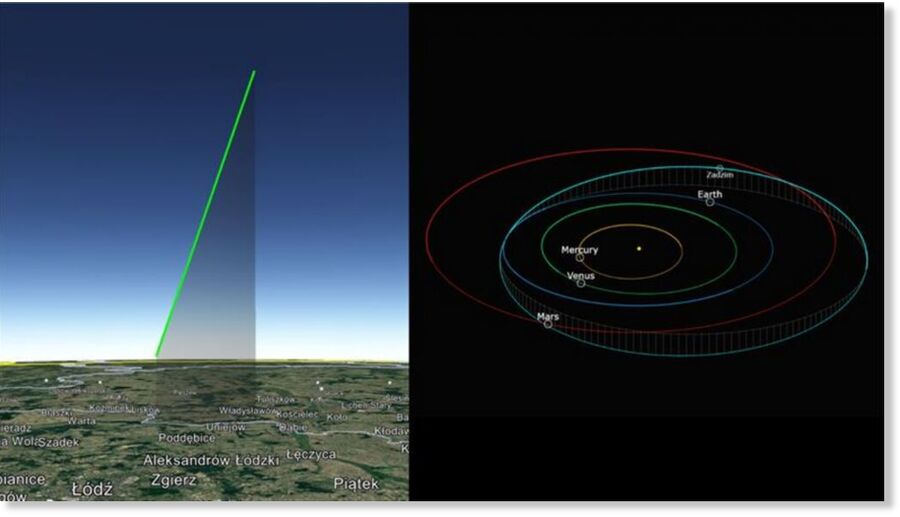
Experts were able to quickly determine an impact zone.
Experts were able to quickly determine an impact zone. © Skytinel meteor network/Facebook

Initial searches began almost immediately. Teams equipped with drones and metal detectors combed the area, but early searches yielded no results.

It was only after further collaboration with Czech scientists, who refined the impact model, that the search area was reduced to a 300-by-200-meter zone.

Skytinel's eventual discovery on April 22 came when two researchers, Anna and Paweł Walczak, spotted a 40-centimeter-deep crater and recovered the meteorite.
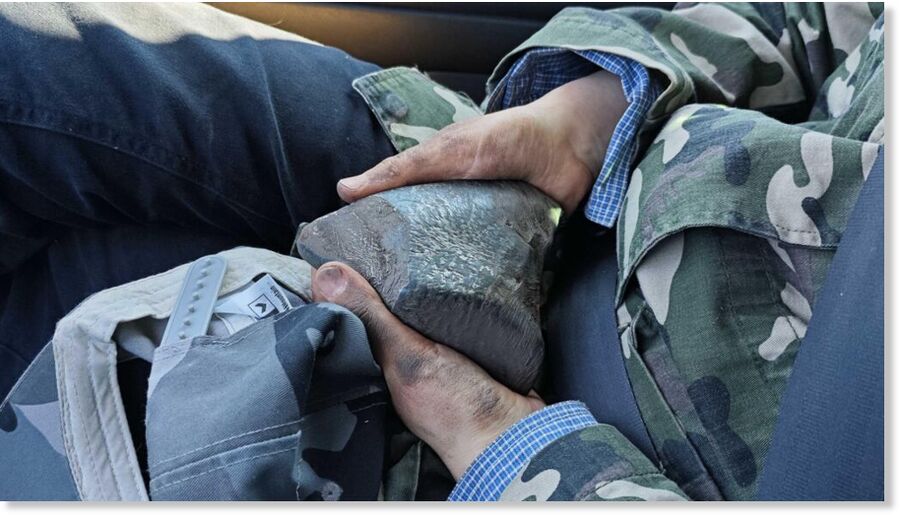

The recovered meteorite weighs nearly three kilograms.
The recovered meteorite weighs nearly three kilograms. © Skytinel meteor network/Facebook

Preliminary analysis confirms the specimen is an iron meteorite, most likely an octahedrite, a type characterized by distinct crystalline patterns formed over millions of years inside asteroids.

Skytinel said the freshly recovered meteorite provides "unique research opportunities—from radioactive isotope analysis to reconstructing the history of this piece of space."

The network added that the first tests would begin on Saturday. Once all procedures are completed, the meteorite is expected to appear on display at a museum, "where it will be able to delight future generations of space enthusiasts," Skytinel said.
 
LeoLabs is talking a good game ("uh, we think the thing maybe just blew itself apart"), but they can't be unaware of the uptick in fireballs we've been noting here. Can't have Starlink customers worried about their product being swept from the skies.

Speaking of malfunctioning or falling satellites, there was this news from the beginning of March:

(March 11) An unexpected failure of a Russian telecoms satellite last week has left millions of households without television service and forced major providers to seek emergency help from foreign operators.

The state-owned Russian Satellite Communications Company (RSCC) said its Express-AT1 satellite abruptly stopped functioning on March 4 for unknown reasons.
On March fourth, an off-nominal situation occurred aboard the Express-AT1 satellite, leading to the immediate shutdown of the spacecraft.

According to the operator, specialists from GP Kosmicheskaya Svyaz and the manufacturer, AO Reshetnev, undertook a set of measures to restore the platform's operability, but these actions produced no result. The company stated that the satellite is technically beyond recovery and may be considered lost.
 
Btw, just because it was discussed before in the sessions:

A: Fragment. Expect a lot of the "rocket launch" excuses. If it was really a "rocket launch" they would have been able to announce it in advance.

There is this mention about Russians not announcing launches anymore, at least from some locations:

Recently, launches from Russia’s northern spaceports have been carried out without prior notice, which was not the case in the past. This is likely due to the attacks on Plesetsk during a launch, as recently mentioned by the head of Roscosmos. Today’s launch successfully placed military spacecraft into orbit.
 
Back
Top Bottom