
You are using an out of date browser. It may not display this or other websites correctly.
You should upgrade or use an alternative browser.
You should upgrade or use an alternative browser.
What are you listening to?
- Thread starter redjade
- Start date


This morning, sitting with a cup (for an idea, see this Amazon offer) showing the periodic table of the elements, in some countries also known as Mendeleev's Table, the conversation led to the reality that many quiz question can be asked around the periodic table. It could be: Is there an element with a name that connects to both an asteroid and a Greek goddess? Which element has two vowels in its name, that are both the same? Which metals are less dense than water? Which element is named after a country?
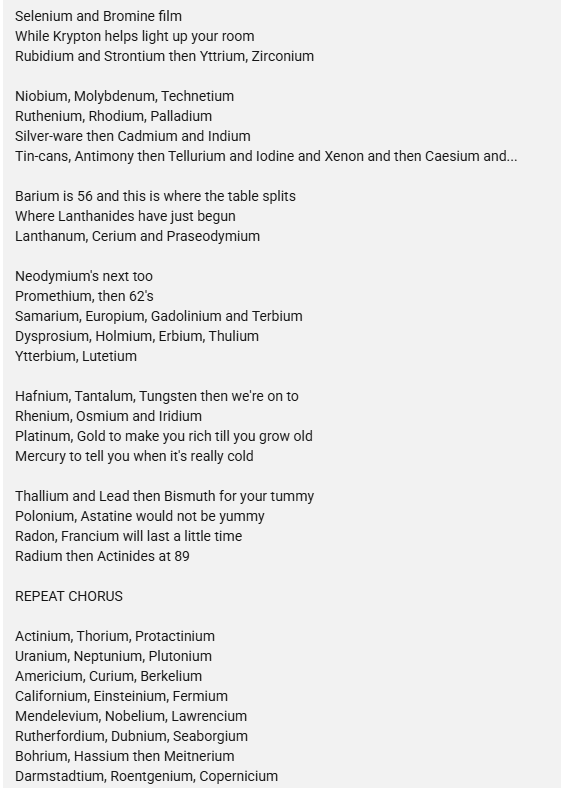
Alright, I don't recall all the elements, but there is a fun video on a teaching channel, The Organic Chemistry Tutor hosted by two Canadians where they make the content memorable by incorporating the names of the elements into the lyrics for a song, - maybe more useful for skillful tongue twisters, but anyone can give it a go or play it at a slower speed.
The lyrics are posted too, if the song is hard to follow:


The "Can-Can" tune may be recognizable to many, but what is its history?
Looking up Can-can by Offenbach, gave the classical version:
A note about Moulin Rouge:
Whole length opera-like productions:
Orpheus in the Underworld 1983 in English (The video quality was not great, but one can understand the English).
J. Offenbach - Orphée en enfer (Opéra de Lyon, 1997) It is hard to catch the French lyrics. Will the Russian subtitle may help few. Alternatively look for a different upload.
If Jacques Offenbach made a satirical version of the story of Orpheus and Eurydice, what was that original story about?
The lyre is more than a constellation, it is also musical instrument
NISORIA Handmade Lyre Harp Review (Pentatonic) | Is it worth buying?
Donner 7 String LYRE Review & Demo | Is it worth it?
She has two uploads played on seven string lyres:
Secunda (Skyrim) 7 String Lyre Cover & Tutorial
Kephallonia Island (Assassin's Creed: Odyssey) 7 String Lyre Cover
A different take on choosing a lyre is from SEIKILO Ancient World Music, Ancient Greek Lyre: Choosing a Lyre - 10 Things I Wished I Knew Before Buying my First Lyre and plays in another upload: Ancient Lyre - Lyre of Aphrodite - 7 strings - LUTHIEROS
The qualities of the seven string harp as an instrument for playing pentatonic music may relate to what the Cs mentioned last year:
Use pentatonic scale
Session 28 June 2025
Summary and final thought
The post began with the elements of the periodic table, moved to the song using the Can-can part from Orpheus in the Underworld, composed by Jacques Offenbach. Following the colorful Moulin Rouge in Paris, next on to the original Greek story of Orpheus and Eurydice, to the fate of Orpheus and his instrument, the lyre, eternalized in the constellation Lyre, followed by a dive into the lyre harp instrument leading to the seven string pentatonic harp. A way to get to elements, not those tabled by Mendeleev, but those associated by the Chinese with both nature and music might be:
The Five Elements vs the Five Pitches (in the Pentatonic Scale)
Offenbach: Can Can - Roberto Metro & Elvira Foti
Alright, I don't recall all the elements, but there is a fun video on a teaching channel, The Organic Chemistry Tutor hosted by two Canadians where they make the content memorable by incorporating the names of the elements into the lyrics for a song, - maybe more useful for skillful tongue twisters, but anyone can give it a go or play it at a slower speed.
The "Can-Can" tune may be recognizable to many, but what is its history?
Looking up Can-can by Offenbach, gave the classical version:
Following the above leads:Offenbach - Cancan | WDR Funkhausorchester
The cancan part from the overture to Orpheus in the Underworld by Jacques Offenbach, played by the WDR Funkhausorchester under the baton of its honorary conductor Helmuth Froschauer. Recorded live at the orchestra's 70th anniversary concert on November 18, 2017 at the Funkhaus Wallrafplatz in Cologne. Jacques Offenbach - Cancan (Orpheus in the Underworld Overture).
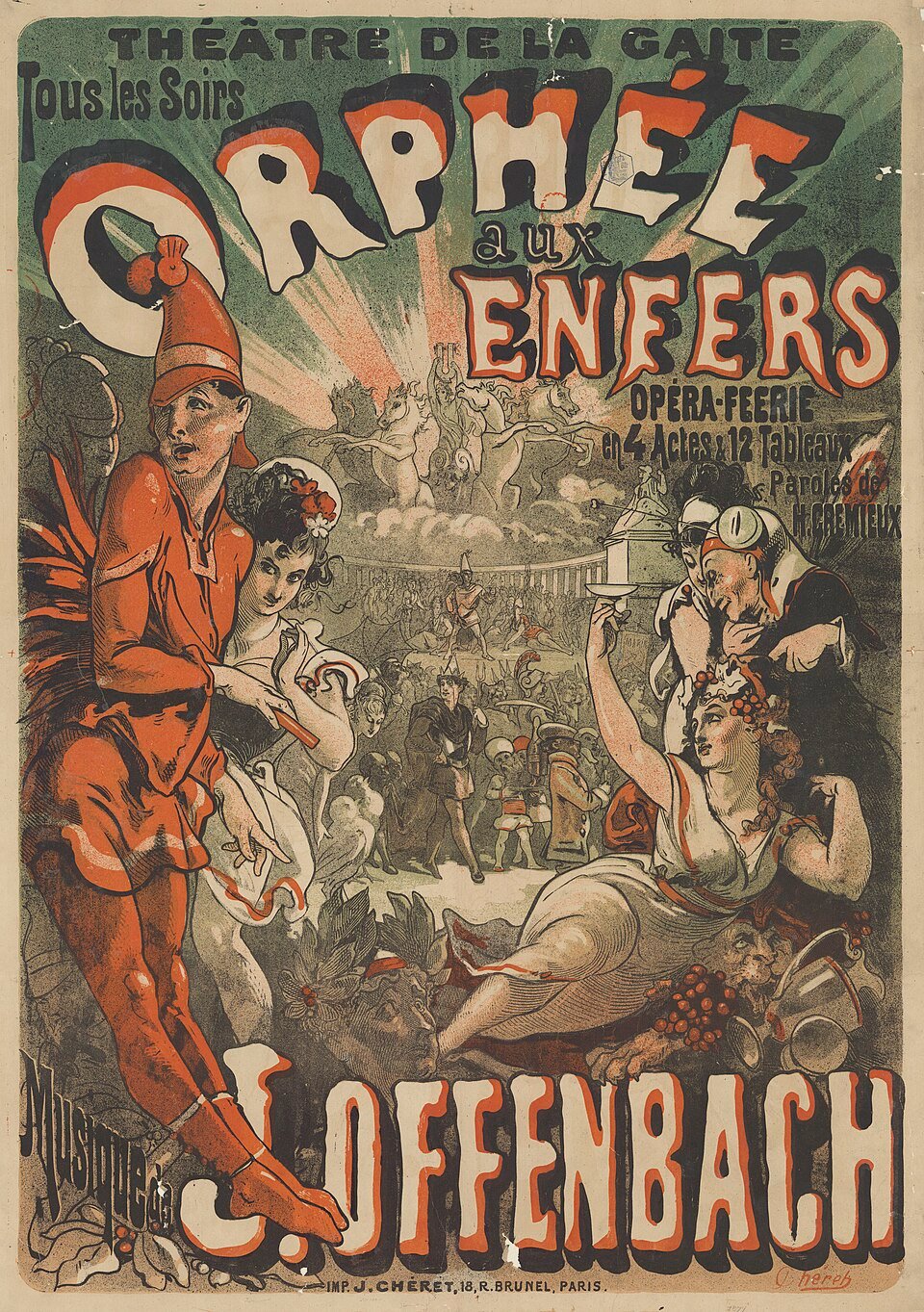
Orpheus in the Underworld[1]and Orpheus in Hell[2] are English names for Orphée aux enfers (French: [ɔʁfe oz‿ɑ̃fɛʁ]), a comic opera with music by Jacques Offenbach and words by Hector Crémieux and Ludovic Halévy. It was first performed as a two-act "opéra bouffon" at the Théâtre des Bouffes-Parisiens, Paris, on 21 October 1858, and was extensively revised and expanded in a four-act "opéra féerie" version, presented at the Théâtre de la Gaîté, Paris, on 7 February 1874.
The opera is a lampoon [Dictionary specifically : a harsh satire usually directed against an individual]of the ancient legend of Orpheus and Eurydice. In this version Orpheus is not the son of Apollo but a rustic violin teacher. He is glad to be rid of his wife, Eurydice, when she is abducted by the god of the underworld, Pluto. Orpheus has to be bullied by Public Opinion into trying to rescue Eurydice. The reprehensible conduct of the gods of Olympus in the opera was widely seen as a veiled satire of the court and government of Napoleon III, Emperor of the French. Some critics expressed outrage at the librettists' disrespect for classic mythology and the composer's parody of Gluck's opera Orfeo ed Euridice; others praised the piece highly.
Orphée aux enfers was Offenbach's first full-length opera. The original 1858 production became a box-office success, and ran well into the following year, rescuing Offenbach and his Bouffes company from financial difficulty. The 1874 revival broke records at the Gaîté's box-office. The work was frequently staged in France and internationally during the composer's lifetime and throughout the 20th century. It is one of his most often performed operas, and continues to be revived in the 21st century.
In the last decade of the 19th century the Paris cabarets the Moulin Rouge and Folies Bergère adopted the music of the "Galop infernal" from the culminating scene of the opera to accompany the can-can, and ever since then the tune has been popularly associated with the dance.
A note about Moulin Rouge:
About the author of the opera, Jacques Offenbach:Moulin Rouge is best known as the birthplace of the modern form of the can-can dance. Originally introduced as a seductive dance by the courtesans who operated from the site, the can-can dance revue evolved into a form of entertainment of its own and led to the introduction of cabarets across Europe. Today, the Moulin Rouge is a tourist attraction, offering predominantly musical dance entertainment for visitors from around the world. The club's decor retains much of the romance of Belle Époque France.
However the dance, Can-can already existed before the work of Offenbach popularized it:Jacques Offenbach (/ˈɒfənbɑːx/;[1] 20 June 1819 – 5 October 1880) was a German-born French composer, cellist and impresario. He is remembered for his nearly 100 operettas of the 1850s to the 1870s, and his uncompleted opera The Tales of Hoffmann. He was a powerful influence on later composers of the operetta genre, particularly Franz von Suppé, Johann Strauss II and Arthur Sullivan. His best-known works were continually revived during the 20th century, and many of his operettas continue to be staged in the 21st. The Tales of Hoffmann remains part of the standard opera repertory.
Born in Cologne, Kingdom of Prussia, the son of a synagogue cantor, Offenbach showed early musical talent. At the age of 14, he was accepted as a student at the Paris Conservatoire; he found academic study unfulfilling and left after a year, but remained in Paris. From 1835 to 1855 he earned his living as a cellist, achieving international fame, and as a conductor. His ambition, however, was to compose comic pieces for the musical theatre. Finding the management of Paris's Opéra-Comique company uninterested in staging his works, in 1855 he leased a small theatre in the Champs-Élysées. There, during the next three years, he presented a series of more than two dozen of his own small-scale pieces, many of which became popular.
In 1858 Offenbach produced his first full-length operetta, Orphée aux enfers ("Orpheus in the Underworld"), with its celebrated can-can; the work was exceptionally well received and has remained his most played. During the 1860s, he produced at least eighteen full-length operettas, as well as more one-act pieces. His works from this period include La belle Hélène (1864), La Vie parisienne (1866), La Grande-Duchesse de Gérolstein (1867) and La Périchole (1868). The risqué humour (often about sexual intrigue) and mostly gentle satiric barbs in these pieces, together with Offenbach's facility for melody, made them internationally known, and translated versions were successful in Vienna, London, elsewhere in Europe and in the US.
Documentaries about popular modern performances of the dance and music: Behind The Scenes At France’s Most Famous Cabaret | Still Standing | Insider Business The dancers come from 18 different countries, with the UK and Australia having the most representatives. For a longer documentary, but in French see Moulin Rouge, les ailes du plaisir.The can-can (also spelled cancan as in the original French [kɑ̃kɑ̃]) is a high-energy, physically demanding dance that became a popular music-hall dance in the 1840s, continuing in popularity in French cabaret to modern days.[1] Originally danced by couples, it is traditionally associated with a chorus line of female dancers.[2] The main features of the dance are the vigorous manipulation of skirts and petticoats, along with high kicks, splits, and cartwheels.
History
The can-can is believed to have evolved from the final figure in the quadrille, a social dance for four or more couples.[3] The exact origin of the dance is obscure,[4] but the steps may have been inspired by a popular entertainer of the 1820s, Charles-François Mazurier (1798–1828), well known for his mime and acrobatic dance, including the grand écart or jump splits—both popular features of the can-can; his greatest success was in Jocko, or The Brazilian Ape (1825).[5]
The dance was considered scandalous, and for a while there were attempts to suppress it. This may have been partly because in the 19th century, women wore pantalettes, which had an open crotch, and the high kicks were intentionally revealing. There is no evidence that can-can dancers wore special closed underwear, although it has been said that the Moulin Rouge management did not permit dancers to perform in "revealing undergarments".[6] Occasionally, people dancing the can-can were arrested, but there is no record of its being banned, as some accounts claim.[citation needed] Throughout the 1830s, it was often groups of men, particularly students, who danced the can-can at public dance-halls.[7]
As the dance became more popular, professional performers emerged, although it was still danced by individuals, not by a chorus line.[8] A few men became can-can stars in the 1840s to 1861 and an all-male group known as the Quadrille des Clodoches performed in London in 1870.[9] However, women performers were much more widely known.
By the 1890s, it was possible to earn a living as a full-time dancer and stars such as La Goulue and Jane Avril emerged, who were highly paid for their appearances at the Moulin Rouge and elsewhere.[10][11] The most prominent male can-can dancer of the time was Valentin le Désossé (Valentin the Boneless), a frequent partner of La Goulue. The professional dancers of the Second Empire and the fin de siècle developed the can-can moves that were later incorporated by the choreographer Pierre Sandrini in the spectacular "French Cancan", which he devised at the Moulin Rouge in the 1920s and presented at his own Bal Tabarin from 1928. This was a combination of the individual style of the Parisian dance-halls and the chorus-line style of British and American music halls.[12]
Whole length opera-like productions:
Orpheus in the Underworld 1983 in English (The video quality was not great, but one can understand the English).
J. Offenbach - Orphée en enfer (Opéra de Lyon, 1997) It is hard to catch the French lyrics. Will the Russian subtitle may help few. Alternatively look for a different upload.
If Jacques Offenbach made a satirical version of the story of Orpheus and Eurydice, what was that original story about?
And the plot:In Greek mythology, the legend of Orpheus and Eurydice (Greek: Ὀρφεύς, Εὐρυδίκη, romanized: Orpheus, Eurydikē) concerns the tragic love of Orpheus of Thrace, located in northeastern Greece, for the beautiful Eurydice. Orpheus was the son of Oeagrus and the Muse Calliope, though in some myths he is considered the son of Apollo. The subject is among the most frequently retold of all Greek myths.
The constellation is Lyra, the brightest star is Vega, the fifth brightest star in the sky, and the second brightest in the norther celestial sphere.Apollo gave Orpheus a lyre and taught him how to play. It had been said that "nothing could resist Orpheus's beautiful melodies, neither enemies nor beasts." Orpheus fell in love with Eurydice, a woman of beauty and grace, whom he married and lived with happily for a short time. However, when Hymen was called to bless the marriage, he predicted that their perfection was not meant to last.
A short time after this prophecy, Eurydice was wandering in the forest with the Nymphs. In some versions of the story, the shepherd Aristaeus saw her and, beguiled by her beauty, made advances towards her and began to chase her. Other versions of the story relate that Eurydice was merely dancing with the Nymphs. Whether fleeing or dancing, she was bitten by a snake and died instantly. Orpheus sang his grief with his lyre and managed to move everything, living or not, in the world; both humans and gods learnt about his sorrow and grief.
At some point, Orpheus decided to descend to Hades by music to see his wife. Any other mortal would have died, but Orpheus, being protected by the gods, went to Hades and arrived at the Stygian realm, passing by ghosts and souls of people unknown. He also managed to attract Cerberus, the three-headed dog, who had a liking for his music. He presented himself in front of the god of the Greek underworld, Hades, and his wife, Persephone.
Orpheus played with his lyre a song so heartbreaking that even Hades himself was moved to compassion. The god told Orpheus that he could take Eurydice back with him, but under two conditions: she would have to walk behind him while walking out from the caves of the underworld, and he could not turn to look at her as they walked.
Thinking it a simple task for a patient man like himself, Orpheus was delighted; he thanked Hades and left to ascend back into the living world. Unable to hear Eurydice's footsteps, however, he began to fear the gods had fooled him. Eurydice might have been behind him, but as a shade, having to come back into the light to become a full woman again. Only a few feet away from the exit, Orpheus lost his faith and turned to see Eurydice behind him, sending her back to be trapped in Hades's reign forever.
Orpheus tried to return to the underworld but was unable to, possibly because a person cannot enter the realm of Hades twice while alive. According to various versions of the myth, he played a mourning song with his lyre, calling for death so that he could be united with Eurydice forever. He was killed either by beasts tearing him apart or by the Maenads in a frenzied mood. His head remained fully intact and still sang as it floated in the water before washing up on the island of Lesbos. According to another version, Zeus decided to strike him with lightning, knowing Orpheus might reveal the secrets of the underworld to humans. In this telling, the Muses decided to save his head and keep it among the living people to sing forever, enchanting everyone with his melodies. They additionally cast his lyre into the sky as a constellation.
The lyre is more than a constellation, it is also musical instrument
Looking up lyre, there was from Samantha on Mars Which Lyre Harp is the Best? Comparing Budgets & Types with a review os seven models, two of which are made for the pentatonic scale and have seven strings while the others have 16 or 21 strings. She has reviews of two seven string lyre harps:Lyre
The lyre (/ˈlaɪər/) (from Greek λύρα and Latin lyra) is a stringed musical instrument that is classified by Hornbostel–Sachs as a member of the lute family of instruments. In organology, a lyre is considered a yoke lute, since it is a lute in which the strings are attached to a yoke that lies in the same plane as the sound table, and consists of two arms and a crossbar.
The lyre has its origins in ancient history. Lyres were used in several ancient cultures surrounding the Mediterranean Sea. The earliest known examples of the lyre have been recovered at archeological sites that date to c. 2700 BC in Mesopotamia. [1] [2] The oldest lyres from the Fertile Crescent are known as the eastern lyres and are distinguished from other ancient lyres by their flat base. They have been found at archaeological sites in Egypt, Syria, Anatolia, and the Levant.[1] In a discussion of the Nubian lyre, Carl Engel notes that modern Egyptians call it qytarah barbarîyeh, reflecting its association with the Barbaras (Berbers)[3]—linked to the brbrta of ancient Egyptian references to Punt, a region identified with present-day Somalia, where the shareero lyre remains in use.
The round lyre or the Western lyre also originated in Syria and Anatolia, but was not as widely used and eventually died out in the east c. 1750 BC. The round lyre, so called for its rounded base, reappeared in ancient Greece c. 1700–1400 BC,[4] and then later spread throughout the Roman Empire.[1] This lyre served as the origin of the European lyre known as the Germanic lyre or rotte that was widely used in north-western Europe from pre-Christian to medieval times.[5]
NISORIA Handmade Lyre Harp Review (Pentatonic) | Is it worth buying?
Donner 7 String LYRE Review & Demo | Is it worth it?
She has two uploads played on seven string lyres:
Secunda (Skyrim) 7 String Lyre Cover & Tutorial
Kephallonia Island (Assassin's Creed: Odyssey) 7 String Lyre Cover
A different take on choosing a lyre is from SEIKILO Ancient World Music, Ancient Greek Lyre: Choosing a Lyre - 10 Things I Wished I Knew Before Buying my First Lyre and plays in another upload: Ancient Lyre - Lyre of Aphrodite - 7 strings - LUTHIEROS
The qualities of the seven string harp as an instrument for playing pentatonic music may relate to what the Cs mentioned last year:
Use pentatonic scale
Session 28 June 2025
Of course, one can also play pentatonic scales on instruments designed for playing seven note scales. There is a wider selection of initial tones if one has a more complex instrument, like a piano, compared to being restricted to seven strings.(irjO) What specific tone or frequency, such as Hz ranges or musical notes, if any, is most effective for enhancing meditation exercises and promoting a relaxation state?
A: Varies but use pentatonic scale.
Summary and final thought
The post began with the elements of the periodic table, moved to the song using the Can-can part from Orpheus in the Underworld, composed by Jacques Offenbach. Following the colorful Moulin Rouge in Paris, next on to the original Greek story of Orpheus and Eurydice, to the fate of Orpheus and his instrument, the lyre, eternalized in the constellation Lyre, followed by a dive into the lyre harp instrument leading to the seven string pentatonic harp. A way to get to elements, not those tabled by Mendeleev, but those associated by the Chinese with both nature and music might be:
The Five Elements vs the Five Pitches (in the Pentatonic Scale)
Ending where we began with the music, almost, here is a lively piano duet:[...] the Chinese emphasized a lot on the nature, elements, harmony; as a result, they assigned each note in the pentatonic scale to one of the elements, where each of the elements represents a number of different things including the five major human organs, directions, climates, basically everything a person would encounter in their daily life. The Chinese believed everything is interlinked.
Trending content
-

-
Thread 'Coronavirus Pandemic: Apocalypse Now! Or exaggerated scare story?'
- wanderingthomas
Replies: 30K -
-

