Which Public Personalities Are 4D STO Candidates?

I agree with everything you've said.

That's why, as you say in the last paragraph, I commented on Beau's enthusiasm for that guy in the videos.

Not sure I follow you. When you say:

I don't see anywhere how this helps anyone.

It would be interesting to see what think the child in Africa watching the video on a mobile phone with his parents' income of 100 dollars a month.

It seems pretty at odds with trying to see how Beau's points could very well be good insights. Your tone seems less 'rigorous devil's advocate playing' and much more 'dismissive and overtly cynical'.

Regarding the idea that if there's nothing to say it's better to remain silent, I assure you all that I try, but damn it, sometimes I read something and think, "This is missing!"

But your tone suggests that because the information being presented doesn't quite fit all your frameworks, criteria, etc. - you give yourself justification, all too easily, for throwing out the proverbial baby with the bathwater. Also, being an STO candidate doesn't mean that the person in question is going to positively impact the lives of all people. Maybe that isn't quite what you were getting at, but can you see how what you wrote can be construed that way?
 
Maybe that isn't quite what you were getting at, but can you see how what you wrote can be construed that way?
Yes.

Not sure I follow you. When you say
Displaying wealth and a life of enjoyment is an obvious catalyst for the 98 percent of the planet who cannot do that to feel the desire to achieve it, for which a lot of money is needed.

The rich and famous are tools that serve the status quo by displaying what no one else can have.

That's my point.
 
Yes, I suspect that being a good person is not enough to qualify as a 4D STO candidate (although it certainly helps a lot).

Learning the lessons and consciously choosing to act accordingly (something incredibly difficult).

So, people who enjoy fame and money, who are the ones we should choose according to the spirit of this thread, I think they can hardly qualify for 4D STO, given the established status quo It requires a toll to STS.

I suppose you know that very few people know the creators of this forum, for example.
Here, I assumed that I would not respond, comment, on your previous post, but in this one you encouraged me. Basically, I have the impression that your thoughts often result in a defensive attitude, as if you need to defend yourself from something. And in order for that to be purposeful, you gradually move, not into an attack literally, but into a possible defense against potential harm through critical thinking. Here, I am not your enemy, I just recognize my enemy in myself, in some moments of self-awareness. In this understanding, my wife, who spent her childhood in a Home for Uncared Children, helped me the most.
Croatia:
Evo, pretpostavljao sam da se neću oglasiti, komentirati, tvoj prethodni post, ali u ovom si me potakla. Uglavnom, imam dojam da tvoja razmišljanja često rezultiraju obrambenim stavom, kao da se od nečeg trebaš obraniti. A da bi to bilo svrshovito, pomalo prelaziš, ne u napad doslovce, nego u moguću obranu od potencijalne štete pomoću kritičkog razmišljnja. Eto, nisam tvoj neprijatelj, samo prepoznajem svog neprijatelja u samom sebi, u nekim trenucima samosvijesti. U tom shvaćanju, najviše mi je pomogla moja supruga koja je djetinjstvo provela u Domu za nezbrinutu djecu.
 
So, people who enjoy fame and money, who are the ones we should choose according to the spirit of this thread, I think they can hardly qualify for 4D STO, given the established status quo It requires a toll to STS.

The thread asks "Which Public Personalities Are 4D STO Candidates?" and then people have brought up POTENTIAL candidates, mostly based on a longer study of a person over time I think, from the people who brought up POTENTIAL candidates. Then people discussed, hopefully based on more than just a quick/superficial glance at a human being.

From all I can see, I think it is pretty unlikely that the following statement is true, and certainly not categorically so, quote: "I think they can hardly qualify for 4D STO, given the established status quo It requires a toll to STS."

Just because someone "enjoys fame and money" as you call it, doesn't have to mean at all that they can't be 4D STO candidates, quite the contrary in fact, IMO.

It seems pretty obvious to me that you have some rather fixed and inflexible ideas of what such a candidate might look like or how such a candidate should be and what he does or what he has. Quite a bit of a black and white way of looking at something like this, IMO. If you want, I think you could greatly benefit from reflecting on the feedback you have received, most especially on those portions that address how you seem to be judging the capacity of any human being to be such a candidate or not.

Here are just a couple of examples/points where a reflection on your own thinking could help you:

Hi Wandering Star, looking from the outside it does seem like Luke Nichols pushed some buttons of yours, hence the judgements and attack rhetoric. I think Beau is just reflecting that back to you.

I am curious about what Luke represents for you, what the motivation for making someone like him “wrong” is, and if there’s anything you see in him that you could also see in yourself?

I’m aware you don’t know him personally, but that doesn’t stop the mind from forming opinions, judgments and projections about people. We do that all the time, in milliseconds. It is that aspect of your experience of him that I was curious about. Don’t you have that curiosity yourself?

It’s these kinds of questions that let us see how our mind and perceptions really operate, so we can practice greater objectivity.

Being a father now myself, anyone out there promoting how to be a good father and raise children is doing some real good. And that should make him a good STO candidate. Who knows, he might me one of those experienced souls who have done and seen it all and just wanted to come back here and live a quite and good life, closer to the nature.

When we take a moment to reflect on what's being said, and how something might be true - maybe not as a definite, but as a possibility at least, we are doing much greater justice to the process of acquiring knowledge and widening our perceptions than we might do otherwise. And that is really one of the main focuses or reasons for having all kinds of discussions here.

We are also under no obligation to form any kind of set opinion immediately, never mind posting a hard and fast view on what's being said right away, as tempting as that may be sometimes when we just don't see what others are seeing necessarily.

And here's the other thing - particularly as it relates to your posts, Wandering Star: You DO bring up a few valid points. But you seem to do so to the exclusion of all the points Beau brought up and his honing in on this YouTuber's BEING as he, and others, understand it. In this way, its like your habit of 'thinking fast' becomes a limiting factor in what you're able to assimilate or, at least, consider.

I'm not even saying that Beau's 'right' here necessarily. These things can sometimes be hard to know without more data and assessment. But what I AM saying is that, at the very least, given the way he made his case, and the substance of his observations, I can certainly see why he chose to bring this person up here as a good possibility.

On that point, and for myself too, it was a good reminder that being a possible STO candidate can look somewhat different than what one might think of ordinarily. Especially when one considers all the many ways that one can be in service to the well-being and knowledge-sharing of all.

But your tone suggests that because the information being presented doesn't quite fit all your frameworks, criteria, etc. - you give yourself justification, all too easily, for throwing out the proverbial baby with the bathwater. Also, being an STO candidate doesn't mean that the person in question is going to positively impact the lives of all people. Maybe that isn't quite what you were getting at, but can you see how what you wrote can be construed that way?
 
If you want, I think you could greatly benefit from reflecting on the feedback you have received, most especially on those portions that address how you seem to be judging the capacity of any human being to be such a candidate or not.
What I say or think about this topic doesn't matter, that's true.

The cow not will be asked about the politics of the livestock industry.
 
What I say or think about this topic doesn't matter, that's true.

That wasn't the gist of what Cosmos was suggesting to you; that what you say or think doesn't matter here. It DOES matter. Or to be more specific, how you think matters - which is why we're giving you feedback about it. Please re-read what he wrote.

The cow not will be asked about the politics of the livestock industry.

I think you might benefit from reading Daniel Kahneman's Thinking, Fast and Slow

From the blurb:

In his mega bestseller, Thinking, Fast and Slow, Daniel Kahneman, world-famous psychologist and winner of the Nobel Prize in Economics, takes us on a groundbreaking tour of the mind and explains the two systems that drive the way we think.

System 1 is fast, intuitive, and emotional; System 2 is slower, more deliberative, and more logical. The impact of overconfidence on corporate strategies, the difficulties of predicting what will make us happy in the future, the profound effect of cognitive biases on everything from playing the stock market to planning our next vacation―each of these can be understood only by knowing how the two systems shape our judgments and decisions.

Engaging the reader in a lively conversation about how we think, Kahneman reveals where we can and cannot trust our intuitions and how we can tap into the benefits of slow thinking. He offers practical and enlightening insights into how choices are made in both our business and our personal lives―and how we can use different techniques to guard against the mental glitches that often get us into trouble. Topping bestseller lists for almost ten years, Thinking, Fast and Slow is a contemporary classic, an essential book that has changed the lives of millions of readers.
 
That's my point.

People often go about the habit of attributing their imagined ideals onto perceived examples in other lives, with any degree of similarity to their own. This is known as externalization in psychology, or vicarious living in religious contexts.

While this may serve as nice material for banter and socialization, there is a discrete issue with it, in that the process offers no means of internal verification and replication -- people will see and believe what they want, and they don't receive any proceeds for their efforts, in that ... while they may be able to point at what they like physically or socially, they may not be able to point at what they need spiritually, if they can even make such distinctions in the first place.

On matters of transcending any experience of cyclical samsara, or reincarnation, this latter aspect is the most, and only important thing that there ever can be. For if one is aware of the nature of such things, one may also discover the requirements of transcendence, and with such, one may realize that attachment to worldly experience, attainment or meaning only holds its sway on those still clinging to such matters.

To rephrase, in more poetical language: "One who has abandoned their desires for the accouterments and theater of 3rd Density experiences, is well on their way towards pondering, if not partially glimpsing 4th Density experiences, for the remainder of their current indwelling of cosmic manifestation ... or not? :D"

I was interested in taking your angle of "potential failures or failings" -- my words, as I am reminded of some figure about 3,000 souls actually graduating into 4th density within the past 300,000 years, within a most recent session ... but apparently that tid-bit got deleted somehow. I'm not the only one who seen it either:

If only 3000 people graduated to 4D STO in the last 300,000 years, that would be on average 1 person in a century.

It would have made for an insightful followup question. Of those listed as examples on this thread, who are departed, how many have actually graduated to 4D STO ... and can public names be given in particular?
 
What I say or think about this topic doesn't matter, that's true.

What you have thought and said about this topic matters in the same way it matters that people here (including me) think the way you are are judging the question at hand is too superficial (or black and white, if you will) and therefore likely based on too little information, after which they expressed that opinion as such perhaps a bit too direct and/or bristling for you liking. That in itself has nothing to do with whether or not the person that was brought up MIGHT be a candidate or not. Perhaps he is, perhaps he isn’t.

It also matters that some people here seem to have checked the character of the person in question for quite a while which naturally gives such an opinion a greater degree of POSSIBLY being true for an outsider (which I am too because I don’t know the guy) compared to an opinion that seems based on much less and superficial data.

It is understandable that bristling could rob you the wrong way as it does for most people in one way or the other, at least some of the time. You could however try to distance yourself from the raw/categorical reactions that this might have caused in you, and try to see (as hard, untrue or unfair it might sound to you at the moment) that there is really something valuable people here are trying to tell you, including the people you might have reacted the strongest against internally for what they said.

What helped me in situations like this is the pointing finger rule:

There is a simple rule that struck me ever since I encountered it and I remember it ever since, because it is so true:

“When you point your index finger towards something or someone else, there are always THREE fingers pointing right back at yourself (middle, ring and little finger)“

What that means is: Often, if not always, the more justified and strongly we feel in pointing a finger, the likelier it is that what we ourselves are (or have been) doing, is exactly what we accuse others of doing. And not only that, but probably 3 times more than the other person or thing we point a finger at even if it should be true that the other party is at fault too! In other words, we tend to project our own issues and faults onto someone or something else.

So every time we feel especially justified and sure that there are for example things like bullying, being offended, not liking straight talk, overly emotional reasoning, rudeness or irrational things going on with something or someone else, chances are that the pointing finger rule above is probably going on.

So, every time we suspect that something like that might be happening with ourselves, it is wise to first and foremost distance ourselves from the pointing and asking ourselves “am I the one that has the actual problem here? And what can I do to change that?“. A good way to distance one’s self from the automatic pointing tendency is to not respond in the heat of the moment but wait at least a day or two to cool down.

Now, you could ask’s yourself a series of questions and contemplate an approach that goes something like this:

In which way could it be that I have been pointing fingers here? Ok, that doesn’t seem obvious to me at all at the moment. I should remember, even if others MIGHT be at fault in some way too, irrespective of that being true or not, there is always something for me to learn and the finger rule above applies more often then not, and MOST especially when I feel very strongly about me pointing the finger being right. Perhaps I was pointing at the proposed 4D STO candidate person? If so, why? And maybe before and after that at people here, maybe especially the ones that “offended“ me for even proposing something like this with such a guy? If so, why? What could be some of the reasons for pointing the finger? Perhaps something like thinking “that guy certainly or almost CATEGORICALLY can’t be a candidate for this or that (if I‘m honest) admittedly superficial reason based on a quick glance“ or “anyone even just suggesting such a POSSIBILITY must be or likely is wrong and makes me feel snarky/dismissive towards“. Or “he offended me, for no reason!“. And/or other reasons I can find in myself for pointing. Now what happens if I contemplate the pointing finger rule?
 
It would have made for an insightful followup question. Of those listed as examples on this thread, who are departed, how many have actually graduated to 4D STO ... and can public names be given in particular?
Ihmo,it's likely that the Wave could provide some boost. On the other hand, we know that CS respects the free will of those who ask/receive, which means their deep beliefs. In any case, whatever the answer may be, if the question is asked, it will be interesting :-) .
 
In regards to the inference that famous people cannot necessarily be 4D STO candidates, consider historical figures—who are famous through the ages—such as Julius Caesar.
I think the reference was made to the C's saying that very popular people usually serve an agenda of the PTB, and that's why they were let to be so popular.
On the other hand, serving a PTB agenda unknowlingly, which is likely the case for many or maybe even for most of the popular public personalities, does not exclude them from being potential 4D STO candidates.
Besides, both 3D to 4D transition and STO vs. STS orientation are 'things' of the Souls, levels of Knowledge and Being, and Awareness, which are not so easily discerned, if at all, with a quick glance over few video clips.

So, this guy with bushing videos could very well be serving the PTB agenda to keep people cosy and sleepy, and uninterested in anything out of the immediate impacts on their everyday lives, for example. And that could easily be why he was let to be so popular.
His potential STO candidacy would not be diminished with all that though, as it would stem from his particular actions and words, his energy and aura that would come through from him, his impact on people around him and consuming his media content. The criteria in that case would simply be delivering those individuals what they "asked" or taking from them what he wanted for his self promotion for example. Serving himself by serving them or only serving his own interests. If there's a net positive impact on people's lives, other than his own and those closests to him, it could be indicative of potential STO candidacy regardless of high popularity or not. OSIT.
 
I nominate Oliver Sacks as a candidate. I greatly admire people who help others, who dare to help them, and who do everything they can to help them. Oliver Sacks helped many patients with unusual illnesses that, it seems to me, no one else dared to treat. He did. Furthermore, he showed us how our brains work. And he was an excellent writer, full of compassion, humility, wisdom, and patience. He was kind, friendly, curious, and adventurous. A perfect candidate, a loyal and intelligent person. His career was long, and I've included a link so you can see his career path.

I believe a candidate must open new paths to help the human condition. A being of light.

I vote for you Mister Sacks!

Source

Sacks served as an instructor and later professor of clinical neurology at Yeshiva University's Albert Einstein College of Medicine from 1966 to 2007, and also held an appointment at the New York University School of Medicine from 1992 to 2007. In July 2007 he joined the faculty of Columbia University Medical Center as a professor of neurology and psychiatry.At the same time, he was appointed Columbia University's first "Columbia University Artist" at the university's Morningside Heights campus, recognising the role of his work in bridging the arts and sciences. He was also a visiting professor at the University of Warwick in the UK. He returned to New York University School of Medicine in 2012, serving as a professor of neurology and consulting neurologist in the school's epilepsy centre.

Sacks's work at Beth Abraham Hospital helped provide the foundation on which the Institute for Music and Neurologic Function (IMNF) is built; Sacks was an honorary medical advisor.he Institute honored Sacks in 2000 with its first Music Has Power Award. The IMNF again bestowed a Music Has Power Award on him in 2006 to commemorate his "40 years at Beth Abraham and honor his outstanding contributions in support of music therapy and the effect of music on the human brain and mind."

Sacks maintained a busy hospital-based practice in New York City. He accepted a very limited number of private patients, in spite of being in great demand for such consultations. He served on the boards of The Neurosciences Institute and the New York Botanical Garden.

Writing​

In 1967 Sacks first began to write of his experiences with some of his neurological patients. He burned his first such book, Ward 23, during an episode of self-doubt. His books have been translated into over 25 languages. In addition, Sacks was a regular contributor to The New Yorker, the New York Review of Books, The New York Times, London Review of Books and numerous other medical, scientific and general publications. He was awarded the Lewis Thomas Prize for Writing about Science in 2001.

Sacks's work is featured in a "broader range of media than those of any other contemporary medical author" and in 1990, The New York Times wrote he "has become a kind of poet laureate of contemporary medicine".

Sacks considered his literary style to have grown out of the tradition of 19th-century "clinical anecdotes", a literary style that included detailed narrative case histories, which he termed novelistic. He also counted among his inspirations the case histories of the Russian neuropsychologist A. R. Luria, who became a close friend through correspondence from 1973 until Luria's death in 1977. After the publication of his first book Migraine in 1970, a review by his close friend W. H. Auden encouraged Sacks to adapt his writing style to "be metaphorical, be mythical, be whatever you need."

Sacks described his cases with a wealth of narrative detail, concentrating on the experiences of the patient (in the case of his A Leg to Stand On, the patient was himself). The patients he described were often able to adapt to their situation in different ways, although their neurological conditions were usually considered incurable. His book Awakenings, upon which the 1990 feature film of the same name is based, describes his experiences using the new drug levodopa on post-encephalitic patients at the Beth Abraham Hospital, later Beth Abraham Center for Rehabilitation and Nursing, in New York. Awakenings was also the subject of the first documentary, made in 1974, for the British television series Discovery. Composer and friend of Sacks Tobias Picker composed a ballet inspired by Awakenings for the Rambert Dance Company, which was premiered by Rambert in Salford, at Opera Theatre of Saint Louis.
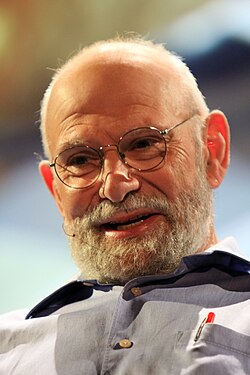
Sacks in 2009
In his memoir A Leg to Stand On he wrote about the consequences of a near-fatal accident he had at age 41 in 1974, a year after the publication of Awakenings, when he fell off a cliff and severely injured his left leg while mountaineering alone above Hardangerfjord, Norway.

In some of his other books, he describes cases of Tourette syndrome and various effects of Parkinson's disease. The title article of The Man Who Mistook His Wife for a Hat describes a man with visual agnosia and was the subject of a 1986 opera by Michael Nyman. The book was edited by Kate Edgar, who formed a long-lasting partnership with Sacks, with Sacks later calling her a “mother figure” and saying that he did his best work when she was with him, including Seeing Voices, Uncle Tungsten, Musicophilia, and Hallucinations.

The title article of his book An Anthropologist on Mars, which won a Polk Award for magazine reporting, is about Temple Grandin, an autistic professor. He writes in the book's preface that neurological conditions such as autism "can play a paradoxical role, by bringing out latent powers, developments, evolutions, forms of life that might never be seen, or even be imaginable, in their absence". Sacks's 1989 book Seeing Voices covers a variety of topics in deaf studies. The romantic drama film At First Sight (1999) was based on the essay "To See and Not See" in An Anthropologist on Mars. Sacks also has a small role in the film as a reporter.

In his book The Island of the Colorblind Sacks wrote about an island where many people have achromatopsia (total colourblindness, very low visual acuity and high photophobia). The second section of this book, titled Cycad Island, describes the Chamorro people of Guam, who have a high incidence of a neurodegenerative disease locally known as lytico-bodig disease (a devastating combination of ALS, dementia and parkinsonism). Later, along with Paul Alan Cox, Sacks published papers suggesting a possible environmental cause for the disease, namely the toxin beta-methylamino L-alanine (BMAA) from the cycad nut accumulating by biomagnification in the flying fox bat.

In November 2012 Sacks's book Hallucinations was published. In it he examined why ordinary people can sometimes experience hallucinations and challenged the stigma associated with the word. He explained: "Hallucinations don't belong wholly to the insane. Much more commonly, they are linked to sensory deprivation, intoxication, illness or injury." He also considers the less well known Charles Bonnet syndrome, sometimes found in people who have lost their eyesight. The book was described by Entertainment Weekly as: "Elegant... An absorbing plunge into a mystery of the mind."


He also wrote The Mind's Eye, Oaxaca Journal and On the Move: A Life (his second autobiography).

Before his death in 2015 Sacks founded the Oliver Sacks Foundation, a non-profit organization established to increase understanding of the brain through using narrative non-fiction and case histories, with goals that include publishing some of Sacks's unpublished writings, and making his vast amount of unpublished writings available for scholarly study. The first posthumous book of Sacks's writings, River of Consciousness, an anthology of his essays, was published in October 2017. Most of the essays had been previously published in various periodicals or in science-essay-anthology books, but were no longer readily obtainable. Sacks specified the order of his essays in River of Consciousness prior to his death. Some of the essays focus on repressed memories and other tricks the mind plays on itself. Sacks was a prolific handwritten-letter correspondent, and never communicated by e-mail.
 
Last edited:
Back
Top Bottom