Session 13 March 2021

If I understand him correctly from that PDF, I think that what he meant was that a single plasma phenomenon could last a few centuries and that auroral events that created those plasma phenomena lasted a thousand years. This could explain why these things became so popular around the world, because these weren't just some temporary flashes in the sky like we have today.
Reminded me of the Cs quote on Stonehenge too:

Q: (L) In many ancient ruins there are found certain symbols which interest me, specifically the coil or spiral which seems to be ubiquitous throughout the world. This is also very similar to one of the Reiki symbols. What is the origin and meaning of this symbol?

A: Energy collector translevel; stonehenge was one. Stonehenge is a coil. The missing stones form a coil arrangement. People have been "zapped" at stonehenge.
A: Location attracted those spirit types on the proper frequency, who in turn, placed stones in proper location to receive the coded communications in code telepathically, in order not to have to chase around the countryside reading encoded pictographs.
Q: (L) What was the technique used within the circle to receive the information telepathically? [Planchette spiralled in, and spiralled out.]
A: Transcendent focused thought wave separation.
Q: (L) OK, so that you're saying that moving in a spiral...
A: The spiral serves to translate message by slowing down the wave and focusing thought wave transference energy. Utilizes /transduces electromagnetic waves, the conduit, by breaking down signal from universal language of intent into language of phonetic profile. This is for mutiple user necessity.
Q: (L) Mutiple user necessity implies that a number of people must do the spiral. Is that correct?
A: No. Must hear and feel and understand precisely the same thing. The molecular structure of the rock, when properly sculpted sing to you.
 
So, the pictographs are encoded messages. And the same message that is encoded in them can be received through stones. But the people who placed the stones had to receive knowledge about how to sculpt the stones. I wonder from where did that knowledge came from?
 
So, the pictographs are encoded messages. And the same message that is encoded in them can be received through stones. But the people who placed the stones had to receive knowledge about how to sculpt the stones. I wonder from where did that knowledge came from?
My guess is that it becomes "obvious" when you can decode that kind of information. From "Characteristics for the Occurrence of a High-Current, Z-Pinch Aurora as Recorded in Antiquity" it's clear that he says that it doesn't have to be solar activity, but any equivalent in the solar system with the required energy.

The known plasma and shockwave instability types, when scaled from experimental to space plasma dimensions, suggests an intense auroral event lasting at least a few centuries. The newer concentrics, especially those with inner patterns (not shown) and the unwinding spirals provide information about the final cessation of intense incoming plasma flux. On the other hand, the ancient concentrics and spirals, the remains of some having been cut and carved 8 cm deep in granite, suggests that intense auroral events were a common occurrence for at least a few centuries if not millennia. The patterns are representative of a long-term period of typically quiescent aurora.
[...] The number of millennia or centuries involved remains unknown. The discovery of buried horizontal petroglyphs in New Mexico and Australia [51], above which the carbon from campfires was found, suggests that the epochs occurred within a time period of 10 000 BC–2000 BC.
From July 16th, 2016:


Q: (L) Considering that sort of charge in the atmosphere kind of leads to the idea that we could be entering a period where some of those things described by the ancients like these giant plasma figures in the sky could begin occurring. Is that correct?

A: Yes. Holy Grail!

Q: (Pierre) The chalice shape of the Z pinch phenomenon.

A: Sheets of rain! Transiting realities?


Q: (L) That's a reference to a previous session where "sheets of rain" and "holy grail" were mentioned in the same session I think... Is the basic idea of the Holy Grail actually some kind of memory or record of the manifestation of some gigantic plasma phenomenon that opens a portal into another reality? Like the strange tale of the castle of the Fisher King where time stopped? And possibly something that can be utilized…?

A: Close!


Q: (L) So in other words, those things you talked about many times before – time travel and interdimensional transport - where it took like mega or gigavolts of electricity to open portals or operate... the Philadelphia Experiment type things...

A: Yes, now you are tracking well!


Q: (L) So we're onto something here.
 
My guess is that it becomes "obvious" when you can decode that kind of information.

I suppose that it might become obvious to us at some point in time. Meanwhile:

Are Stonehenge's Boulders Actually Big Bells?

Some of the structure's 'bluestones' ring when struck with a hammer.

Not every neolithic site can claim its own ’70s pop classic, but, hey: That’s Stonehenge. Countless theories and tools have attempted to make sense of the set of raised stones and earthworks in the south of England, categorizing it as an astronomical calendar, a healing site, a burial ground, or all of them at once.

Now, a study from the Royal College of Art in London has suggested a new possibility: The monument might make music.
We’re just beginning to think about not only what historic places looked like, but how they sounded.

Since the 1920s, archaeologists have known that the rocks which make up the inner circle of Stonehenge came from a set of hills in Wales—a set of hills nearly 200 miles from the site. In just the past decade, they’ve located what they believe to be the precise mining site of the stones. Researchers have even found the remains of the men who they think transported them.

They couldn’t figure out why, though, the stones moved in the first place. A 2012 book even hypothesized that the monument was meant to unify Britain—that the apparent arduousness of the construction was intentional, not accidental, a kind of proto-nationalization.

Researchers at the Landscape and Perception Project at the Royal College of Art suggest a simpler idea. When struck, they say, stones from that part of Wales sound like a bell.

“The percentage of the rocks on the Carn Menyn ridge are ringing rocks, they ring just like a bell,” Paul Deveraux, an investigator with the project, told the BBC.

“In fact, we have had percussionists who have played proper percussion pieces off the rocks,” he added.

They sound so much like a bell, in fact, that churches in the region used them as their bells until the 1700s. A nearby village is named Maenclochog, meaning ringing stones.

When the English government gave the team permission to test the rocks at Stonehenge, they expected disappointing results. Many of the rocks have been weathered by millennia of elements, and others are lodged seemingly too far in the ground to make any sound.

So it was to their pleasant surprise when a number of rocks, when struck, made “distinctive (if muted) sounds.” They judged that enough made sounds such that once, they all would have rung, and furthermore saw marks on the rocks that might—upon further forensic testing—prove to be strike marks.

In other words, Stonehenge seems to be made of ringing rocks. Deveraux’s team thinks that the rocks were chosen for this exact feature.

If you’re building a monument, why not build it out of stones that speak?

“We don't know of course that they moved them because they rang, but ringing rocks are a prominent part of many cultures,” English archeologist Tim Darvill told the BBC. “Soundscapes of pre-history are something we're really just beginning to explore.”

It’s true. Academics and researchers are just beginning to think about what many historic places—both geographic and architectural—sounded like. Just three years ago, architects and humanists teamed up to get a sense for what John Donne’s church sermons would have sounded like at the time. A 2007 study tried to capture the sound of prehistoric settlements in the south of India, accounting not only for music-making but also for loud crop-snapping and axe-clanging.

And this study, in fact, was conducted by Landscape and Perception Project, an attempt to understand the land in sensory ways. It’s that sensory understanding—and how it shaped what people thought about their building materials—that may help us understand just why they built what they built.

Ringing rocks, by the way, are a feature of many cultures—including some of our own. If you’re in America, you only have to travel to as far as Pennsylvania or Montana to hear fields of resounding rocks, which—just as the Welsh boulders do—chime when struck.


Singing stones

The Gaval Dash, which stands at the entrance to the park, is one of four “singing stones” found in the reserve.

When this hefty two-meter-long stone is struck with smaller rocks, it makes a hollow, ringing sound – in Azerbaijani, Gaval Dash means “tambourine stone.”

This unusual resonance is due to the presence of microscopic holes inside the rock, thought to be a consequence of the dry climate and the effect of natural gas in the region.

Visitors today can still play this early musical instrument, beating out rhythms which echo those made eons before.

“Each of [the stones] has traces” showing “they’ve been used for a long time,” explains Abdullayev, pointing out the bowl-like hollow that has eroded the center of the rock.

The rock is free-standing on top of smaller stones, to better enhance the sound.

One of Gobustan’s most famous petroglyphs is thought to depict dancers taking part in Azerbaijan’s traditional Yalli dance, where participants are arranged in a circle or chain and dance holding hands or shoulders.

The Gaval Dash may have been used to make ritual sounds for these Yalli dancers.


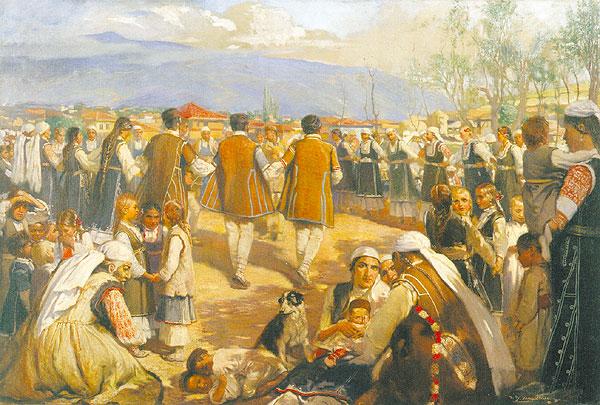
It's interesting how much the circle dance became popular around the world. Perhaps in the past it wasn't done just for fun.
 
One of Gobustan’s most famous petroglyphs is thought to depict dancers taking part in Azerbaijan’s traditional Yalli dance, where participants are arranged in a circle or chain and dance holding hands or shoulders.

Those definitely fall into the category of "The anthromorphic man, with or without the side dots, called a “squatter” by rock art collectors,
is recorded everywhere (Peratt, 2003)"

It's interesting how much the circle dance became popular around the world. Perhaps in the past it wasn't done just for fun.
Yes, for sure. One would hope that "What has been will be again, what has been done will be done again; there is nothing new under the sun."

And another example of circle dance is the Sufi dances:

 
In this picture, people are doing the circle dancing, and below them other people are holding the Holy (Plasma) Grail:


Circle dance was popular in Western Europe during the Middle Ages:

Faroese Chain Dance

The Faroese Folkdance has its origin in South Europe. In the 13th century during the Middle Ages ballade dance was popular in the higher classes in societies like Spain and France. The chain dance was practiced in the often cold castles of kings, earls and lords. The dance spread over Europe and towards Scandinavia. In the Faroe Islands the dance was popular and used on many occasions. People danced at different kinds of gatherings and also at home. The dance was especially popular during the cold winter as the closeness and the movement in the dance gave the participants warmth.

Gradually the dance died out in many countries, probably due to a ban from the church which saw the dance as a heathen tradition. In the Faroe Islands however the dance was preserved.

 
Back
Top Bottom