Watch the skies and land and oceans

These folks need help, as do people in other areas afflicted by the disasters noted above. A prayer and a donation would be in order. Samaritan's Purse is responding and maybe some other organizations too.
There is another winter storm brewing for the southeast US.

Sliger said people who were prepared to manage a couple of days without power can’t go much longer without help.

“They’re cold, they don’t have power, they don’t have heat, they’re out of propane, they’re out of wood, they’re out of kerosene for their kerosene heaters,” she said. “They have no food, they have no additional fuel for their alternative heating sources, so they’re needing out.”

In northeast Mississippi, emergency managers in Alcorn County were also receiving “calls of desperation” from people running out of food, water, medication and other supplies, said Evan Gibens, the emergency agency’s director. He said dispatchers who have been sleeping at work since Friday have fielded more than 2,000 calls.

“We are doing everything we possibly can,” said Gibens, noting 200 people were staying at a local arena being used as a warming shelter.

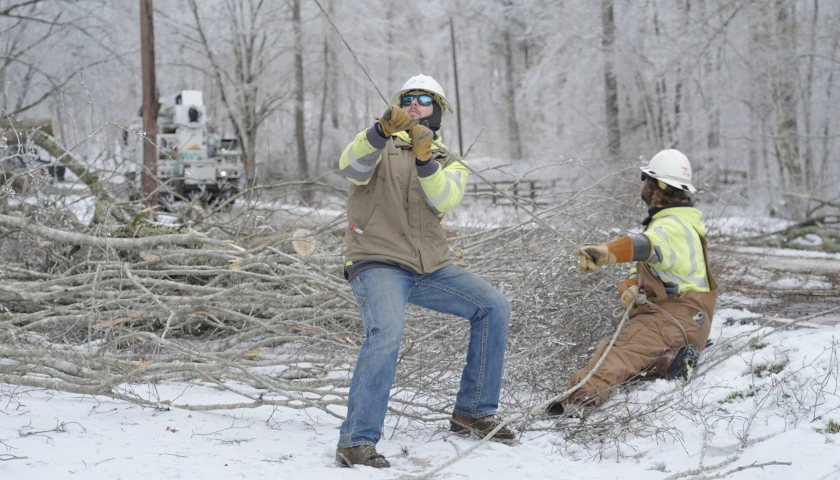
More than 100,000 outages remained in Nashville, Tennessee, where downed trees and snapped power lines blocked access to some areas. Utility workers will need at least the weekend, if not longer, to finish restoring power, said Brent Baker, a Nashville Electric Service vice president
 
These folks need help, as do people in other areas afflicted by the disasters noted above. A prayer and a donation would be in order. Samaritan's Purse is responding and maybe some other organizations too.
There is another winter storm brewing for the southeast US.
It seems as though the devastation in Tennessee is being made intentionally worse by the leadership in Nashville and the ineptness at Nashville Electric Service. Two stories about the madness going on there:


Nashville Electric Service is facing criticism after multiple union members and contractors report the utility refused help from available linemen, as more than 100,000 outages remain in freezing temperatures throughout the Nashville area.

Two members of the International Brotherhood of Electrical Workers, who asked to remain unnamed, say NES declined offers of assistance from multiple union crews, potentially opting for less expensive contractors instead.

“I’ve had a lot of people reach out trying to come to Nashville to help restore power,” the union member said. “They keep getting the same answer- that NES is full and doesn’t need help... I just don’t think they want to pay the union rates.”

FOX 17 News uncovered on Monday, the third day after the storm, NES began work with significantly fewer linemen in the field (less than 300) than neighboring Middle Tennessee Electric, which had 200,000 fewer outages at the storm's peak- 150 fewer linemen.

As of Tuesday, NES reported some 700 linemen in the field.

With potentially a quarter of a million people without power in Nashville, some argue additional crews are urgently needed to restore power- and heat- during dangerously cold conditions, regardless of the company or union.

Another IBEW member from out-of-state, who asked not to be identified, said thousands of union linemen were potentially available after getting released from North Carolina, where they were originially staged, which didn't suffer as intense a storm.

He said he was part of roughly 18,000 linemen who were then sent home, or to other areas. But he said Nashville appeared not to be on that list. Instead, he is now working with Middle Tennessee Electric, which has significantly fewer outages than NES.

“Why are we 10 minutes down the road with 2,000 outages when we could be 15 minutes to Nashville and help out with more than 200 broken poles?” he said. “Union or non-union, they could bring in way more people... You think they would put all hands on deck, and flood that city with linemen and just get everything turned on as fast as they can."

FOX 17 News asked the worker if he believed 700 lineworkers was enough?

"That's no not at all not even close. I'm sorry... I think a minimum of 2,000... I mean, North Carolina had 18,000 of a stage."

NES was asked directly during a press briefing Tuesday, whether it had refused assistance.

“As far as we know, no,” NES representative Brent Baker said. “We are sticking to the path of bringing on the crews that we have partnered with and through the mutual aid... NES currently has crews from Florida, Maryland, Kentucky, Indiana, Ohio, Mississippi and states across the United States and especially the region. As we continue to scale up and grow the workforce, we were accepting workforce from all of those agreements. We had already mutual aid as a more speedy way to get some of our folks here, as well as the contracts we already had. So we had people en route."

FOX 17 News' Kelly Avellino emailed NES asking which crews, if any, had been turned away, why that decision was made, and whether unions were involved. We haven't received a direct response, as of this publication.

Meanwhile, a community group has launched a petition calling on NES to hire any available linemen, saying more workers are needed than the approximately 700 currently deployed.

“People are already in temperatures in the 30s, and it’s going to be single digits again,” said Cecilia Prado of the Nashville People Power Committee. “People are going to die.”

A national representative for IBEW responded to Fox 17 News' inquiry in an email after two days of researching the issue, "Sounds like there are a bunch of our folks on the way or there working already now, but I’m not able to confirm numbers," said Matt Spence.

FOX 17 News has also received numerous comments on social media from viewers reporting similar accounts of NES allegedly declining help from contractors and union crews. We also reached out to all NES Board members, but have not yet heard back.

Reporter Slams Nashville Electric Service, Democratic Leadership in Nashville Power Crisis​

January 28, 2026 Kaitlin Housler

Tom Pappert, lead reporter at The Tennessee Star, criticized the handling of Nashville’s recent ice storm, highlighting what he described as systemic mismanagement by city officials and the Nashville Electric Service (NES) board.

More than 108,000 NES customers remained without power Wednesday morning after an ice storm swept through the region over the weekend. The utility company has since faced criticism after multiple union members and contractors reported that NES declined offers of assistance from available linemen to restore service.

Two members of the International Brotherhood of Electrical Workers, who spoke anonymously to Fox 17, claimed that NES “declined offers of assistance from multiple union crews, potentially opting for less expensive contractors instead.”

In comparison, other Middle Tennessee electric companies have reported far fewer outages. Middle Tennessee Electric, which serves more than 359,000 customers, reported only 284 outages at noon on Wednesday.

On Wednesday’s edition of The Michael Patrick Leahy Show, Pappert attributed much of the prolonged outage to the NES board’s lack of operational experience.

He pointed out that board members, many of whom were politically appointed, “None of them particularly seem to have a lot of expertise in the field.”

Pappert also criticized NES’s communication with residents, calling the utility’s text alerts telling residents to utilize warming centers “patronizing.”

“If it’s freezing and you don’t have heat and you don’t have electricity, do you really need a municipally-owned power company… to let you know that? It’s insulting,” he said.

Pappert went on to call for NES to accept outside assistance in restoring power across Nashville.

“They need to invite these folks from Middle Tennessee Electric and other utilities nearby and say, this is an all-hands-on-deck situation. Please bail us out,” he said. “After all, Democrats are good at accepting bailouts.”

Pappert framed the situation as part of a broader pattern of mismanagement in cities run by Democrats, warning that political loyalty and political correctness often outweigh expertise in critical municipal roles.

“It turns out that the price you pay for Democrat mismanagement is weeks in the dark…This is really what anybody in any Democrat city has to look forward to… you’re going to have mismanagement that can cost lives,” he said, though he noted that Tennessee communities are generally well-prepared to handle crises through neighborly support.

“Fortunately, I think the people of Tennessee are very well prepared for things like this. You have neighbors that take care of each other, but in other states this could be tragic,” Pappert added.
 
The neighborhood behind me still doesn't have power since Sunday night when I think a transformer blew. I heard a loud bang and my electricity went out but fortunately came back on within a minute. Sunday was nerve wracking having electricity and not knowing if I was next. Went out to Kroger yesterday morning. Several large reach in coolers were completely empty. Not one item. Very little to choose from. I got a gluten free pepperoni pizza and some sushi, which was freshly made. I'm finally returning to work this afternoon but some of our employees still don't have power. Another arctic blast is on the way.
 

On the Pulse with Silki providing a closer look (+ alot commentary) on the Niscemi Landslide, Sicily, Italy. In her latest video (not attached) she covers more on the nature of rotational landslide believed to be taking place at Niscemi.


I have NEVER seen anything like this ! Niscemi under EVACUATION and CUT OFF. Situation is DRAMATIC according to Officials, the Niscemi Landslide is moving fast ! Sicily under Emergency !The Images we get from Sicily are heartbreaking ! But also Sardinia and more islands in the Mediterranean are devastated ! Italy in Emergency. Waves like a gigantic Tsunami hit the coast of Sicily, Mount Etna volcano's home. Cyclone Harry is responsible for the storm surge and destruction.
 
The neighborhood behind me still doesn't have power since Sunday night when I think a transformer blew. I heard a loud bang and my electricity went out but fortunately came back on within a minute. Sunday was nerve wracking having electricity and not knowing if I was next. Went out to Kroger yesterday morning. Several large reach in coolers were completely empty. Not one item. Very little to choose from. I got a gluten free pepperoni pizza and some sushi, which was freshly made. I'm finally returning to work this afternoon but some of our employees still don't have power. Another arctic blast is on the way.
My family over in Tennessee still has no power, they are staying with a friend who has a generator thankfully but couldn't bring their cats with them :( School is closed all week and remains to be seen if power comes back on in the small town by next week. Sucks to be powerless to help. Needless to say, my sister has realized the need to have backup power.
 
My family over in Tennessee still has no power, they are staying with a friend who has a generator thankfully but couldn't bring their cats with them :( School is closed all week and remains to be seen if power comes back on in the small town by next week. Sucks to be powerless to help. Needless to say, my sister has realized the need to have backup power.
The good thing is the TN National Guard is assisting in the efforts to clear downed trees and powerlines.

 
Look like Moscow had an epic snowfall.

Russia: Moscow Buried Under Historic Snowfall​

Moscow

Moscow White – Snow has reached over 60 cm (approximately 2 feet) in height in the Russian capital. According to meteorologists at Moscow State University, this is the worst snowfall in two centuries.

An “Abnormally High” Amount.
In Russia, Moscow is being buried this January by almost unprecedented snowfall, according to meteorologists at Moscow State University. This Thursday, precipitation totaled 92 mm (3.62 inches) – "the highest value in the last 203 years" the university notes on the VK social network.

Snow has reached over 60 cm in height in the capital, and some streets have been transformed into temporary storage areas to facilitate clearing other roads. One must go back to 1823 to find such intense snowfall in the Russian capital, with precipitation reaching 122 mm (4.8 inches) at that time, the university adds, while warning that “observations made in such a distant past may not be entirely reliable.” The second record was recorded in January 2004 with 88.9 mm (3.5 inches) of precipitation.

“Deep Cyclones”​

The amount of snowfall, described as "abnormally high," is the result of “the passage over the Moscow region of ‘deep and extensive cyclones with an intensified atmospheric front’,” explained Moscow State University in its statement. The temperature is also 1.5°C below the seasonal average, which stands at -6.2°C (20,84 °F) for January, according to this institution.

“In total, over two days (Tuesday and Wednesday), the capital received 27 mm (1.06 inches) of snow – more than half of the monthly norm,” Tatiana Pozdniakova, chief meteorologist of the specialized service “Meteonovosti”, stated on Telegram. In mid-January, two people died due to heavy snowfall in the Russian Kamchatka Peninsula in the Far East, a remote territory where roads and houses were buried.

Source
 
France is breaking snow records too...

“It’s Quite Exceptional”: These Pyrenees Resorts are Breaking All Records in 2026 with Over 2 meters (6.5 Feet) of Snow​


Pyrenees Resorts are Breaking All Records in 2026


“One man's loss is another man's gain”: this expression perfectly applies to the situation currently faced by different regions of France. The numerous depressions that have passed through Brittany, which haven’t stopped bringing rain, have also affected certain mountainous areas.

These areas, due to the cold and altitude, have seen those same precipitations transformed into snow. A situation enabled by a “disturbed west-to-southwest current,” explains skipass.com, and which is delighting ski resort professionals. Beautiful records have indeed been broken and have significantly thickened the snowpack on the slopes.

Snow Accumulations Not Seen for a Long Time​


While the Northern Alps are usually more favored in terms of snowfall, that’s not the case this time around. In recent days, impressive accumulations have been recorded in the Pyrénées-Orientales, particularly on Canigou and Puigmal, which haven't seen such good snow depth in at least 15 years, explains Midi Libre.

The record was even broken on the Canigou massif, where “a snow height of 2.30 m (7.5 feet) has been recorded at an altitude of 2,160 m (6,988 ft). Speaking to our colleagues at L’Indépendant, Thomas Dulac, a high mountain guide, also explained that such depth "is quite exceptional for this time of year."

More Snowfall Forecasted in the Coming Days​


Meanwhile, as Midi Libre indicates, the Font-Romeu ski resort has accumulated “between 1.15 m and 1.55 m (3.77 ft - 5.08 ft) on its domain.” Enough to please skiers, who aren’t used to seeing so much fresh snow in such quantity in the Pyrénées-Orientales.

The ski resorts of the Cévennes are also particularly lucky this year. No less than “80 cm (2.6 feet) on Mont Lozère or 40 cm (1.3 feet) on Aigoual” have been recorded recently. The same is true "a little further south" with the Caroux massif and La Salvetat. The Southern Alps have also seen beautiful accumulations on the ground, as skipass.com reminds us, “falling in less than 24 hours from 30 to 50 cm (12-20 inches) over a large part of the massif at altitude, and locally 60 to 70 cm (24-28 inches) in the most favored sectors, namely Mercantour.”

Source
 
Celestial activity for twenty-twenty-six. Interesting is the path the Eclipse takes across the USA.

January 16, 2026

This year will be busy for avid skywatchers, with some incredible opportunities to view meteor showers, planets, and the Moon in the night sky.

In 2026, we will also mark the 20th anniversary of NASA Marshall Space Flight Center’s Observatory. Originally established as an engine test site in 1958, it was converted to a solar observatory in 1968 to study the sun. In 2006, it was transformed into a lunar and meteor observatory, marking the beginning of its modern era. Today, the observatory plays a crucial role in monitoring the Moon for impacts, studying eclipses, tracking comets, and measuring meteoroid production through advanced telescopes and cameras.

So, get ready to watch the skies with us! Here are the top astronomical events happening this year:

February 28: Planetary Parade
On February 28, we will see not one, not two, but six planets in the evening sky. Mercury, Venus, Neptune, Saturn, Uranus, and Jupiter will appear shortly after sunset. Four of those planets will be visible to the unaided eye, weather permitting, but only those with optical assistance will be able to view Uranus and Neptune (Mercury can sometimes be harder to spot, too).
  • March 3: Total Lunar Eclipse
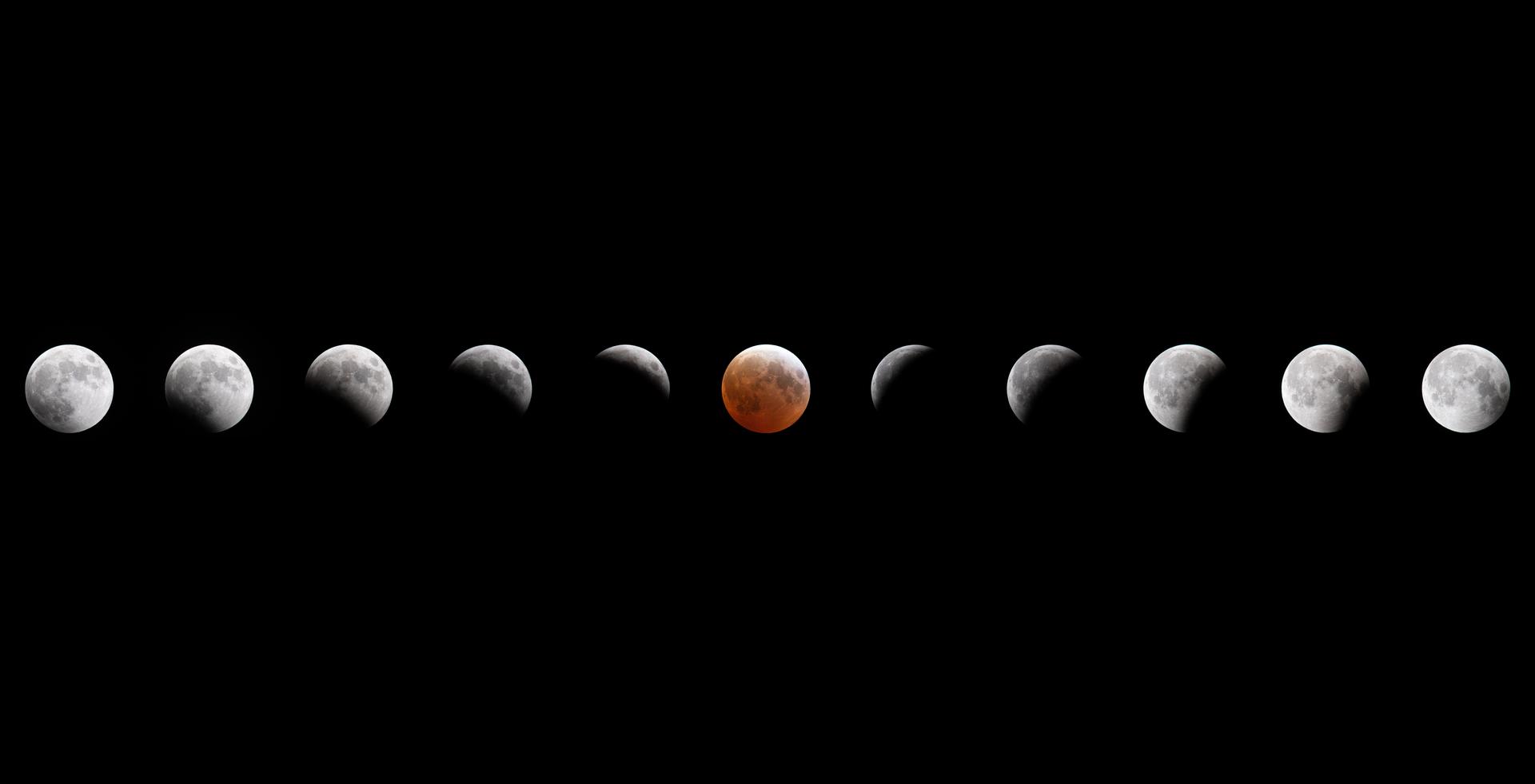
In March, a total lunar eclipse will be visible for those in North America – especially for those on the West Coast. This event is for the earlier risers, as it will occur right before sunrise on the 3rd. Lunar eclipses occur when Earth is positioned precisely between the Moon and Sun – shading the Moon in Earth’s shadow.
  • May 31: Full Blue Moon
A Blue Moon signifies the rare occasion of having a second full moon in one month – hence the phrase “once in a blue Moon”. We will get one of these rare Blue Moons at the end of May – meaning we will have a total of 13 full Moons in 2026. But don’t be fooled by the name – this moon will not actually be blue in color.
  • June 8-9: Venus and Jupiter Conjunction
We will be treated to another special planetary event this year when the two brightest planets in the sky – Venus and Jupiter – will appear only a pinky finger apart in June. No telescopes will be required for this one!
  • August 12-13: Perseids Meteor Shower
The best annual meteor shower is ready to put on a show this year. With a New Moon in the sky, we should have excellent viewing opportunities across most of the world – weather permitting.
  • December 13-14: Geminids Meteor Shower
Another great annual meteor shower – the Geminids – will also show off for us this year. Step outside right after midnight to catch these famous “green” meteors streak across the sky.
  • December 24: Supermoon
To end the year, we are being treated to a special Christmas Eve Supermoon. A “supermoon” occurs when a full Moon is closest to Earth – making it appear bigger and brighter. So don’t worry kids, Santa will have lots of light to deliver all his toys.

Other 2026 Sky Events
  • January 2-3: Quadrantids Meteor Shower
  • January 3: Supermoon
  • January 10: Jupiter at Opposition
  • February 17: Annular Solar Eclipse (Visible in Antarctica)
  • March 20: March Equinox
  • April 21-22: Lyrids Meteor Shower
  • May 5-6: Eta Aquariids Meteor Shower
  • June 21: June Solstice
  • July 30-31: Southern Delta Aquariids AND alpha Capricornids Meteor Shower
  • August 12: Total Solar Eclipse (Visible in Greenland, Iceland, and Spain)
  • September 23: September Equinox
  • September 25: Neptune at Opposition
  • October 4: Saturn at Opposition
  • October 7: Draconids Meteor Shower
  • October 21-22: Orionids Meteor Shower
  • November 4-5: Taurids Meteor Shower
  • November 17: Leonids Meteor Shower
  • November 24: Supermoon
  • November 25: Uranus at Opposition
  • December 21: December Solstice
  • December 21-22: Ursids Meteor Shower

More from Watch the Skies


Citizen Science Highlight #3: Planetary Defense🌍

8 new main-belt shape models were created with the help of our data
These main-belts were picked because they are relatively young (<10 million years) and dynamically fresh.
The broader research goal is to study the link between asteroid fragmentation (which is what created these main-belts) and meteorites reaching Earth.

To study this we need to know the same physical characteristics that go into determining the shape model through lightcurve inversion

22 flyby events were observed this year

Davin Potts observed the full Eros lightcurve (4 hours) 5 times
Top observer - Darren Rivett with 101 observations
Target with most observations - Eros with 194
Total observations - 1603

Here's to another year discovering the universe with YOU 🥂
#citizenscience #year2025 #planethumans #Earth

That’s a wrap on 2025! Every year, SETI Institute &
@Unistellar
Network observers amaze us with their dedication to the skies above — and 2025 truly raised the bar.

In 2024, the Network submitted just over 10,000 citizen science observations, a record-breaking feat. In 2025, that number jumped to more than 15,000 observations, making this our biggest year yet.

Every scientific program grew, with exciting new opportunities across the board. We even launched a brand-new Satellites program, while comet observations more than doubled compared to the previous year.

From distant exoplanets to fragmenting comets and high-energy cosmic explosions, citizen scientists helped produce results that are pushing the frontier of what community-driven science can achieve. Let’s break it down by science case!


2:17 AM · Jan 29, 2026
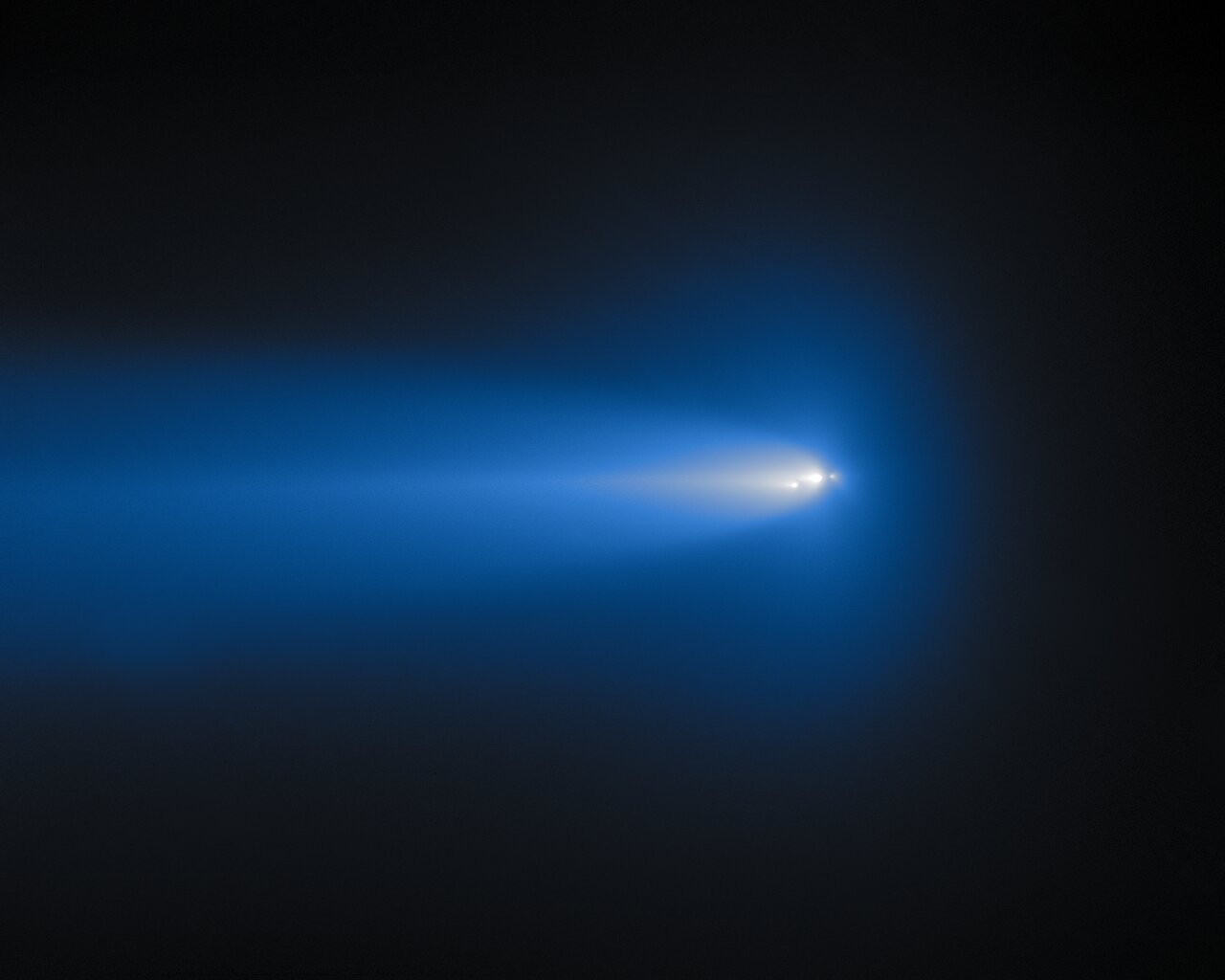
On 11 November and 6 December 2025, the Comet C/2025 K1 (ATLAS) soared in the skies above Maunakea, Hawai‘i, where Gemini North captured it in action! Gemini North is one half of the International Gemini Observatory, supported in part by the U.S. National Science Foundation and operated by NSF NOIRLab.

Comet C/2025 K1 (ATLAS)’s nucleus started breaking apart as early as October 2025. Three of the suspected fragments are visible in this image. Each piece makes an exciting show as it fluctuates in brightness, density, and position from night to night. You can view images of this here.

C/2025 K1 (ATLAS) originated in the Oort cloud and surprisingly survived its closest approach to the Sun in October 2025. But now that it has experienced the intense heat and gravity of the Sun, it’s struggling to hold together, leading to the crumbling that we’re witnessing now. View the trajectory of C/2025 K1 (ATLAS) here.

Credit:
International Gemini Observatory/NOIRLab/NSF/AURA/B. Bolin
Image Processing: J. Miller & M. Rodriguez (International Gemini Observatory/NSF NOIRLab), T.A. Rector (University of Alaska Anchorage/NSF NOIRLab), M. Zamani (NSF NOIRLab)
Acknowledgments: PI: Bryce Bolin (Eureka Scientific)

Usage of NOIRLab Images and Vide
 
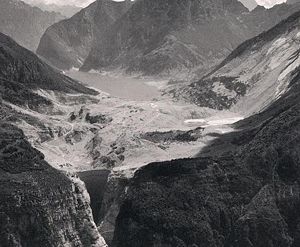
On the Pulse with Silki providing a closer look (+ alot commentary) on the Niscemi Landslide, Sicily, Italy. In her latest video (not attached) she covers more on the nature of rotational landslide believed to be taking place at Niscemi.

Much bigger than the flyover, and there are things missing from this:
1769755250086.png


Interesting commentary here where the above came from:

 
Much bigger than the flyover, and there are things missing from this:
View attachment 115602

Interesting commentary here where the above came from:

Here is a comparison of what Niscemi looked like before the landslide disaster:


However, today I heard this news from the head of Italian civil protection, which turned my stomach a little. 🤮

Let me explain, as a geologist, I can agree with him, but as head of civil protection, no lives were lost in the Niscemi landslide.
Only this is estimated:

Approximate estimate of the percentage lost

The area directly affected by the landslide (area of detachment, sliding, and visible collapse) appears to be limited to a strip of the slope (not the entire municipal territory), probably in the order of a few km² (perhaps 2-5 km² as the area of greatest impact, considering the 4 km long front and an average width of 500-1, 000 m estimated from descriptions and aerial images).
Compared to the total 96.5 km² of the municipality, this corresponds to approximately 1% to 5% lost/destroyed or severely compromised (with more conservative estimates around 2-3%).

In contrast, in the Vajont dam tragedy of 1963, approximately 2000 people lost their lives and an entire village disappeared.

This is an animation of the disaster:
 
More images from the sky coming from last week's storm.


THIS RED ARC IS NOT AN AURORA: During last week's severe geomagnetic storm, red auroras danced across the skies of Europe. This red arc, however, was not one of them:

Andreas-Graw-sa4_1127534_1769036352_strip.jpg


"This is an SAR arc," says Andreas Graw, who photographed the phenomenon on Jan. 20th from Lower Saxony, Germany.

SAR arcs were discovered in 1956 at the beginning of the Space Age. Researchers didn’t know what they were and unwittingly gave them a misleading name: "Stable Auroral Red arcs" or SAR arcs. In fact, SAR arcs are neither stable nor auroras.​

Auroras appear when charged particles rain down from space, hitting the atmosphere and causing it to glow. SAR arcs form differently. They come from Earth's ring current system.

662614main_inner-mag-MOS_full.webp


Earth is surrounded by a donut-shaped circuit carrying millions of amps around our planet. Think Saturn's rings--except made of electricity. During geomagnetic storms, heat from the ring current leaks into the upper atmosphere and causes it to glow.

Heat from the ring current leaking into the upper atmosphere.
 
In contrast, in the Vajont dam tragedy of 1963, approximately 2000 people lost their lives and an entire village disappeared.

Yeah, rock and soil have their own structural porous worlds of weakness. In the Rockies, Purcell's and elsewhere, the historical (and not so historical) types of mass wasting have been vast, while things have been relatively stable, it show all kinds of signs.

Unlike the Vajont dam event, it is not so different than Frank Slide, with the exception of impacting a dam and the amount of people killed. Over in the Purcell's, was around for the 1997 East Gate Landslide and a few others - there are actually so many (slides, slumps etc.) of various sizes, yet generally, there are no people living in the areas and certainly not within the angle of repose (such a big possible future risks building towns within that angle - or on the edge of an escarpment, or heck, at the bottom of where a glacier and its created debris runs down an avalanche path (see town of Blatten).

East Gate (the photo dose not give justice to the real steepness)

1769834309448.png


There was also the 1958 Lituya Bay earthquake induced head scarp slip in the Alaska fjord.

 
Here is key points from Stefan Burns’ Live Stream of January 26th, 2024. Although he tend to be a drama queen, he always correlate interesting points. The main point I'm taking away is that a lot of events are converging to the Earth and so we have global weather volatility, not just cooling or heating.

To know: the BZ component refers specifically to the north-south direction of this magnetic field:
  • Positive BZ: The IMF points away from Earth, i.e., in a northerly direction.
  • Negative BZ: The IMF points toward Earth, i.e., in a southerly direction.
nT = nanoTesla, a unit of magnetic field strength. A value of 60 nT (nanotesla) is relatively strong for the BZ component. It indicates that the solar wind's magnetic field has a significant northward orientation.

🌍

  • A strong positive BZ component (60 nT) was observed in a recent solar storm, stronger than the G5 "Mother's Day" storm of May 2024.
  • The positive field caused longer-term geomagnetic effects rather than immediate massive plasma injection.
  • This led to strong Birkeland currents, affecting Earth’s magnetic and atmospheric systems.

    Birkeland currents

🌠

  • A giant radio flare from Signis X3 (a quasar) occurred between December 13–19, 2024.
  • Planetary alignments in early January triggered solar activity and sunspot growth on January 8th.
  • An interstellar comet (C/2024 E1) passed through the inner solar system at perihelion during this period.

🌋

  • Unusual earthquake patterns have emerged, with high-magnitude quakes (5–6) occurring in a short span.
  • A magnitude 8.8 mega quake occurred near Kamchatka on July 29, 2024, linked to planetary alignments involving Saturn, Neptune, Mars.
  • Volcanic activity has increased globally, especially in the Kamchatka Peninsula.

🌡️

  • Extreme weather patterns are emerging: record snowfall in East Asia and disruptions to the polar vortex.
  • The Earth is experiencing global weather volatility, not just warming or cooling.

🪐

  • A conjunction between Saturn and Neptune on February 20, 2025, is being closely watched for its potential to trigger major global events.
  • Past alignments (e.g., July 2024) were linked to geopolitical shifts, economic volatility, and natural disasters.

💰

  • Precious metals like gold and silver are experiencing extreme price swings, possibly influenced by the Saturn/Neptune conjunction.
  • Historical patterns suggest such alignments correlate with major global events (e.g., fall of the Berlin Wall).

🧠

  • Schumann resonances were affected during the Signis X3 flare and are biologically relevant, overlapping with human brainwave frequencies.
  • This suggests a potential influence on human consciousness and perception.

🌌

  • Interstellar object ‘Oumuamua (3I/Atlas) is passing near Jupiter in March 2025. Its trajectory may have long-term cosmic significance.
  • The comet C/2024 E1 and ‘Oumuamua are both part of a broader energetic alignment.

🧘‍♂️

  • The speaker had vivid dreams during the solar storm, including one involving Donald Trump. The dream was Donald Trump as an aid during a sudden street collapse caused by a discharge of collective energy from America. These were interpreted as symbolic of collective energy discharges.
  • Dreams may reflect subconscious processing of cosmic and planetary energies.

📈

  • While the speaker provides forecasts based on patterns (e.g., earthquake likelihood in NorCal), they emphasize that these are not guarantees and should be taken as probabilities.
  • The Earth is currently undergoing an energetic buildup with increasing volatility across natural, economic, and geopolitical systems.
 
Last edited:
Although he tend to be a drama queen, he always correlate interesting points.
He has a tendency to dramatize other's people material for the clicks and awe factor, making him a source to be wary of. Just keep in mind that he might have some pattern recognition run amok in him.

  • A strong positive BZ component (60 nT) was observed in a recent solar storm, stronger than the G5 "Mother's Day" storm of May 2024.
  • The positive field caused longer-term geomagnetic effects rather than immediate massive plasma injection.
  • This led to strong Birkeland currents, affecting Earth’s magnetic and atmospheric systems.

He hasn't told anything insightful here, it doesn't explain anything at all. It's just a description, with the second point being practically BS. Just nomenclature that makes people go "oh" and tells nothing of the processes involved. He doesn't seem to have the ideas clear in his head. To be fair, that is what most of them do.

You'll find far more honesty in the Russian Laboratory of Solar Astronomy as opposed to this guy. The former isn't hystericized like people in the West. So they genuinely admit the anomalies more willingly as opposed to anybody in the West. They even seem more genuinely happy that the U.S. is going to the moon than the Americans themselves.

If you think about it, it's the Cs that have quite the track record. What could explain all the factors of the storm? The X flare was a minor one by this sun cycle's standard. It's a weaker magnetic shield that could explain the phenomenon observed though, including blue auroras in the Northern Hemisphere and purple auroras in the South Atlantic Anomaly, which by scientific observations thus far, should not have auroras during a geomagnetic storm.

I think it is a good timing to review BZ and auroras, though. Good point! He's worth for increasing awareness into these subjects 🙏


The solar wind has embedded up-down magnetic field direction called Bz. Tracking the Bz direction is one of the most important and useful tool for aurora chasers. A negative Bz value of south (minus) is like an "on" switch for the aurora, while a Bz of positive (north) is like an "off" switch). Generally speaking, the lower the Bz, the better.

When the Interplanetary Magnetic Field (IMF), essentially the magnetic field of the solar wind itself, points south, conditions are favourable to connect Earth’s magnetosphere, with the solar wind and inject charged particle into the upper atmosphere. When the IMF points south it has a negative Bz and when it points north a positive Bz.

Earth's magnetic field naturally points north and since opposites attract, we want an incoming stream of charged solar particles to have a south pointing magnetic field. North-north coupling will repel and deflect the solar wind away from Earth.

When the Bz points south, a crack opens up in Earth’s magnetic field. This happens on the daytime side of the Earth, where the magnetopause connects with the incoming solar wind. The field lines then reconnect on the nightside, in the magnetotail where the particles are then accelerated along the field lines towards the polar regions to cause aurora. This phenomena is called the Dungey cycle and happens when Bz is south. The video below shows the process.


The Interplanetary Magnetic Field data published here on Iceland at Night comes from the DSCOVR satellite, located 1.5 million km from Earth, between the Earth and the Sun. This satellite senses incoming solar wind 15 to 60 minutes before a blizzard of charged particles rains over Earth. It’s like a buoy at sea that warns of an oncoming tsunami, as NASA writes.

And that's the caveat: When you see the Bz suddenly turn south, you’ll need to wait from 15 to 60 minutes or so for the Northern Lights to appear in the sky.

In Iceland, under the aurora oval, a Bz strength of –1 to –5 is fine and good Northern Lights are very likely to appear in the sky. When the direction drops below –5 or even –10 or lower and stays there for an hour or more, beautiful Northern Lights dance in the sky. If it plunges below –20, an unforgettable evening of worldwide aurora displays ensues, like happened on October 10-11, 2024.

So when you are outside, focus on Bz and skip the almost completely useless Kp-index.

Faster solar wind expands the aurora oval and moves it further south. Higher density leads to more colourful displays.


The magnetic field of our Sun doesn’t stay around the Sun itself. The solar wind carries it through the Solar System until it reaches the heliopause. The heliopause is the place where the solar wind comes to a stop and where it collides with the interstellar medium. Because the Sun turns around her axis (once in about 25 days) the interplanetary magnetic field has a spiral shape which is called the Parker Spiral.

Bt value​

The Bt value of the interplanetary magnetic field indicates the total strength of the interplanetary magnetic field. It is a combined measure of the magnetic field strength in the north-south, east-west, and towards-Sun vs. away-from-Sun directions. The higher this value, the better it is for enhanced geomagnetic conditions. We speak of a moderately strong total interplanetary magnetic field when the Bt exceeds 10nT. Strong values start at 20nT and we speak of a very strong total interplanetary magnetic field when values exceed 30nT. The units are in nano-Tesla (nT) — named after Nikola Tesla, the famous physicist, engineer and inventor.

Bx, By and Bz

The interplanetary magnetic field is a vector quantity with a three axis component, two of which (Bx and By) are orientated parallel to the ecliptic. The Bx and By components are not important for auroral activity and are therefor not featured on our website. The third component, the Bz value is perpendicular to the ecliptic and is created by waves and other disturbances in the solar wind.

BxByBz.gif


Interaction with Earth’s magnetosphere​

The north-south direction of the interplanetary magnetic field (Bz) is the most important ingredient for auroral activity. When the north-south direction (Bz) of the the interplanetary magnetic field is orientated southward, it will connect with Earth’s magnetosphere which points northward. Think of the ordinary bar magnets that you have at home. Two opposite poles attract each other! A (strong) southward Bz can create havoc with Earth’s magnetic field, disrupting the magnetosphere and allowing particles to rain down into our atmosphere along Earth’s magnetic field lines. When these particles collide with the oxygen and nitrogen atoms that make up our atmosphere, it causes them to glow and emit light which we see as aurora.

For a geomagnetic storm to develop it is vital that the direction of the interplanetary magnetic field (Bz) turns southward. Continues values of -10nT and lower are good indicators that a geomagnetic storm could develop but the lower this value goes the better it is for auroral activity. Only during extreme events with high solar wind speeds it is possible for a geomagnetic storm (Kp5 or higher) to develop with a northward Bz.

magnetosphere.jpg

A schematic diagram showing the interaction between the IMF with a southward Bz and Earth’s magnetosphere.

It is important to note that we still cannot predict (accurately and consistently) the Bz(t) i.e. the strength, orientation and duration of the north-south interplanetary magnetic field component Bz of an incoming solar wind structure. We do not know what the solar wind and magnetic field characteristics are until it arrives at the Sun-Earth Lagrange Point 1 (fixed point in space between the Earth and the Sun about 1.5 million kilometers away from the Earth) where satellites measure the properties of the incoming solar wind. We are going to learn more about this in the next paragraph.

Measuring the interplanetary magnetic field​

The real-time solar wind and interplanetary magnetic field data that you can find on this website come from the Deep Space Climate Observatory (DSCOVR) satellite which is stationed in an orbit around the Sun-Earth Lagrange Point 1. This is a point in space which is always located between the Sun and Earth where the gravity of the Sun and Earth have an equal pull on satellites meaning they can remain in a stable orbit around this point. This point is ideal for solar missions like DSCOVR, as this gives DSCOVR the opportunity to measure the parameters of the solar wind and the interplanetary magnetic field before it arrives at Earth. This gives us a 15 to 60 minute warning time (depending on the solar wind speed) as to what kind of solar wind structures are on their way to Earth.

The Deep Space Climate Observatory (DSCOVR) mission is now the primary source for real-time solar wind and interplanetary magnetic field data but there is one more satellite at the Sun-Earth L1 point that measures the incoming solar wind and and that is the Advanced Composition Explorer. This satellite used to be the primary real-time space weather data source up until July 2016 when DSCOVR become fully operational. The Advanced Composition Explorer (ACE) satellite is still collecting data and now operates mostly as a backup to DSCOVR.

To give an idea of how unreliable DSCOVR is, these reports are relevant:

November 12, 2025

Unfortunately, spacecraft operating near the Earth and measuring the parameters of the solar wind have been transmitting strongly distorted values for the last few hours (Солнечный ветер 12 ноября 2025 года ). For an unknown reason, NOAA has replaced the main device for measuring ACE solar wind parameters with a backup DSCOVR, which is very unstable and currently producing many failures. From the incoming "broken" data, one can only understand that exceptionally high plasma density and temperature are recorded in the vicinity of the Earth, exceeding the usual ten times, as well as very high values of magnetic field induction, which are at the level of historical peaks.
As noted earlier, NOAA, for unknown reasons, stopped transmitting data from the ACE spacecraft located at the same location a few hours ago and designed to directly measure the parameters of the solar wind. At the same time, there were also no failures or failures of the device. Currently, the measurements, although in a very distorted form (Солнечный ветер актуальные данные ), come from the DSCOVR backup device.
Information is being received from orbit about the parameters of the interplanetary magnetic field close to historical records against the background of very low solar wind speeds. In general, this combination of parameters looks so unusual that there are even doubts about its reliability. The current magnetic storm is developing unevenly. Moderately perturbed periods alternate with impulsive bursts. The forecast of the development of a magnetic storm formed the day before by world centers has already been completely refuted from the very beginning of the event, and now the situation is being monitored simply by the fact. The G5 level has not yet been reached, but with the observed values of the interplanetary magnetic field of about 50 Nt, the Earth's magnetosphere can reach it now at any moment.

December 25th, 2025

The world's main spacecraft, which has served as the main source of information in recent years, DSCOVR, failed as a result of a software glitch back in July of this year (Лаборатория солнечной астрономии (XRAS) ). During this time, there were several attempts to get it back to work, but in all cases, broken information came from the board, and it was turned off. For the last six months, the ACE spacecraft, launched back in 1997 and located, like DSCOVR, at the L1 Lagrange point 1.5 million km from Earth, has been used as a backup source. At this distance, there is no influence of the Earth's magnetosphere, and the instruments are able to measure the solar wind without distortion caused by the Earth's magnetic field. It is clear that the 28-year-old device is making the most of itself, but miracles do not happen. In the last couple of months, the situation has become quite sad: up to 50% of information is lost per day.

Strictly speaking, there is another satellite at point L1 capable of measuring the parameters of the solar wind— Wind, but it was launched even earlier than ACE, in 1994. In addition, it is formally scientific (it belongs to the competence of NASA, not NOAA), and the legal possibilities for its use for monitoring space weather are not fully understood. The technical condition of Wind is also not completely clear.
As far as can be understood, currently NOAA's main "bet" is the SWFO-L1 spacecraft, which was launched on September 24 this year and is equipped with new instruments for measuring solar wind parameters, as well as the new CCOR solar coronagraph. The latter may be able to replace the LASCO coronagraph, which has also been in space for more than 30 years. Currently, SWFO-L1 is on the flight path to the L1 point, where it is scheduled to arrive in January 2026, that is, within a month. If the spacecraft successfully reaches a given orbit and the equipment is successfully tested, new data should begin to arrive in mid-2026, but given the situation, it is hoped that NOAA will turn on the satellite earlier, in the spring. In particular, in early December, NOAA began to turn on and check some instruments in advance at the flight stage, and on December 11 it even published the first test data from the magnetometer (NOAA Shares First Space Weather Data from SWFO-L1’s Magnetometer ). From this alone, it can be seen that the schedule for testing the SWFO-L1 and its commissioning will try to shift to the left as much as possible.

You may notice that after the satellite starts operating, its current nondescript working name will be replaced with a much more beautiful one: SOLAR-1. If everything goes well, then from the middle of next year it will become familiar to everyone who monitors space weather.

So all is not well in space weather monitoring. There's withholding of data among other things. That will have to be kept in mind.
 
Back
Top Bottom