
Benjamin
The Living Force
A few inches in height, and also one has the full backing of the CBC.
Heh. Only because they're paid to. Mercenary influencers. And those two should get a room.

A few inches in height, and also one has the full backing of the CBC.
... at the Trump International Hotel and Tower: Toronto. Discounts.And those two should get a room.
...the next election is scheduled for October 18, 2027. However, the Election Act is subject to the powers of the lieutenant governor of Alberta to dissolve the legislature before that time, in accordance with the usual conventions of the Westminster parliamentary system.


 www.lapresse.ca

What Bills C-8 and C-9 mean for your freedom of expression
A panel discussion held by the Free Speech Union of Canada (FSU) on November 4, 2025, with FSU directors Prof. Bruce Pardy, Lisa Bildy, and Hannah Park Roche.
On the table: Bill C-9 and its potential to create a “thought police” scenario, where citizens mired in a legal minefield run the risk of severe consequences for what used to be considered civil liberties and the fabric of Canadian democracy. At stake is our freedom to think, say, and believe as we choose—yes, even the right to hate.
Also on the table: Bill C-8, which would grant the government sweeping powers to cut off telecommunications services to individuals deemed a “threat” without the need for any criminal offense. We only need consider the Freedom Convoy protests in Ottawa to fathom the possibilities of how this legislation could be weaponized.
The primary focus concerns Bill C-9 and its capacity to unleash a chilling wave of censorship that criminalizes emotions rather than actions. Prof. Pardy warns this could pave the way for a two-tier justice system, where individuals are prosecuted not for their deeds but for their thoughts, echoing the oppressive tactics of authoritarian regimes. He provides the following example of the strange(r) land we may soon live in:
“Let’s say you have somebody committing an assault. They commit it for hate. They commit it for greed. They commit it because they don’t care. Which of those two? Which of those three things is worse? If you assault somebody randomly on the street because you’re a psychopath and don’t care, is that better or worse than if you attack somebody because you hate them? For my money, that’s irrelevant. The crime is in the violence.”
That logic is absent in the context of Bills C-8 and C-9, which lack the legal certainty critical to the rule of law; this erosion of certainty is already long evident in Canada and would be further jeopardized by these proposed legislations. Canada need only look to the U.K. for what’s in store: arrests daily for merely offensive comments and a place on the register for “non-crime hate incidents” ...
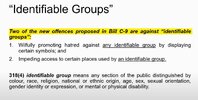
Follow the discussion as the panel examines the ramifications of these bills on debate, unpopular opinion, faith, symbols, identifiable groups, protest actions, and (so much) more.





Adam Pankratz: B.C.'s reconciliation nightmare gets even worse
Court rules all province's laws must be interpreted through UNDRIP
By Adam Pankratz
Published Dec 09, 2025
National Post
It has been clear for some months now that David Eby and the B.C. NDP’s approach to Indigenous reconciliation would have ruinous consequences for British Columbia’s economy. Last Friday, the situation got even worse, as a new court ruling poured more cold water on economic activity in the province and opened the door to every B.C. law being subject to interpretation through a United Nations human rights document. The implications for British Columbia could not be much more dire.
On Friday, the B.C. Court of Appeal ruled in favour of the Gitxaala and Ehattesaht First Nations that B.C.’s Declaration on the Rights of Indigenous Peoples Act (DRIPA) — which seeks to align the laws of British Columbia with the United Nations Declaration on the Rights of Indigenous Peoples (UNDRIP) — did in fact affirm UNDRIP as “the interpretive lens through which B.C. laws must be viewed and the minimum standards against which they should be measured.” That is to say that all B.C. laws, even if they have not yet been changed, are immediately subject to interpretation through UNDRIP, when the NDP government had explicitly said that DRIPA was not designed to strike down existing B.C. laws.
A key paragraph in the ruling should raise the alarm for any business considering investing in British Columbia. Paragraph 181 lays out Justice Gail Dickson’s view as to where there could be future potential for dispute arising from DRIPA and the current law of British Columbia. The ruling foresees five areas that are so broad that the court is opening up any and all B.C. laws to interpretation through UNDRIP.
The ruling states areas for dispute could be: “i) whether there is an inconsistency between a British Columbia law and UNDRIP (as in this case); ii) whether the type of inconsistency in issue must be addressed by the Crown taking measures; iii) what measures should be taken; iv) the adequacy of the consultation process; or v) the meaning or extent of ‘cooperation.’”
The ruling then continues to say that the above areas would be “justiciable,” meaning they could be litigated in court. To quote the ruling: “In every instance, justiciability concerns may arise, and, if they do, the court will need to determine whether, given the nature of the dispute, including the relevant articles of UNDRIP, the matter is justiciable.”
Taking a step back, it seems almost impossible to think of any area of the B.C. economy (or indeed any area of B.C. life) which would not potentially be touched by one of those future areas of dispute, and thus open the path for a court to force the UNDRIP doctrine onto every aspect of life in British Columbia.
The significance of the ruling cannot be overstated, given that the court has deemed that UNDRIP must be the “interpretive lens” through which all B.C. laws are viewed. Two articles in particular from the UN document are informative of what that means.
Article 26 states “Indigenous peoples have the right to own, use, develop and control the lands, territories and resources that they possess by reason of traditional ownership or other traditional occupation or use.” That means: you claim it, you own it. So is there no Crown land in B.C. now? Do parks exist for the public or are they First Nations property?
Article 32.2 of UNDRIP states that a country must “consult and cooperate in good faith with the indigenous peoples concerned through their own representative institutions in order to obtain their free and informed consent prior to the approval of any project affecting their lands or territories and other resources, particularly in connection with the development, utilization or exploitation of mineral, water or other resources.”
“Informed consent” could mean a First Nations veto over resource projects or future economic development and at a minimum the ruling opens up all B.C. laws and programs to endless challenges for not being consistent with UNDRIP. Education, health care, the list needn’t just include resource projects or infrastructure as UNDRIP is a wide and all encompassing document.
Premier Eby has said he’s concerned about the court’s recent ruling and interpretation of the law, suggesting the government may amend DRIPA to ensure the legislature, not the courts, remain in control of how UNDRIP is implemented in the province. No one should believe him or his government, though. Since taking power Eby’s tenure has been marked by secrecy and duplicity on any issue involving B.C.’s First Nations. Whether hiding land use deals or failing to protect private property rights, Eby’s NDP has zero credibility left on this file.
Following the court ruling last Friday, more bad economic news is now a certainty, as businesses look at British Columbia as a province no longer ruled and governed by its own laws, but rather the esoteric imaginings of a United Nations human rights committee.
Adam Pankratz is a lecturer at the University of British Columbia’s Sauder School of Business.


Apparently there was a recent push in Alberta to have a referendum on whether they should be independent from Canada. Predictibly, this idea is first being "nixxed" in the courts and then, if it actually goes ahead, will get "nixxed" at the ballot box. (Just like the Scottish one was). You know you can't let the citizens actually have any POWER or control over their lives or their country. Those in charge, just have to "pretend" that they will be given a choice. Citizens are not really free, they're just slaves or servants whom the government pretends are "free". What a mess. So too in Australia. Everything that country was built on is a lie. A lie to support the Elites.


The bank will be owned by its member nations, which would capitalize the bank so it would get a triple-A rating it could take to the bond market to raise money.
The theory is the bank would allow Canada and other countries to re-arm in the face of Russian and Chinese aggression.
“This multi-national bank would provide financing and guarantees (to countries that) are increasing their defence spending up to five per cent of GDP,” Bethlenfalvy said.

The great military generals have always loved wars, and above all, they love seeing their precious cannon fodder perish. The more deaths there are in battles (which they program in their cellars, for they are monsters, and they live in cellars, even if they smoke cigars or drink whiskey, and live in palaces and give fine speeches to incite people to defend the Fatherland), the happier they are. Battles where 300,000 soldiers die? They are happy and applaud; it allows them to sleep soundly at night, in peace. They do a good job at Mephisto's command. The problem with humans is that they have lost common sense since the beginning of time, and they ignore the wisdom of experience. Other wars have instilled nothing in their brains. It's a whole plan that repeats itself ad nauseam. It's a morbid play that unfolds endlessly, in a vicious cycle. It's propaganda, which works through social engineering.I remember having a conversation with my mother about 3 months ago, stating that they would eventually start offering cash bonus's for Canada's youth to join the army, and they would be willing to do so because none of them can get jobs. It's all so unbelievably predictable at this point.
>Flood the country with immigrants
>Give immigrants all the entry level positions with corporate DEI BS
>Start a war against Russia with NATO/EU
>Offer exorbitant bonus's and incentives to desperate young people
>Send the desperate young people off to die
NATO just stated that basically if they don't get enough recruits, they would be forced to start forcing people in to war, for everyone to prepare for war with Russia.. its all so convenient isn't it. I would bet that they are also going to increase the conscription age to something much higher than it is as well.
Its pure f*cking evil.

Unconfirmed settlement before 1891
Minority opinions among historians of Ukrainians in Canada surround theories that a small number of Ukrainians settled in Canada before 1891. Most controversial is the claim that Ukrainians may have been infantrymen alongside Poles in the Swiss French “De Watteville's Regiment” who fought for the British on the Niagara Peninsula during the War of 1812 – it has been theorized that Ukrainians were among those soldiers who decided to stay in Upper Canada (southern Ontario). Other Ukrainians supposedly arrived as part of other immigrant groups; it has been claimed that individual Ukrainian families may have settled in southern Manitoba in the mid- to late 1870s alongside block settlements of Mennonites and other Germans from the Russian Empire. "Galicians" are noted as being among the miners of the British Columbia gold rushes and figure prominently in some towns in that new province's first census in 1871 (these may have been Poles and Belarusians as well as Ukrainians). Because there is so little definitive documentary evidence of individual Ukrainians among these three groups, they are not generally regarded as among the first Ukrainians in Canada.
First wave: Settlers, 1891–1914
Post-independence Ukrainian fifteen-kopiyka stamp commemorating the centennial of Ukrainian settlement in Canada, 1891–1991
See also: Post-Confederation Canada (1867–1914) § Immigration to the West, and Block settlement § Ukrainian
Further information: Dominion Lands Act and Dominion Land Survey
During the nineteenth century the territory inhabited by Ukrainians in Europe was divided between the Austro-Hungarian and Russian empires. The Austrian crownlands of Galicia and Bukovina were home to many Ukrainian speakers. Austrian Galicia was one of the poorest and most overpopulated regions in Europe, and had experienced a series of blights and famines. Emigration on a large scale from Galicia to the Balkans (the north-south border region of Croatia and Bosnia) and even to Brazil was already underway by 1891.
The first wave of Ukrainian immigration to Canada began with Iwan (Ivan) Pylypow and Wasyl Eleniak, who arrived in 1891, and brought several families to settle in 1892. Pylypow helped found the Edna-Star Settlement east of Edmonton, the first and largest Ukrainian block settlement. However, it is Dr Josef Oleskow, along with Cyril Genik, who are considered responsible for the large Ukrainian Canadian population through their promotion of Canada as a destination for immigrants from western (Austrian-ruled) Ukraine in the late 1890s. Ukrainians from Central Ukraine, which was ruled by the Russian monarchy, also came to Canada – but in smaller numbers than those from Galicia and Bukovina. Approximately 170,000 Ukrainians from the Austro-Hungarian Empire arrived in Canada from September 1891 to August 1914.
Clifford Sifton, Canada's Minister of the Interior from 1896 to 1905, also encouraged Ukrainians from Austria-Hungary to immigrate to Canada since he wanted new agricultural immigrants to populate Canada's prairies. After retirement, Sifton defended the new Ukrainian and East European immigrants to Canada – who were not from the United Kingdom, the United States, Scandinavia, Iceland, France or Germany – by stating:
I think that a stalwart peasant in a sheepskin coat, born to the soil, whose forefathers have been farmers for ten generations, with a stout wife and a half-dozen children, is good quality.
Most Ukrainians who came to Canada from Galicia were Ukrainian Catholic and those from Bukovina were Ukrainian Orthodox. However, people of both churches faced a shortage of priests in Canada. The Ukrainian Catholic clergy came into conflict with the Roman Catholic hierarchy because they were not celibate and wanted a separate governing structure. At the time, the Russian Orthodox Church was the only Orthodox Christian church that operated in North America – because they had arrived first via Alaska, and traditionally Orthodox churches are territorially exclusive. However, Ukrainians in Canada were suspicious of being controlled from the Russia, first by the Tsarist government and later by the Soviets. Partially in response to this, the Ukrainian Orthodox Church of Canada was created as a wholly Ukrainian Canadian-controlled alternative. As well, the Ukrainian Catholic clergy were eventually given a separate structure from the Roman Church.
Most Ukrainian Canadians were anti-Soviet, yet a minor group of Ukrainians has since 1910 supported Canadian socialism and contributed to the formation of the Communist Party of Canada, and formed a significant bloc within that group. They were also active in other Marxist {wiki text says this is disputed - needs more discussion} organizations like the Ukrainian Labour Farmer Temple Association (ULFTA).

 canadianpatriot.org
Immigrants like Hunka were granted entry specifically because their collaborationist pasts made them useful in crushing left-wing organizing in Ukrainian Canadian communities. Collaborators assumed control of community organizations, some of which were transferred to them by the federal government, having seized them from socialist groups during the war. The process was often quite violent, with mob violence intimidating leftists, fascists serving as strikebreakers in mining towns, and a Ukrainian labor temple being attacked with a bomb during a concert. All of these actions were condoned by the Canadian state in the name of anti-communism.
Ukrainian Labor Temples and “Hall Socialism”
Contrary to the present existence of Ukrainian Nazi collaborator monuments in Canada, there was once a robust Ukrainian Canadian left. Organized around the Ukrainian Labour Farmer Temple Association (ULFTA), it played a pivotal role in various chapters of Canadian labor history, often adopting radical stances. The ULFTA operated hundreds of “labor temples” across the country that nurtured a political movement often called “hall socialism.” Labor temples hosted political rallies, contained lending libraries, published newspapers, supported Ukrainian immigrants, sponsored cultural activities, and provided a venue for collective socialization. In Winnipeg, Manitoba, the finest still-existing labor temple was completed in 1919, just in time to serve as the headquarters of the city’s general strike that same year.
Between the world wars, the Canadian government feared Ukrainian Canadian radicalism and its connections to communist agitation. Ukrainians were enormously overrepresented in the Communist Party of Canada, which even had a Ukrainian language section. The ULFTA was formally affiliated with the party and helped organize Winnipeg’s large Ukrainian Canadian working class to elect communists like Bill Kardash from the 1930s to the 1950s. In contrast, Ukrainian nationalists in Canada were marginal. They expressed admiration for Hitler and denounced communist politicians as the triumph of the “Bolshevik-Jewish clique.” In 1934, they published a Ukrainian edition of The Protocols of the Elders of Zion. …
By June 1947, displaced persons registered as ethnic Ukrainian totaled 106,549. Initially, the Canadian government showed limited interest in admitting more Ukrainians, reflecting a long-standing bias against non-Western European immigrants. Furthermore, Canadian law prohibited the acceptance of former combatants who had voluntarily served in the German armed forces. However, much of the screening was conducted by British major Denis Hills, a self-described fascist who instructed collaborators on how to avoid investigation. The British exonerated the Galicia Division and transferred many of them to Britain to fill labor shortages in agriculture.
The UCC lobbied the Canadian government to accept Ukrainian displaced persons and emphasized their anti-communist potential. Against the backdrop of a booming labor market in Canada, these Ukrainians were portrayed as disciplined workers opposed to any sort of union radicalism. They were positively characterized as capable of filling vacancies in mining and forestry, where they could break up left-wing Ukrainian Canadian organizations.
Starting in 1947, this lobbying began to yield results, especially as the British government pressured Canada to accept them. In 1950, the immigration ban on Ukrainians who served in the SS was lifted, thanks to UCC advocacy that claimed they were simply soldiers who had fought against communism.
Many Ukrainian Canadians and Jewish groups opposed the admission of Nazi collaborators. The Association of United Ukrainian Canadians (AUUC), created in 1946 as the successor to the ULFTA, lobbied against the move. While supporting the immigration of Ukrainian refugees to Canada, they argued for thorough screening of their wartime activities. They were largely ignored.
.
By January 1952, official figures indicated that twenty-six thousand Ukrainian displaced persons had been accepted. However, later historical research suggests that official figures undercounted, and that the actual number could have been as high as fifty thousand, with half originating from western Ukraine, the heartland of the nationalist movement. Approximately 3 percent were veterans of the 14th SS Division, about 1,500 people, although some sources cite figures as high as two thousand. Additionally, there were other nationalists who collaborated in less formal ways than joining the SS, but were still active participants in the Holocaust.
Canada’s admittance of Ukrainian collaborators after 1945 was not a failure to properly screen immigrants, but an intentional policy decision. Canada did not care what many of these people were accused of doing in eastern Europe. The primary consideration was their usefulness in domestic anti-communism.
Expunging the Reds
On October 8, 1950, a bomb went off during a concert at the Central Ukrainian Labor Temple on Bathurst Street in Toronto. Eleven people were injured, and the explosion leveled part of the building. Authorities offered a $1,500 reward for information, but no one was ever caught. The long-standing suspicion is that Ukrainian nationalists were responsible, as this attack aligned with a pattern of violence directed against the Ukrainian Canadian left during the 1950s. Ukrainian labor temples and the broader labor movement were central to the postwar struggle between Ukrainian fascist emigres and the Ukrainian Canadian Left.
Soon after arriving in Canada in the late 1940s, Ukrainian nationalist immigrants organized to target labor temples and disrupt meetings. In December 1948 in Val-d’or, Quebec {PM Brian Mulroney's home town} , a group of them attacked a temple hosting a speaker discussing the Soviet Union. Armed with sticks, stones, and bottles they invaded the event to attack the speaker but were repulsed and thrown out. Unable to kidnap the speaker, they split up into smaller groups to stake out the homes of suspected communists.
In the immediate postwar years, it became clear that an independent Ukraine was unlikely. Consequently, attacking leftists in the Ukrainian Canadian community became a sort of consolation prize. The Canadian state was to some extent pleased with this change of focus by the nationalists, and tacitly approved of such attacks.
Official anti-communist sentiment was coupled with the need for more workers in Canada’s booming postwar economy. Ukrainian displaced persons, as a condition for immigration, often entered into work contracts binding them to an employer, typically in resource extraction towns in the north of Ontario or Quebec. Mining company agents visited refugee camps in Europe, screening prospective employees for anti-communist beliefs, and then recruited them to relocate to Canada. They often arrived in places that had a preexisting Ukrainian Canadian left.
Initially the AUUC tried to organize the new immigrants, but this was ineffective. In December 1947, several dozen Ukrainian displaced persons took a train to Timmins, Ontario, to start work in a gold mine. Stopping in North Bay, Ontario (where Hunka currently resides), they were greeted by communist organizers at the station who sought to explain the importance of unionization. In response, the organizers were severely beaten and thrown off the train — an event celebrated by the local press.
Enduring Historical Revisionism
By the 1970s the nationalists had established domination over the Ukrainian Canadian experience. This framework excluded diverse points of view, such as labor radicalism, and replaced it with a monolithic identity built on a conservative nationalism. This era coincided with the fashioning of Canada’s official multiculturalism, in which both the federal and provincial governments aimed to celebrate diverse ethnic communities.
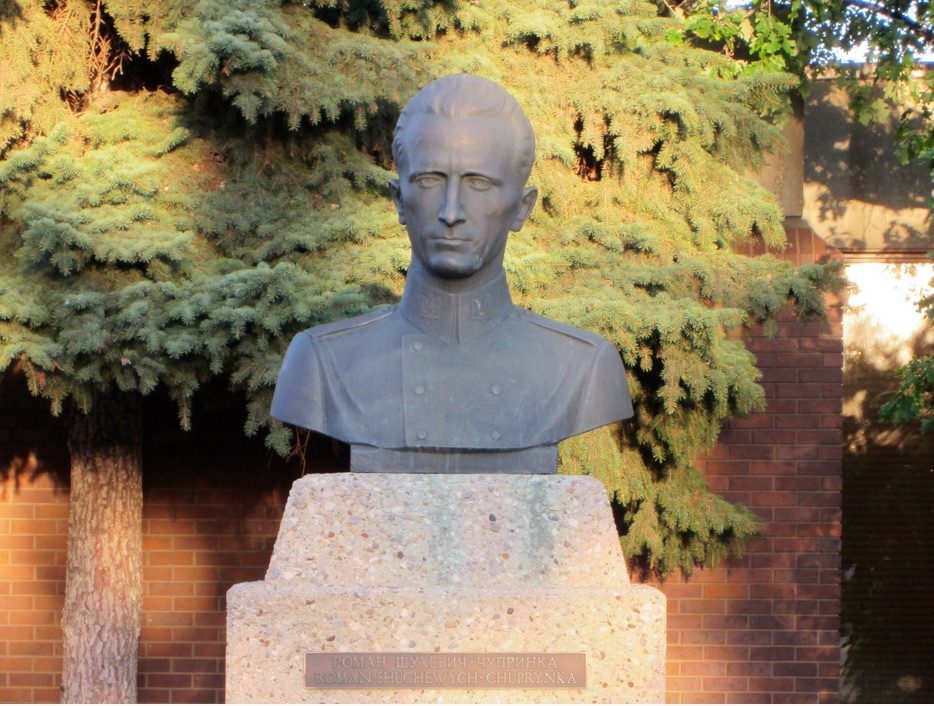
Under the fig leaf of celebrating ethnic heritage, statues of Ukrainian Nazi collaborators, such as Roman Shukhevych in Edmonton, began to be erected at this time, often with government money. Having extensively researched postwar violence in the Ukrainian Canadian community, the historian Kassandra Luciuk argues that this was a deliberate project of the Canadian state, intended to marginalize leftists. It left no room for other ideas of “Ukrainianness” other than one tightly wound with anti-communist nationalism.
The presence of Nazi monuments in Canada is symptomatic of this hegemony, visibly illustrating the historical revisionism the Ukrainian nationalists have successfully imposed. These monuments not only celebrate individuals and organizations that took part in war crimes during World War II, but also represent a triumph over left-wing opposition in the Ukrainian Canadian community. This historical revisionism has become so prevalent that even a mainstream politician, such as federal finance minister Chrystia Freeland, regularly extols her Ukrainian grandfather, who happened to run a Nazi collaborationist newspaper recruiting for the 14th SS Division — the same division that Hunka joined.
 www.sott.net
This revisionism owes its existence to the Canadian state, which used the many tools at its disposal — from the immigration system to the police — to ensure an outcome that has persisted well after its anti-communist purpose faded. Ukrainian Canadian nationalists of course have been active in constructing this revisionism, but they flatter themselves if they believe they could have accomplished it alone.
Understanding the political context of the Hunka affair requires delving into this chapter of Canadian history. It sheds light on how a small minority of far-right immigrants, with state backing, gained substantial influence in Ukrainian Canadian communities, and shaped Canadian policy toward Ukraine. Hunka’s celebration was not a result of historical ignorance, but rather stemmed from active historical revisionism that has sought to recast collaborators as heroes and render invisible Ukrainian Canadian socialist movements.
——
——
And this is how it came to be that the pro-Nazi Ukrainians in Canada have been organized and effectively represented while the others (the non-Nazi Ukrainians) were suppressed; and, above all, how it came to be the case that America’s armaments-manufacturers and their NATO have thrived while coup-after-coup and invasion-after-invasion have continued to expand the U.S. empire up till the present moment.


