From Tass
Rospotrebnadzor extended the quarantine in the Prokopyevsky boarding school in Kuzbass It will be valid until February 26
KEMEROVO, February 12. /TASS/. Quarantine in the Prokopyevsky boarding school has been extended until February 26 in connection with the detection of new cases of diseases. This was reported by TASS in the management of Rospotrebnadzor in the Kemerovo region.
The quarantine was introduced on January 24. Earlier, the department
reported that it will last approximately on February 12, but can be extended in case of detection of new diseases.
"Extended until February 26, 2026, in connection with the detection of new cases of diseases," the source said.
UNIAin the Parliament check reports about the poisoning of deputies
Preliminarily consider the version of the spread of rotavirus or other acute intestinal
infectionN.
Russia's high-speed electric train will feature an aerodynamic body shape.
Active work is underway to manufacture, test, and certify key components of the electric train, the High Speed Rail Info Center reported.
Video
MOSCOW, February 12. /TASS/. Russia's first high-speed electric train will feature an aerodynamic body shape with a minimal drag coefficient, the High-Speed Rail Info Center reported.
"The high-speed electric train will feature an aerodynamic body shape with a minimal drag coefficient, which will reduce noise levels and energy consumption," the statement said.
In addition, active work is underway to manufacture, test, and certify key components of the electric train. Forty-nine components have already been manufactured, including 12 that have successfully completed testing.
"The first line of the Moscow-St. Petersburg high-speed railway is planned to operate eight-car trains with four service classes and a total capacity of up to 460 passengers. The project also includes the possibility of operating in dual mode (8+8 cars)," the information center clarified.
About the project
The project to build the first high-speed railway in the Russian Federation, Moscow-St. Petersburg, is being implemented at the request of Russian President Vladimir Putin as part of the national project "Efficient Transport System."
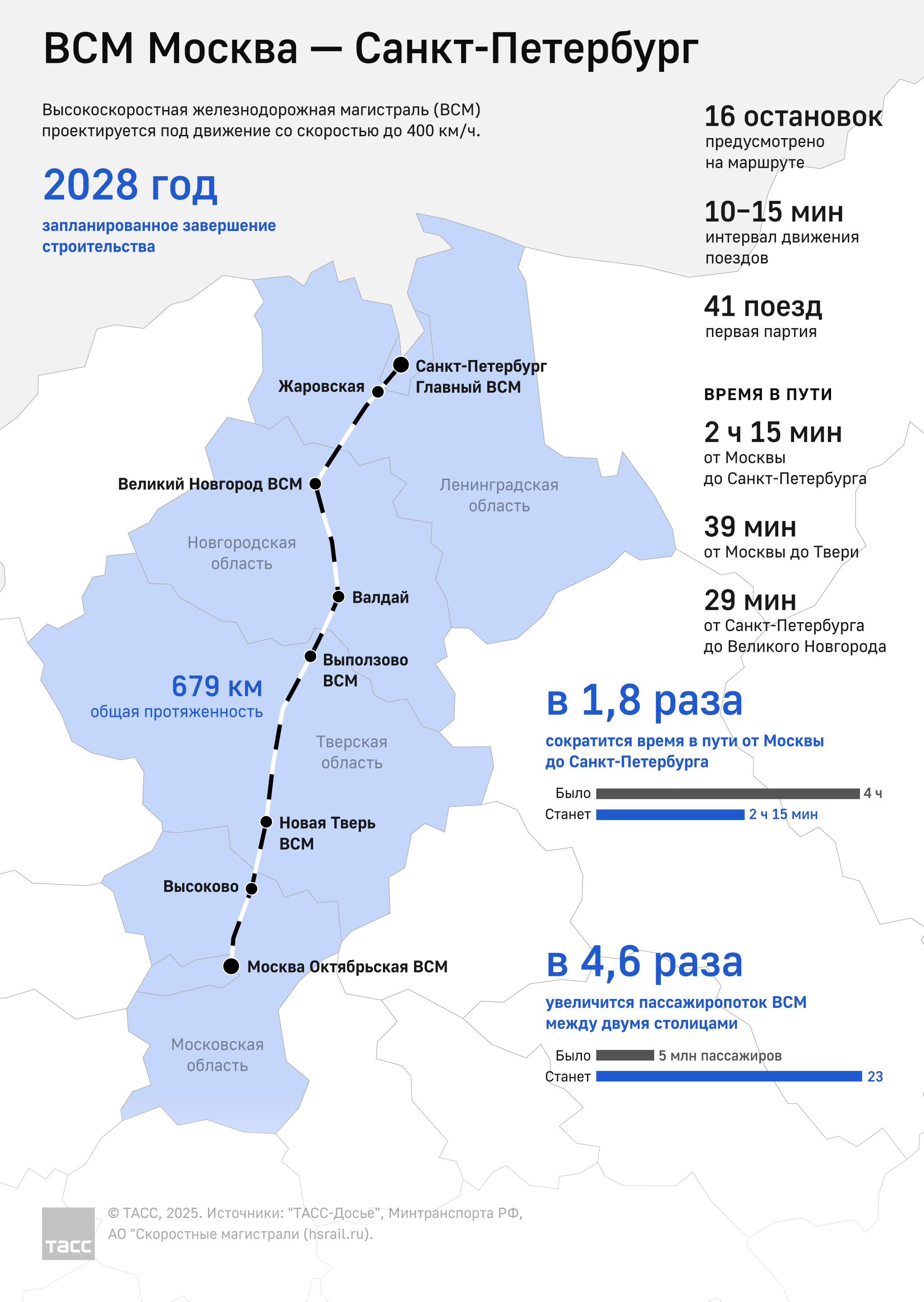
The approximately 700-kilometer railway will pass through six regions of the country, home to 30 million people. Annual passenger traffic between the cities is expected to increase to 23 million by 2030.
According to a Russian government decree, the design and construction of the Moscow-St. Petersburg high-speed highway is scheduled for 2024-2028, with commissioning scheduled for 2028.
#
Russia
Deputy Gorelkin stated that there are no plans to block Google in Russia.
The first deputy chairman of the State Duma Committee on Information Policy noted that he had specifically clarified this issue with the regulatory authorities.
MOSCOW, February 12. /TASS/. A possible Google block in Russia would have a wide range of negative consequences, but there are currently no such plans. This was stated by Anton Gorelkin, First Deputy Chairman of the State Duma Committee on Information Policy (United Russia).
This is how the deputy commented on the words of his committee colleague, Andrei Svintsov, who told the radio station "
Moscow Speaks " that blocking Google is technically feasible, but it is unlikely to be worth pursuing now.
"As for the loud announcements about blocking, there are actually no such plans: I specifically clarified this with the regulatory authorities," Gorelkin wrote in
Max . "Obviously, blocking will entail a whole host of negative effects—primarily problems with the functionality of the Android operating system (which affects 60% of all Russian smartphone users)."
The parliamentarian also noted that blocking Google is unlikely to force it to pay the existing fines levied against it by Russian companies. "Especially since this matter isn't over yet: lawsuits are ongoing in foreign jurisdictions, and legal mechanisms are being invoked. And even if the fine can't be collected in full, there remains a chance of reaching a settlement under some reasonable terms," he added.
According to Gorelkin, the phaseout of Google services should be gradual in any case. "I believe we need to create legislative conditions for a smooth transition to domestic solutions," the deputy concluded.
https://tass.ru/tag/rossiya
Andrey Belousov held a meeting at a command post of one of the Battlegroup South's units, listening to reports from commanders on the current situation in the area of responsibility and troop operations

tass.com
TASS has put together key facts about the defense minister’s inspection.
Meeting at a command post
- Belousov held a meeting at a command post of one of the Battlegroup South's units, listening to reports from commanders on the current situation in the area of responsibility and troop operations.
- Battlegroup Commander Lieutenant General Sergey Medvedev reported to the defense chief on the progress of offensive operations by the Battlegroup’s forces and the details of enemy actions.
- Belousov praised the effectiveness of the Battlegroup’s combat operations.
- The Russian defense chief handed state awards to the service members who had displayed bravery, courage and valor.
3D printing equipment
The deputy chief of the Battlegroup South’s Command of Unmanned Systems Forces reported that 3D printing equipment had been delivered to the Battlegroup South’s troops in fulfillment of the defense minister’s instruction to make parts for UAVs and provide for their maintenance and repairs.
Innovations demonstrated to the defense chief
- Belousov was informed that a new fixed-wing unmanned aerial vehicle was now available for relaying a radio signal and increasing the operational range of strike drones.
- The defense minister viewed a mobile system prototype developed by the Battlegroup South’s personnel and designed to provide the entire spectrum of advanced and secure communications.
- In addition, Belousov viewed deployable jammers of FPV drones designed to shield the routes of the movement of assault groups along with the routes for the delivery of supplies and ammunition.
- The Russian defense minister was also shown unmanned aerial vehicles and ground-based robotic platforms made by specialists of the Battlegroup South. These systems undergo constant upgrade and are outfitted with combat modules depending on the nature of assigned objectives.
This increase compared to November is due to a more significant increase in goods exports compared to imports, primarily due to seasonal factors, the regulator noted
tass.com
MOSCOW, February 12. /TASS/. Russia's foreign trade surplus for December 2025 decreased by $0.2 billion compared to the same period in 2024, reaching $10 billion, according to a preliminary estimate from the Central Bank.
Compared to the revised figure for November 2025, the surplus in foreign trade in goods increased by $3.3 billion, to $10 billion. This increase compared to November is due to a more significant increase in goods exports compared to imports, primarily due to seasonal factors, the regulator noted.
The deficit in the balance of services in December increased to $5.9 billion due to the traditional year-end surge in outbound tourism as well as an increase in imports of other services, including construction, telecommunications, computer, and information services, the regulator said.
The current account surplus in December 2025 amounted to $2.6 billion, compared to $1.9 billion in November 2025. The regulator attributed the change compared to November 2025 to an increase in the trade surplus.
The surplus in the balance of foreign trade in goods decreased to $116.7 billion from $132.1 billion in 2024, due to a decline in goods exports, primarily mineral products. Goods imports remained unchanged.
In 2025, the current account surplus decreased to $41.4 billion (2% of GDP) from $62.6 billion in 2024 (3% of GDP).
Russia’s Proton-M rocket with Elektro-L weather satellite launches from Baikonur spaceport
The weather satellite will be orbited in about six hours and 38 minutes at an altitude of 35,406 km
MOSCOW, February 12. /TASS/. A Proton-M carrier rocket with the Elektro-L No. 5 weather satellite has successfully lifted off from the Baikonur spaceport, Russia’s State Space Corporation Roscosmos said in a live broadcast.
The weather satellite will be orbited in about six hours and 38 minutes at an altitude of 35,406 km. Its working orbit will be located at an altitude of 35,786 km, it said.
Elektro-L weather satellites placed in a geostationary orbit help receive and process multispectral images of clouds and the underlying surface of the entire observable disk of Earth, obtain hydrometeorological data in orbit, perform the telecommunications functions of spreading and exchanging hydrometeorological and helio-geophysical data and relay signals from emergency radio beacons of the Cospas-Sarsat system.
And Lastly on This Day, February 12, 2026
If the company continues ignoring Russia’s demands, there will be no chance for the service’s return, Russian presidential press ecretary Dmitry Peskov said
tass.com
MOSCOW, February 12. /TASS/. WhatsApp (owned by Meta, which has been designated as extremist) will be unblocked in Russia if Meta complies with Russian laws and demonstrates readiness for dialogue, Russian presidential press ecretary Dmitry Peskov told TASS.
"This is a matter of compliance with Russian laws. If Meta complies, it will enter into dialogue with the Russian authorities, and then there will be an opportunity to reach an agreement," he said.
"This is a matter of compliance with Russian laws. If Meta complies, it will enter into dialogue with the Russian authorities, and then there will be an opportunity to reach an agreement," he said.
However, in his words, if the company continues ignoring Russia’s demands, there will be no chance for the service’s return. "If the corporation continues to cling to its uncompromising stance and, I would say, demonstrate absolute unwillingness to complies with Russian laws, then there will be no chances," he added.
Russia’s telecom watchdog confirmed to TASS that it is taking measures to slow down WhatsApp over violations of Russian laws. It claims that the messenger is used to organize and carry out terrorist activities in the country, and is also one of the main services used to defraud and extort money from citizens.


 ️ILLEGAL cattle culling — a real tragedy is taking place in the food supply chain
 Novosibirsk region, Siberia — my hometown


