Events in Russia

Not saying it is not true, but I will take this with a grain of salt, considering the user said himself he left Russia and is waiting for regime change.
That is fair; I focus less on the users inputs (which he delivers in a content creator manner) and more on the views of the local people in those affected regions.
 
Not so much in Russia, but against her. If there are any close connections to the current US administration or other money-hungry officials, the post would better fit in the Trump presidency thread, but that is yet to be found (or not).

The most comprehensive article by RBC.ru is behind paywall, the one quoted below was published by Izvestia.ru in English using Yandex translation.

On Friday, January 16, it became known that the American investment fund Noble Capital RSD filed a lawsuit in an American court against the Russian Federation in order to recover debts on bonds from tsarist Russia from the country. According to the plaintiffs, we are talking about the amount of $225.8 billion. For more information about the claim, its validity and reasons, see the Izvestia article.

The US lawsuit against Russia

On January 16, it became known about the lawsuit filed by the American investment fund Noble Capital RSD against Russia. It is reported that the organization wants to recover from the Russian Federation debts on bonds from the time of tsarist Russia. It is clarified that the lawsuit was filed in June last year in the U.S. District Court for the District of Columbia. In November 2025, the American court decided to respond to the application no later than January 29, 2026.

We are talking about an amount of $225.8 billion. The defendants are the Russian Federation, the Ministry of Finance of the Russian Federation, the Central Bank of the Russian Federation and the National Welfare Fund. According to the plaintiff, the funds can be withdrawn from the frozen assets of Russia.

Noble Capital RSD noted that in December 1991, Russia became the legal successor to the sovereign assets and sovereign debts of the Soviet Union, the Provisional Government and the Imperial Government of Russia.

At the same time, the lawsuit notes that the Russian Federation has repaid almost all sovereign bonds issued by the government of Imperial Russia to citizens of Great Britain and France, as well as almost all sovereign debts of the Soviet Union. Nevertheless, Russia has failed and continues to fail to repay the sovereign bonds issued by the Government of Imperial Russia to U.S. citizens.

Can the United States claim Russia's money​

Russia has already responded to the news about the lawsuit in the United States. Daniil Bessarabov, first deputy chairman of the State Duma Committee on State Construction and Legislation, noted in an interview with REN TV that Russian foreign exchange reserves haunt the West, so they want to get them under any pretext, including suing Moscow for debts from the time of tsarist Russia. He added that this has nothing to do with law and is regrettable because the judicial system is being used to legalize international raiding.

Vyacheslav Plahotniuc, Adviser to the Russian Academy of Natural Sciences, Doctor of Law at the National Research University of Higher School of Economics, Chairman of the Legal Affairs Committee of the International Congress of Industrialists and Entrepreneurs, questioned the prospect of a lawsuit in an interview with Izvestia.

"The issue of the so—called "royal debts", debts of the Provisional Government, loans and the property of American companies and citizens nationalized by the Soviet government has been settled and closed," the expert explains.

He recalls that in 1933, a number of agreements were concluded, including the so—called "Litvinov Assignment" (named after Maxim Litvinov, People's Commissar for Foreign Affairs of the USSR), according to which the Soviet government ceded assets and claims in the United States to the U.S. government on account of debts.

— The American financial authorities handled the settlement of the claims of private creditors. The right of the U.S. government to enter into such agreements and the obligation to recognize them is confirmed by a series of decisions of the U.S. Supreme Court. In addition, the statute of limitations has expired for all claims of private individuals and there is no prospect of its restoration," Vyacheslav Plahotniuc points out.

Vladimir Kozinets, President of the Association of Corporate Treasurers, noted that from the point of view of financial history, the issue of debt succession has always been extremely difficult, but in the case of Russia it has long been resolved.

— The Soviet Union officially renounced the obligations of Tsarist Russia, and this position was fundamental. In turn, modern Russia has almost completely paid off the debts of the USSR. From the point of view of financial logic, claims for royal debts today have no basis in fact," he explains.

Alexey Gavrishev, lawyer and managing partner of AVG Legal, added that legally this story looks like an attempt to "push" a private lawsuit through the window of politics and frozen reserves, and not as a realistic prospect of recovery. According to him, even if the plaintiff does have papers on imperial bonds in his hands, and he proves the chain of rights, everything rests on the fundamental barriers of American law — state immunity from jurisdiction and very narrow exceptions, under which royal debts usually do not fall.

— With a hypothetical victory in court, the next step is execution. It is even tougher: the property of a foreign state in the United States is protected from arrest or foreclosure, and the assets of the central bank and monetary authorities are in a particularly protected category," the expert explains.

Mikhail Khachaturian, PhD in Economics, Associate Professor of the Department of Strategic and Innovative Development at the Financial University, suggested that the United States could cling to the precedent of 1986, when Mikhail Gorbachev concluded an agreement with the United Kingdom to pay small holders of bonds of the Russian Empire at the rate of 10% of face value. As another example, the expert cites the 1997 agreement between Russia and France "On the final settlement of mutual financial and property claims that arose before May 9, 1945," according to which the Russian Federation paid $ 400 million. The money was paid in tranches of $50 million, the first of which took place in June of the same year, and the last on August 1, 2000.

— Obviously, these were one-time interstate agreements, the purpose of which was to improve bilateral political and economic relations. As for the United States, no such agreements have been concluded, and, consequently, the demands look groundless, since the Russian Federation has not officially recognized the entire mass of the state debt of the Russian Empire," explains Mikhail Khachaturian.

Why now, Russia's answer​

Alexey Gavrishev explains that in the United States, the royal debts have now been recalled due to the constant search for legal ways to get to Russia's sovereign assets in the face of sanctions and a political demand for money. He also explains that Russia has a chance to defend itself against actions in the United States — the Russian Federation can file petitions to dismiss or dismiss a lawsuit due to immunity (based on the Foreign Sovereign Immunities Act; FSIA), argue about jurisdiction, succession, the timing of claims, and other polls.

Russia's response in such cases, he explains, is tough procedural defense in the United States, parallel work to protect assets, and, if necessary, mirror measures in its jurisdiction against the assets or interests of unfriendly individuals.

Vladimir Kozinets also draws attention to the fact that what is happening lies outside the framework of financial law.

It is possible to consider this situation only from the point of view of a political background and nothing more than informational "noise". If American and European institutions take more decisive action, despite the obvious risks, then the reason will no longer be so important," he believes.

Mikhail Khachaturian emphasizes that the issue of tsarist debts and the possibility of using Russian assets frozen in the United States to repay them is another step in political and economic pressure on Russia in terms of accepting the unfavorable but much-desired deal on Ukraine for Trump in the form in which it exists now. Most likely, the lawsuit is another tool of pressure on Russia in a big trade, which periodically escalates around, he concludes.

Noble Capital is represented in this case by Kenneth Noble of Noble Law PLLC, described as a "leading Restructuring Lawyer" who represent[ed] domestic and foreign banks, financial institutions, investment funds and other creditor groups in middle market and large cap out-of-court workouts and bankruptcy proceedings.

Dockets and Fillings of the period between June 9, 2025 and November 8, 2025 here.

From another Russian publication (Forbes.ru) based on RBC:

The investment fund Noble Capital filed a claim for $225 billion over Russia's royal debts in a US federal court, RBC found out. He proposed paying off debts on bonds of the Russian Empire using sovereign assets blocked in the United States. The plaintiff also demands that Russia be prohibited from disposing of blocked assets until the debt is repaid and that an external manager be appointed to control them.

... The interests of the defendants will be represented by the law firm Marks & Sokolov. A representative of the Russian Ministry of Finance told RBC that the issue of the claim in the United States «is within the competence of the Prosecutor General's Office». The publication sent a request to the Prosecutor General's Office, the Central Bank, as well as Marks & Sokolov and Noble Capital.

The plaintiff in his statement indicated that he is the legal owner (successor) of bearer bonds with an original par value of $25 million, an interest rate of 5.5% per annum and a five-year maturity, which were issued by the Russian Empire in 1916. The securities were placed through the American National City Bank of New York (now — Citibank) and offered to private investors. They provided for payment in US dollars with a gold clause (linking the payment currency to the gold standard that was in effect until the early 1970s).

The fund insists in its statement of claim that the bonds were not repaid, and the obligations under them were transferred to the Russian Federation. The amount of claims is estimated by the plaintiff at no less than $225.8 billion, but the final amount of compensation is proposed to be determined during the trial. ...

Lawyers interviewed by RBC note that previously even recognizing the debt would not have allowed the court decision to be executed, but the sanctions policy has created the possibility of applying interim measures and asset management. The plaintiff in his statement notes that this is not about confiscation, but about offsetting the debt as a form of fulfillment of the obligation. According to experts, confiscation — public law seizure of state property for public purposes, and set-off — private law method of terminating obligations through mutual repayment of claims.

According to RBC's sources, the settlement scheme proposed by the plaintiff is aimed at circumventing the immunity of the US central bank, and the appointment of an external administrator directly affects the protection of sovereign reserves. The amount of the claim is significantly higher than the volume of assets frozen in the US — approximately $5 billion. Creating additional legal risk and uncertainty around Russian assets could affect the negotiating positions of the US and Russia on the settlement in Ukraine, lawyers warn.

Bruce Samuel Marks of Marks & Sokolov is listed on The Arbitration Centre at the RSPP (Russian Union of Industrialists and
Entrepreneurs) website among their arbitrators/associated as a partner (in Ru).

From Wikipedia:

In 2016, as a result of his connection with then-President Donald Trump arising from his 1994 campaign, Marks was engaged by the Trump campaign to defend a lawsuit filed by the Pennsylvania Democratic Party in federal court, stating that the Trump campaign and Pennsylvania Republican Party intended to engage in voter suppression targeted at minority communities in Philadelphia.

In 2020, Marks was engaged by President Trump's reelection campaign to advise on litigation related to the 2020 United States presidential election in Pennsylvania. Marks, along with Professor John Eastman, filed a petition with the Supreme Court of the United States challenging the 2020 election results based on false claims that the Pennsylvania Supreme Court illegally changed election law, resulting in the counting of sufficient illegal ballots to change the result and cost Trump the election. The petition contained no supporting arguments that were not previously dismissed by other federal courts and state courts, and contained no evidence of so-called 'illegal ballots'. The petition was dismissed, and both the Pennsylvania Secretary of State and Congress certified Joe Biden as the president-elect.

On their blog, Marks & Sokolov, LLC Announces New Representation of the Russian Federation

Marks & Sokolov, LLC is pleased to announce that it has been engaged to represent the Russian Federation, the Ministry of Finance, the Central Bank of Russia, and the National Wealth Fund (which has no separate legal identity) in Noble Capital RSD LLC v. The Russian Federation et al. (Case No. 1:25-cv-01796), pending before the U.S. District Court for the District of Columbia. Bruce S. Marks, the firm’s managing member, serves as lead counsel for Defendants.

The case involves claims asserting alleged obligations arising from historical sovereign debt instruments issued during the era of the Russian Empire. The plaintiff seeks to enforce purported obligations tied to Imperial Russian sovereign debt instruments that are more than a century old in an amount not less than $225.8 billion. The action raises substantial questions regarding the Court’s jurisdiction under the Foreign Sovereign Immunities Act (FSIA), as well as significant substantive issues concerning the validity and enforceability of long-repudiated, century-old debt.

Marks & Sokolov brings extensive experience in sovereign representation, international arbitration, and cross-border litigation. The firm’s attorneys have a proven track record advising clients on complex disputes involving financial instruments, international claims, and enforcement proceedings before U.S. courts and tribunals across multiple jurisdictions. The firm is committed to safeguarding its clients’ interests and to addressing complex international matters with rigor, expertise, and care.

By the way, the same Noble Capital attempted to sue People's Republic of China last year, with the following result:
September 15, 2025

MEMORANDUM OPINION. Defendant's 29 motion to dismiss is granted and this action is dismissed without prejudice. Plaintiff's 37 motion for a hearing is denied as moot. Plaintiff's 39 motion for leave to file a surreply is denied and Defendant's 41 motion to strike is granted. See document for details. Signed by Judge Amir H. Ali on 9/15/2025. (lcaha1)
 
Last edited:
From Tass
Rospotrebnadzor extended the quarantine in the Prokopyevsky boarding school in Kuzbass It will be valid until February 26
KEMEROVO, February 12. /TASS/. Quarantine in the Prokopyevsky boarding school has been extended until February 26 in connection with the detection of new cases of diseases. This was reported by TASS in the management of Rospotrebnadzor in the Kemerovo region.

The quarantine was introduced on January 24. Earlier, the department reported that it will last approximately on February 12, but can be extended in case of detection of new diseases.

"Extended until February 26, 2026, in connection with the detection of new cases of diseases," the source said.

UNIAin the Parliament check reports about the poisoning of deputies
Preliminarily consider the version of the spread of rotavirus or other acute intestinal infectionN.

Russia's high-speed electric train will feature an aerodynamic body shape.
Active work is underway to manufacture, test, and certify key components of the electric train, the High Speed Rail Info Center reported.
Video

MOSCOW, February 12. /TASS/. Russia's first high-speed electric train will feature an aerodynamic body shape with a minimal drag coefficient, the High-Speed Rail Info Center reported.

"The high-speed electric train will feature an aerodynamic body shape with a minimal drag coefficient, which will reduce noise levels and energy consumption," the statement said.

In addition, active work is underway to manufacture, test, and certify key components of the electric train. Forty-nine components have already been manufactured, including 12 that have successfully completed testing.

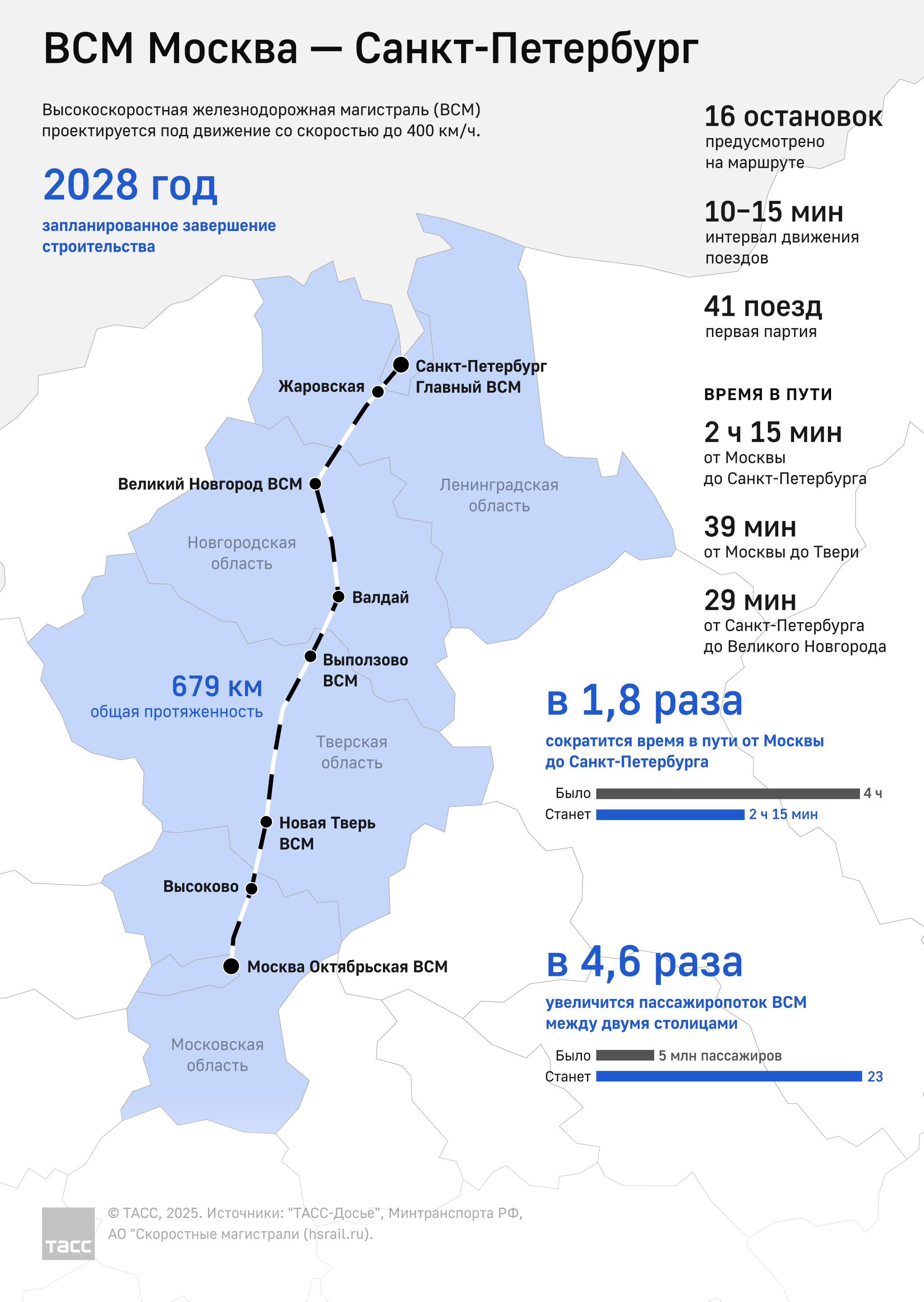
"The first line of the Moscow-St. Petersburg high-speed railway is planned to operate eight-car trains with four service classes and a total capacity of up to 460 passengers. The project also includes the possibility of operating in dual mode (8+8 cars)," the information center clarified.

About the project

The project to build the first high-speed railway in the Russian Federation, Moscow-St. Petersburg, is being implemented at the request of Russian President Vladimir Putin as part of the national project "Efficient Transport System."

The approximately 700-kilometer railway will pass through six regions of the country, home to 30 million people. Annual passenger traffic between the cities is expected to increase to 23 million by 2030.

According to a Russian government decree, the design and construction of the Moscow-St. Petersburg high-speed highway is scheduled for 2024-2028, with commissioning scheduled for 2028.
Construction of the Moscow-St. Petersburg high-speed railway
#Russia

Deputy Gorelkin stated that there are no plans to block Google in Russia.
The first deputy chairman of the State Duma Committee on Information Policy noted that he had specifically clarified this issue with the regulatory authorities.
MOSCOW, February 12. /TASS/. A possible Google block in Russia would have a wide range of negative consequences, but there are currently no such plans. This was stated by Anton Gorelkin, First Deputy Chairman of the State Duma Committee on Information Policy (United Russia).

This is how the deputy commented on the words of his committee colleague, Andrei Svintsov, who told the radio station " Moscow Speaks " that blocking Google is technically feasible, but it is unlikely to be worth pursuing now.

"As for the loud announcements about blocking, there are actually no such plans: I specifically clarified this with the regulatory authorities," Gorelkin wrote in Max . "Obviously, blocking will entail a whole host of negative effects—primarily problems with the functionality of the Android operating system (which affects 60% of all Russian smartphone users)."

The parliamentarian also noted that blocking Google is unlikely to force it to pay the existing fines levied against it by Russian companies. "Especially since this matter isn't over yet: lawsuits are ongoing in foreign jurisdictions, and legal mechanisms are being invoked. And even if the fine can't be collected in full, there remains a chance of reaching a settlement under some reasonable terms," he added.

According to Gorelkin, the phaseout of Google services should be gradual in any case. "I believe we need to create legislative conditions for a smooth transition to domestic solutions," the deputy concluded.


https://tass.ru/tag/rossiya
TASS has put together key facts about the defense minister’s inspection.

Meeting at a command post

- Belousov held a meeting at a command post of one of the Battlegroup South's units, listening to reports from commanders on the current situation in the area of responsibility and troop operations.

- Battlegroup Commander Lieutenant General Sergey Medvedev reported to the defense chief on the progress of offensive operations by the Battlegroup’s forces and the details of enemy actions.

- Belousov praised the effectiveness of the Battlegroup’s combat operations.

- The Russian defense chief handed state awards to the service members who had displayed bravery, courage and valor.

3D printing equipment

The deputy chief of the Battlegroup South’s Command of Unmanned Systems Forces reported that 3D printing equipment had been delivered to the Battlegroup South’s troops in fulfillment of the defense minister’s instruction to make parts for UAVs and provide for their maintenance and repairs.

Innovations demonstrated to the defense chief

- Belousov was informed that a new fixed-wing unmanned aerial vehicle was now available for relaying a radio signal and increasing the operational range of strike drones.

- The defense minister viewed a mobile system prototype developed by the Battlegroup South’s personnel and designed to provide the entire spectrum of advanced and secure communications.

- In addition, Belousov viewed deployable jammers of FPV drones designed to shield the routes of the movement of assault groups along with the routes for the delivery of supplies and ammunition.

- The Russian defense minister was also shown unmanned aerial vehicles and ground-based robotic platforms made by specialists of the Battlegroup South. These systems undergo constant upgrade and are outfitted with combat modules depending on the nature of assigned objectives.

MOSCOW, February 12. /TASS/. Russia's foreign trade surplus for December 2025 decreased by $0.2 billion compared to the same period in 2024, reaching $10 billion, according to a preliminary estimate from the Central Bank.

Compared to the revised figure for November 2025, the surplus in foreign trade in goods increased by $3.3 billion, to $10 billion. This increase compared to November is due to a more significant increase in goods exports compared to imports, primarily due to seasonal factors, the regulator noted.

The deficit in the balance of services in December increased to $5.9 billion due to the traditional year-end surge in outbound tourism as well as an increase in imports of other services, including construction, telecommunications, computer, and information services, the regulator said.

The current account surplus in December 2025 amounted to $2.6 billion, compared to $1.9 billion in November 2025. The regulator attributed the change compared to November 2025 to an increase in the trade surplus.

The surplus in the balance of foreign trade in goods decreased to $116.7 billion from $132.1 billion in 2024, due to a decline in goods exports, primarily mineral products. Goods imports remained unchanged.

In 2025, the current account surplus decreased to $41.4 billion (2% of GDP) from $62.6 billion in 2024 (3% of GDP).

Russia’s Proton-M rocket with Elektro-L weather satellite launches from Baikonur spaceport
The weather satellite will be orbited in about six hours and 38 minutes at an altitude of 35,406 km

MOSCOW, February 12. /TASS/. A Proton-M carrier rocket with the Elektro-L No. 5 weather satellite has successfully lifted off from the Baikonur spaceport, Russia’s State Space Corporation Roscosmos said in a live broadcast.


The weather satellite will be orbited in about six hours and 38 minutes at an altitude of 35,406 km. Its working orbit will be located at an altitude of 35,786 km, it said.


Elektro-L weather satellites placed in a geostationary orbit help receive and process multispectral images of clouds and the underlying surface of the entire observable disk of Earth, obtain hydrometeorological data in orbit, perform the telecommunications functions of spreading and exchanging hydrometeorological and helio-geophysical data and relay signals from emergency radio beacons of the Cospas-Sarsat system.


And Lastly on This Day, February 12, 2026


MOSCOW, February 12. /TASS/. WhatsApp (owned by Meta, which has been designated as extremist) will be unblocked in Russia if Meta complies with Russian laws and demonstrates readiness for dialogue, Russian presidential press ecretary Dmitry Peskov told TASS.


"This is a matter of compliance with Russian laws. If Meta complies, it will enter into dialogue with the Russian authorities, and then there will be an opportunity to reach an agreement," he said.

"This is a matter of compliance with Russian laws. If Meta complies, it will enter into dialogue with the Russian authorities, and then there will be an opportunity to reach an agreement," he said.

However, in his words, if the company continues ignoring Russia’s demands, there will be no chance for the service’s return. "If the corporation continues to cling to its uncompromising stance and, I would say, demonstrate absolute unwillingness to complies with Russian laws, then there will be no chances," he added.

Russia’s telecom watchdog confirmed to TASS that it is taking measures to slow down WhatsApp over violations of Russian laws. It claims that the messenger is used to organize and carry out terrorist activities in the country, and is also one of the main services used to defraud and extort money from citizens.

Screenshot 2026-02-12 at 07-25-45 Instagram.png
 
Last edited:
Back
Top Bottom