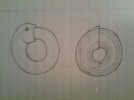
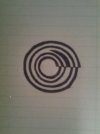
Q: (M) That's the second time they said that. (R) Yeah, okay, so in essence, that means what we are doing now is assembling the orchestra before the concert, and tuning the instruments. (L) Have you ever sat in the concert hall when they were getting ready, warming up? (J) It's chaos. (L) It is. (R) But after awhile it starts getting tuned. But that's what this is all about - the whole Cassiopaean Communication. Were not playing yet. We're just tuning. (L) Yeah. (JN) So if our level of consciousness creates the barriers of where this wave can go and how it behaves, can we ... (R) No, No. No. Excuse me for interrupting. Our level of consciousness doesn't create the barriers, it's only aware of those barriers. It can see, okay, what are the barriers: "oh these are the barriers. I can see, okay. So here's what I get to play." But if your awareness grows, then you get to see an array of barriers. "Okay I want to play with this bigger one. I can play with the smaller ones if I want to, but I have the awareness to see other barriers that are more extensive." (L) I think that the concept that we have a hard time grasping is that - going with the analogy - the musical selection is made, more or less. We at some level - us in the future - have chosen what instrument to play, what part to play. And so, the options that we really have now are: how well we play, how loud we play, how in tune we play with others; can we practice, can we stay in tune, can we do any numbers of these things? And even if we find ourselves sitting next to some jerk who can't carry a tune, and whose instrument is all screwed up, can we still continue to play true? Because even though the rest of the orchestra, being heard from a distance, may sound quite melodic, because we are sitting next to this guy who can't play, it is possible for us to be distracted - pulled off track - and then to distract the guy on the other side of us, leading to general chaos. (R) It's about focus. (L) Yeah. I'm getting tired. (A) I have still a question, because all the discussion around this computer modeling, whether it can be helpful or should be developed, or can lead to something; and all these spirals and barriers; they are all about, it's a standard, there are no events, there are no detectors yet. My idea was that it is the detectors which make events which make the wave collapse. Until now, in all our simulations, there is no collapse and no jumps. And yet we speak about consciousness, while there is this other concept that it is consciousness that makes the wave collapse. Okay. So I see a contradiction and I don't know how to get out of this contradiction. There is no collapse, and yet there was some encouragement that what we have relates to ...
A: The music is on the page long before it is played.
Q: (R) So, when the orchestra starts playing you have the musical notes, the timing instructions. Right. So it's the same music. You can play over and over again. But the difference is how well the orchestra plays and how well it is tuned. Okay, so one implication can be that ...
A: The FRE is the notes on the page. It is the selection. The "playing" constitutes "events." Frequency resonant envelope: FRE.
Q: (R) So when you're starting out, you have a small orchestra, you play simple notes. (L) Kinda like first density. (R) Exactly. As you get better at playing you get the bigger orchestra, you get more instruments, you have to be more careful about having them in tune because otherwise ... (L) And you get more notes. (R) And you get more notes. But the playing constitutes events. It's one thing to have an orchestra, it's another to have it tuned. (L) Alright, let's think about this FRE idea and this application of it and then take it back to V's original questions about it. FRE is emanated and maintained in concert with the environment and others ... (R) Well, it is also bonded to the perception through awareness, right? (L) Okay. (V reads back from the notes) "Your awareness maintains a frequency emanation in concert with your environment. When there are fluctuations in bonding of another, the fluctuations create discontinuities." (R) So a discontinuity would be a quantum jump, for example, yes or no?
A: Yes.
Q: (R) But this requires that you have an orchestra that is well tuned. Because if you don't have it well tuned, it's not resonating so it doesn't matter if the ... (V) So the orchestra's not going to make the music in fourth density. (R) Exactly. So you have the concert hall, the audience is there, you have the notes, but the orchestra is not in tune, so you get bad music. If the orchestra is not in tune, which is why it is important to ...
A: Sing "Goodnight Ladies," Yes?
Perhaps I can explain it better through this wonderful metaphor.
The orchestra chooses me as the conductor.
Imagine you want to perform a piece of music. Before deciding to conduct the orchestra, you ask each musician individually:“Do you know the piece?”“Do you master your instrument?”“Are you ready to give your all so we can achieve the best possible result together?”
You receive agreement from everyone. You can only rely on their words—so you place your trust in them.
Then the rehearsal begins, followed by the performance. You stand at the front as the conductor. Your role is not to be the loudest or most brilliant instrument yourself, but to enable the others to sound together, to create harmony, to bring the piece to life.
But reality looks very different:
The flute doesn’t truly master its instrument—and never really wanted to. It mainly wants to stand in the spotlight.The trombone has forgotten its mouthpiece—and blames its own lack of preparation on the flute.The violin has broken strings and genuinely believes that “it’ll somehow turn out fine anyway,” without making any changes.
As the conductor, you relied on everyone keeping their promises. You believed that no one would deliberately or negligently destroy the sound—and above all, that you yourself would not be harmed.
The performance becomes a catastrophe. A painful, ear-splitting dissonance emerges.
Still, you don’t give up immediately. You try again and again: you motivate, you explain, you correct gently, you seek compromises, you take on more work yourself, you sacrifice your own energy—always hoping that eventually this chaotic group will become a real orchestra that breathes together and pursues a common goal.
After the thousandth performance, you give up. You throw in the towel, lay down the baton, and leave the room.
The musicians are stunned. Instead of looking inward, they place the blame on you. They feel abandoned, betrayed, unfairly treated. They don’t understand why you are suddenly “so cold,” why you no longer continue, even though they “at least tried.”
I have meditated on this metaphor for a long time—and it describes my innermost feeling with painful precision.
And in recent months, an even deeper realization has emerged:
I currently find myself in fundamental dissonance with people with whom I should actually be forming a group, an “orchestra.” Everyone thinks the piece is wonderful, everyone wants to be on stage, everyone wants the applause—but no one is willing to do what is required for a truly successful performance: practice seriously, master their instrument, show up on time, take responsibility, admit mistakes, support each other instead of undermining one another.
The crucial question now is:
Does the fault lie with the conductor, who simply insists that the agreed-upon basic rules and prerequisites be followed—or does the fault lie in the repeated, conscious or unconscious behaviors of the orchestra members?
I would be very grateful for your thoughts, perspectives, and experiences.