Sol (Sun) and its phenomena

An interesting study was conducted to evaluate the impact of solar storms and how they make the Earth more hot. While the top down effect through the stratosphere can take days to weeks, the instant energization of the upper layer rapidly impacts the global system.

So it certainly do the same action of aerosols, volcanic ash and water vapor by impacting the electrostatic attraction between particles and then cloud formation and precipitation.

December 19, 2025

It is found that the Joule heating has a fast increase at the beginning of the storm main phase when the storm is initiated by HSS/SIRs (High-Speed Solar Wind Streams/Stream Interaction Regions) or by ICME (Interplanetary Coronal Mass Ejections) sheath regions, while a more gradual and longer lasting increase is found in storms driven by magnetic clouds within the ICMEs. In all the driver categories the Joule heating during the main phase is concentrated on the morning and afternoon auroral ovals, with the largest hemispheric median heating of 240-250 GW seen at the end of the main phase in storms driven by sheaths and magnetic clouds. Joule heating is highly correlated with the SuperMAG SME index ($R^2$values between 0.71-0.76), while correlation with the Newell coupling function is moderate ($R^2$ values between 0.52-0.56). Magnetic cloud driven storms have the highest geoefficiency in terms of solar wind energy input driving Joule heating.

Hearth joule heating in the northern hemisphere during Sun geomagnetic storms driven by high- speed streams and coronal mass ejections


Sources:
 

Attachments

Last edited:
I found a graph with the other side of the equation. Above, you can see the number of magnetic storms in red. In yellow, you can see the the total number of days with geomagnetic disturbances, in which the Kp index reached a value of 4 or higher (yellow and red levels).

The number of days with magnetic storms and the total number of geomagnetically disturbed days in 2025 significantly exceeded last year's figures and became one of the largest in the last 2 decades. Over the past 358 days since the beginning of the year, magnetic storms have been observed in 69 cases compared to 44 cases in 2024. Even more significant was the increase in the total number of days with geomagnetic disturbances, in which the Kp index reached a value of 4 or higher (yellow and red levels). There were 164 of them against 94, which is 75% more.

In the following graph, the annual number of magnetic storms is represented by each bar of the histogram. Superimposed is the smoothed sunspot number. The dashed lines indicate solar minima and the dotted lines indicate solar maxima. Note the correlation of magnetic activity with solar activity and the apparent increase in magnetic activity with time during the 20th century

image022.jpg
 
Caught Venus and Mars at one degree from the sun via the LASCO space telescope:


Xras.ru

The rare simultaneous approach of Venus and Mars to the Sun, which will not happen again until the second half of the 23rd century, was recorded from space by LASCO coronagraphs located on the SOHO spacecraft. The planets, which had been moving towards each other for several months, converged in the sky last night in a line with the Sun at a distance of about 1 degree and are now beginning to diverge. Venus, which passed closer to the Sun, is moving to the left of the solar disk and in two months, in March, will become visible in the Earth's sky as an evening star, setting below the horizon at sunset immediately after the Sun. At present, it is impossible to see it, as it, like Mars, is completely drowned in the sun's rays. Mars, moving to the right of the Sun, will, on the contrary, become the morning star in the spring, appearing in the sky at dawn.

The fact that the planets passed below the Sun rather than coinciding with it is due to the inclination of their orbits relative to Earth's orbit. For Mars, it is about 2 degrees, and for Venus, about 3.5 degrees. In some rare cases, however, Venus can pass directly across the Sun's disk. The last time this happened was in 2012, and the next time will be on December 11, 2117. Mars is an outer planet that cannot be projected onto the solar disk under any circumstances. At the moment of the conjunction, both planets were on the opposite side of the Sun from Earth: Venus at a distance of 256 million km, and Mars at a distance of 360 million km.

Alignments happen all the time, whether they're "energetically" significant, that's another thing.

Minimal G1 geomagnetic storm for tomorrow in the latest forecast:

Minimal magnetic storms, G1, are expected tomorrow at midday due to a medium-sized plasma ejection passing by the planet, which left the Sun on January 6. Given the strong lateral displacement of the plasma cloud, clearly visible in the video, the forecast is rather unstable. With even a slight deviation of the ejection to the left, it will pass Earth without any geomagnetic consequences, while an “error” in the other direction could cause a noticeable increase in geomagnetic fluctuations compared to the calculated values.

The level and number of solar flares since the beginning of the year remain low, with no signs of intensification in the coming days. Over the next two days, there may be a moderate increase in the speed of the solar wind due to the appearance of another coronal hole of a rather unusual shape on the side of the Sun facing Earth.
 
Spaceweather.com published an article on the topic of alignments and solar cycles which delves into tidal effects:

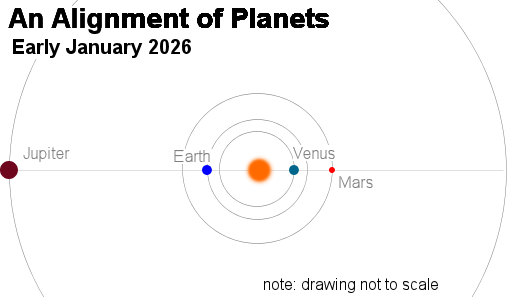
PLANETARY ALIGNMENTS AND THE SOLAR CYCLE: This week, Jupiter and Venus are on opposite sides of the sun. To some researchers, this geometry is more than a celestial coincidence. A small but persistent body of research suggests that planetary alignments help regulate solar activity.​


aligned_strip2.png


"A decade ago, I set out to to find a viable mechanism by which the solar cycle could be synchronised by tidal forces of the planets," says Frank Stefani, a physicist at the HZDR national research center in Germany. "These forces are known to be very small, yet we have developed a model that shows remarkable agreement with observed solar activity."

This is a controversial topic. Some researchers, like Stefani, have focused their careers on it, while others are vehemently opposed. The idea refuses to go away mainly because Jupiter, Venus, and Earth form repeating alignment patterns with a characteristic period near 11 years, similar to the average length of the sunspot cycle. Coincidence--or something more?

Mainstream solar physics holds that the tides of Venus and Jupiter are too weak to affect solar activity. Jupiter's tides on Earth are a million times weaker than the Moon's tides, and Venus's tides are even weaker than Jupiter's. How could these absurdly small forces affect the sun?

A 2019 study led by Stefani suggested a way: The sun's inner magnetic dynamo is exquisitely sensitive to external perturbations ("parametric resonances"). Regular "taps" from planetary tides could nudge the dynamo into an 11-year pattern like a metronome keeping a piano player on time.


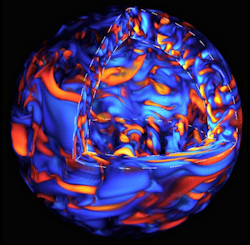
Critics note that convective noise in the sun's interior (pictured right) dwarfs tidal stresses. Yet the coincidences are hard to ignore.

Stefani’s more recent work focuses on magneto-Rossby waves in the solar dynamo. "Our latest model shows that the natural periods of these waves fit amazingly well to the two-planet spring tides of Venus, Earth, and Jupiter: 118 days for Venus-Jupiter, 199 days for Earth-Jupiter, and 292 days for Venus-Earth."

These spring tides do not cause the solar cycle, clarifies Stefani. They help synchronize it. Tidal beat-periods match several well-known cycles of solar activity including the famous Schwabe cycle of 11 years, a Quasi-Biennial Oscillation (QBO) of 1.7 years, and the Suess-de Vries cycle of 193 years (plus two Gleissberg cycles at 90 and 58 years).

Again, critics have a counterargument: With so many cycles and harmonics to play with, you can always find a match. Indeed, this may be true.

But Stefani has a prediction: "The present alignment is happening only 40 to 60 days before the expected peak of a Quasi-Biennial Oscillation. If the alignment excites magneto-Rossby waves as our model predicts, we might expect a higher probability of strong solar activity 40 to 60 days from now."

That's science. Stay tuned for a follow-up story in two months.
 
Alignments happen all the time, whether they're "energetically" significant, that's another thing.
There's also a 3rd dimension that might be good to keep in mind with these kinds of considerations.

For example, Jupiter's orbit is inclined to ecliptic cca 1.3°, which for an orbit of 5.23 AU translates to roughly 18 millions km distance from the ecliptic plane in its extreme, which is almost 13 times larger than the diameter of the Sun.
FWIW.
 
The fact that the planets passed below the Sun rather than coinciding with it is due to the inclination of their orbits relative to Earth's orbit.
I wondered the same, and I think their inclination couldn't account for that to such a degree. Rather, LASCO/SOHO is in an halo orbit around L1, so it could be currently below the planetary plane, looking up at the constellation from below.
 
Alignments happen all the time, whether they're "energetically" significant, that's another thing.

I think that you need a third type of body, like a comet, that will act as a spark plug to ignite the alignments. Alignments are like conduits for electricity, but you need some other body to ground the Sun. Otherwise, we would be having "energetically" significant events all the time, because, as you said, alignments happen all the time.
 
Spaceweather.com published an article on the topic of alignments and solar cycles which delves into tidal effects:
Very interesting.

Jupiter could activate the solar capacitor when it aligns with the sun and Earth every 13 months. It is assumed that the electron current powers the winds. In the event of a storm, these winds can become very violent. I have oticed weather forecasts are announcing strong winds these days in certain regions, coinciding with Jupiter's alignment.

I think that you need a third type of body, like a comet, that will act as a spark plug to ignite the alignments. Alignments are like conduits for electricity, but you need some other body to ground the Sun. Otherwise, we would be having "energetically" significant events all the time, because, as you said, alignments happen all the time.
Like the 3 body problem:


But with the caveat that the third body could well be a very active comet, electrically speaking. We're force to think outside the box beyond the "snowball comet theory", in order to connect the dots beyond what our eyes can see in the strictly material realm.
 
Back
Top Bottom