
You are using an out of date browser. It may not display this or other websites correctly.
You should upgrade or use an alternative browser.
You should upgrade or use an alternative browser.
Sol (Sun) and its phenomena
- Thread starter mabar
- Start date
Olivierlejardinier
Dagobah Resident
Although it was impressive the last X8 flare WON'T be a Carrington event, Burns is a bit of an enthusiast clickbaiting for fame/ego.
Seems the sunspot has a caged magnetic field which impeded the plasma ejection during the flares. Here's a video for yesterday's X1 flare showing this phenomenon:
The overall X-ray flux has been above M level for nearly 24h now.

Someone noticed that the number of this sunspot, AR4366, is a rearrangement of that of the famous group of sunspots responsible for the magnetic storm of May 2024, AR3664. Should we note to look for incoming AR4663 ???
The last summary by Russian institute:
Seems the sunspot has a caged magnetic field which impeded the plasma ejection during the flares. Here's a video for yesterday's X1 flare showing this phenomenon:
The overall X-ray flux has been above M level for nearly 24h now.
Someone noticed that the number of this sunspot, AR4366, is a rearrangement of that of the famous group of sunspots responsible for the magnetic storm of May 2024, AR3664. Should we note to look for incoming AR4663 ???
The last summary by Russian institute:
AT THE CURRENT MOMENT — on the flare and the overall situation on the Sun
A large center of activity with exceptionally large reserves of energy, which were accumulated deep in the Sun and are now being brought to the surface in the form of electrical currents and strong magnetic fields, has formed on the Sun. The areas of concentration of the latter are now forming numerous sunspots on the surface. The region, which is relatively compact in size, is "swallowing up" this energy and burning it off in all available ways, continuously producing major flares. Since, apparently, there are not enough strong and very strong flares, superflares have come into play.
There are no signs of a decrease in energy reserves in the active center. Strong flares will continue. There may be new major explosions.
The X8.1 event is, without any exaggeration, a superflare. Over the past quarter century, since January 1, 2001, there have been only 13 such or larger explosions on the Sun. That is, on average, one every two years. Such an event occurred tonight.
Not every flare of this magnitude affects the Earth. In particular, the two previous events of the current cycle, which occurred in 2024 — X8.7 and X9.0 — did not affect the Earth. The flare may be on the edge of the disk, the flare may occur without a plasma ejection, the ejection may go sideways — there are many reasons, and more often it's "no" than "yes". Every time, the details matter.
As for the details. For this event at the current moment, an impact on Earth has not been confirmed. There's a 90% chance that it won't happen. According to the available data, powerful plasma clouds, which form the main impact force, have not been formed, and those that were have been directed sideways. Final confirmation will be obtained today, but preliminarily the flare is "sterile" (without a geoeffective ejection).
Now a bit about the downsides. The first is that today by the end of the day, the active center will approach the Sun-Earth line and will be in the zone of the most effective impact until Saturday. There's no way to avoid it. Moreover, so far there have been no major plasma ejections from the center, but this doesn't mean that it's not there. It's just that it hasn't been able to break through yet. Against this backdrop, a flare with a very large ejection is possible. A small plus is that the plasma from the current superflare was ejected at an upward angle, past the planets. In general, active centers tend to operate according to a certain pattern, and the next ejections may go in the same direction. But this is not guaranteed.
In general, this is all that can be written for now. Science, like everything else, is currently in the role of an observer. As news arrives, we will inform you.
The size of the active center and the associated group of sunspots allow it to be confidently observed from Earth even in amateur telescopes. If anyone is filming them, they can send photos. This area has already made its mark on the history of solar physics, and getting a personal photo of it can be inspiring.

"Space Bro" (and geophysicist), Stephan Burns is somewhat concerned that there might be another Carrington Event.
Although it was impressive the last X8 flare WON'T be a Carrington event, Burns is a bit of an enthusiast clickbaiting for fame/ego.
Seems the sunspot has a caged magnetic field which impeded the plasma ejection during the flares.
Second that, don't rely on Stephan Burns as your feed, or he will hystericize you. As I said here, he has a tendency to dramatize other's people material for the clicks and awe factor, making him a source to be wary of. Just keep in mind that he might have some pattern recognition run amok in him.

He has a tendency to dramatize other's people material for the clicks and awe factor, making him a source to be wary of. Just keep in mind that he might have some pattern recognition run amok in him.Although he tend to be a drama queen, he always correlate interesting points.
- A strong positive BZ component (60 nT) was observed in a recent solar storm, stronger than the G5 "Mother's Day" storm of May 2024.
- The positive field caused longer-term geomagnetic effects rather than immediate massive plasma injection.
- This led to strong...

He hasn't told anything insightful here, it doesn't explain anything at all. It's just a description, with the second point being practically BS. Just nomenclature that makes people go "oh" and tells nothing of the processes involved. He doesn't seem to have the ideas clear in his head. To be fair, that is what most of them do.
You'll find far more honesty in the Russian Laboratory of Solar Astronomy as opposed to this guy. The former isn't hystericized like people in the West. So they genuinely admit the anomalies more willingly as opposed to anybody in the West. They even seem more genuinely happy that the U.S. is going to the moon than the Americans themselves.

Kadam303
Jedi Master
event on going so lets wait and see. this is not yet earth directed but cumulative impact can shake earth up.Although it was impressive the last X8 flare WON'T be a Carrington event, Burns is a bit of an enthusiast clickbaiting for fame/ego.
Seems the sunspot has a caged magnetic field which impeded the plasma ejection during the flares. Here's a video for yesterday's X1 flare showing this phenomenon:
The overall X-ray flux has been above M level for nearly 24h now.
View attachment 115722
Someone noticed that the number of this sunspot, AR4366, is a rearrangement of that of the famous group of sunspots responsible for the magnetic storm of May 2024, AR3664. Should we note to look for incoming AR4663 ???
The last summary by Russian institute:
CS said that our magneto is much weaker .so good slap can jiggle
Kadam303
Jedi Master
few blown transformers would calm things on earth i think:) war mangers would need to pool back for a willeSecond that, don't rely on Stephan Burns as your feed, or he will hystericize you. As I said here, he has a tendency to dramatize other's people material for the clicks and awe factor, making him a source to be wary of. Just keep in mind that he might have some pattern recognition run amok in him.
He has a tendency to dramatize other's people material for the clicks and awe factor, making him a source to be wary of. Just keep in mind that he might have some pattern recognition run amok in him.Although he tend to be a drama queen, he always correlate interesting points.
- A strong positive BZ component (60 nT) was observed in a recent solar storm, stronger than the G5 "Mother's Day" storm of May 2024.
- The positive field caused longer-term geomagnetic effects rather than immediate massive plasma injection.
- This led to strong...

Ruth
The Living Force
I don't think he's hystericized me. I find him entertaining, engaging and open minded and too much of a modern day 'hippie' for that.... If he's concerned, it doesn't necessarily mean that I am (at all), besides, there's nothing that can be done about it.Second that, don't rely on Stephan Burns as your feed, or he will hystericize you. As I said here, he has a tendency to dramatize other's people material for the clicks and awe factor, making him a source to be wary of. Just keep in mind that he might have some pattern recognition run amok in him.
What's the worst thing that can happen in a Carrington Event? Power blackouts? Not a great time to have them in the Northern Hemiphere. Earthquakes? Maybe.
The only thing to do is enjoy the beautiful auroras and not have to travel to the 65th parallel + to see them..... (that I will bring popcorn for), and hope and pray that this is Mother Nature doing a "Great Reset"
 on our toxic Elites and all their flunkeys! I could toast that, but I'm not allowed to drink anymore.
Here's the deal. Everytime anyone brings Stephan Burns here, quote what he said, what are his claims and explanations. We stand to gain by analyzing what he says. We'll do our homework. Otherwise, don't just leave his video without any commentary. This forum is not a no-thinking zone. For that, you go to social media.
Another X flare, this time X1.65.
The X8.1 superflare translates into insignificant amounts of particles leaving the sun and reaching Earth. That is, the majority of the energy stayed in the sun and it might be released latter today or this week (or not).

Another X flare, this time X1.65.
The X8.1 superflare translates into insignificant amounts of particles leaving the sun and reaching Earth. That is, the majority of the energy stayed in the sun and it might be released latter today or this week (or not).
New X-class solar flare!
The score is not yet clear, but it is growing more slowly than last night.
Apparently, yesterday's M-class flares are no longer enough to cope with the incoming energy flows. X-class flares are beginning to appear.
UPDATE 11:16 MSK
The new X-class flare shows signs of a large mass ejection. It is possible that all the plasma that was not ejected by the previous super-explosion will now go into space. The active center is currently at an angle of about 25° from the direction of Earth. A large ejection from such an angle could hit the planet. Stay tuned for updates. The flare is still growing. The final score is unknown. At the moment, it is definitely higher than X1.5.
UPDATE 11:22 MSK
Peak reached at 11:14 Moscow time. Flare score — X1.65. Plasma ejection into interplanetary space from the epicenter of the explosion is confirmed. Direction and power are still unknown.
The “sterility” of the X8.1 nighttime superflare has been confirmed. After the flare, insignificant amounts of matter left the Sun and will pass by the planet. If you look closely, you can see a faint touch of Earth (green circle) by the edge of the plasma cloud, but that's definitely not what's happening right now. Most of the plasma stayed on the Sun and will most likely be thrown out in one of the next big explosions, maybe even today.
Kadam303
Jedi Master
i agree .... with your judgementI don't think he's hystericized me. I find him entertaining, engaging and open minded and too much of a modern day 'hippie' for that.... If he's concerned, it doesn't necessarily mean that I am (at all), besides, there's nothing that can be done about it.
What's the worst thing that can happen in a Carrington Event? Power blackouts? Not a great time to have them in the Northern Hemiphere. Earthquakes? Maybe.
The only thing to do is enjoy the beautiful auroras and not have to travel to the 65th parallel + to see them..... (that I will bring popcorn for), and hope and pray that this is Mother Nature doing a "Great Reset"
Another "bird" witnessed today, with a very strong resemblance to the one witnessed in May 25th, 2025.

The one below is from 2025:

This is what the Cs said about the one from 2025:
Hello, hello. Long time no see (Лаборатория солнечной астрономии (XRAS)) )
There is still a belief that this is a galactic particle.
Taken today at 18:12 Moscow time with the LASCO C2 telescope.
The one below is from 2025:
May 25, 2025, 14:04 Moscow time
A bird above the SunA beautiful and somewhat mysterious image was taken yesterday from one of the LASCO telescopes. The image clearly shows a "bird" or "flying machine" with a "fiery trail" trailing behind it. The wing size of the "bird" is about 150 thousand km. The height of the "flight" above the surface of the Sun is about 2 million km. The size of the "bird", assuming that it is a physical and not an optical object, is more than 10 times the size of the Earth.The image was taken in the channel of the C2 telescope yesterday at 10:00 a.m. World time. The link to the original image is 20250524_100000_c2.png. The detector type is a 1024-by-1024-pixel CCD sensor. The spectral range is optical (visible to the eye). In the previous and subsequent images (approximately 10 minutes before and 10 minutes after) there is no structure.
This is what the Cs said about the one from 2025:
(Nienna) What was the “bird" above the sun pictured on May 24th by the LASCO telescope?
A: Expulsion of mass from sun's core due to temporary opening of channel.
Q: (L) Would that have anything to do with any of the current cosmic energies?
A: Yes
Q: (L) Should we expect other odd behaviors or phenomena in relation to the sun?
A: Definitely.

I agree, totally!
From Gaby ;
This is what the Cs said about the one from 2025:
GIANT SUNSPOT ALERT: A few days ago, sunspot 4366 didn't exist. Now it is a behemoth almost half the size of the great Carrington sunspot. Rapid growth is making the sunspot unstable. Indeed, it has already unleashed dozens of solar flares in the past 24 hours, including a powerful X8-class flare described below. More explosions are almost certain on Feb. 2nd. Solar flare alerts: SMS Text
X8-CLASS SOLAR FLARE AND CME (UPDATED): Giant sunspot 4366 is a solar flare factory. In the past 24 hours, it has produced 23 M-class solar flares and 4 X-class flares. The most intense so far was yesterday's X8-class flare, shown here in a movie from NASA's Solar Dynamics Observatory:
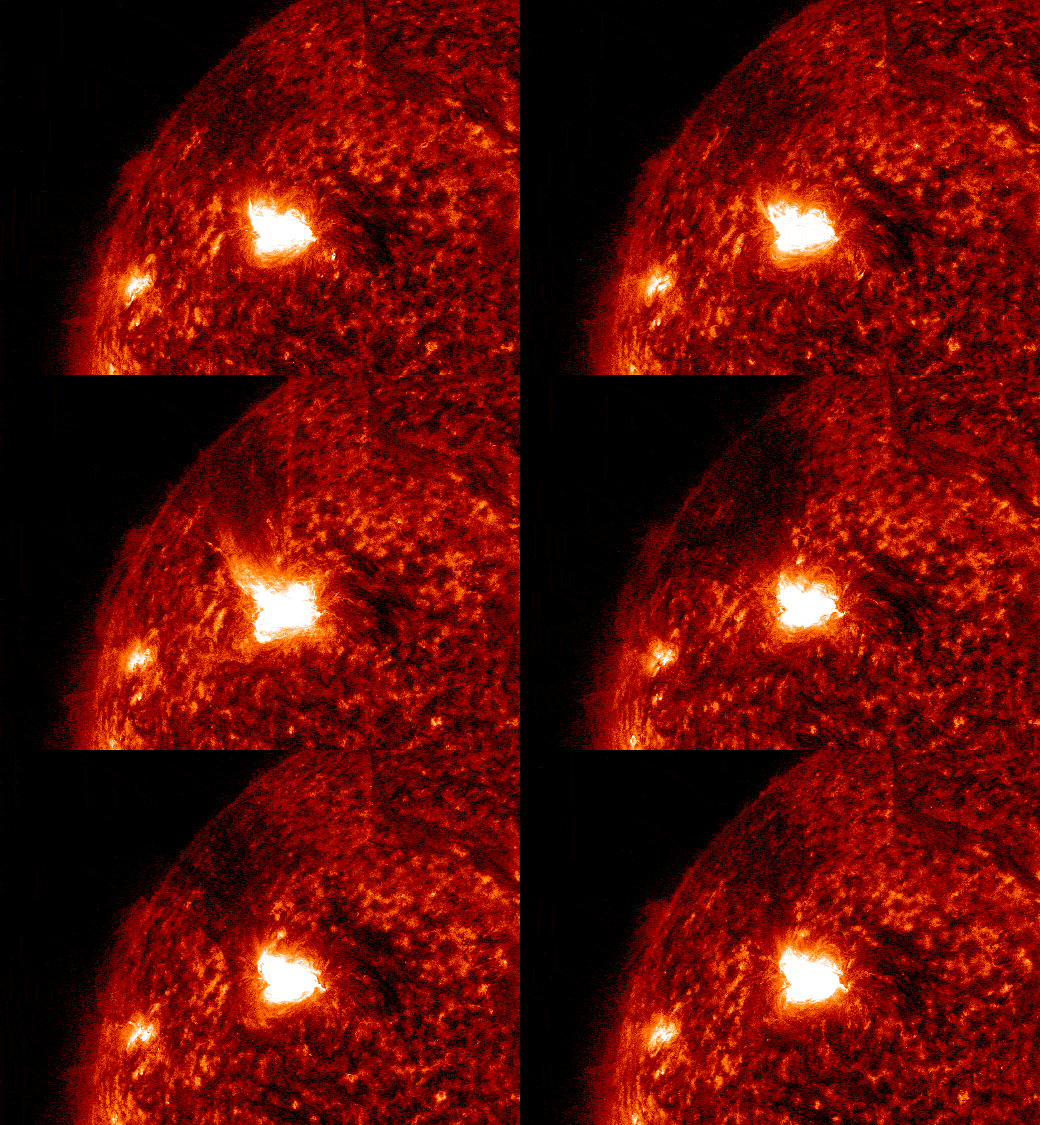
This X8-class solar flare peaked on Feb. 1st at 23:57 UTC.
Extreme ultraviolet radiation from the flare ionized the top of Earth's atmosphere. This, in turn, caused a shortwave radio blackout across the South Pacific Ocean: blackout map. Ham radio operators in Australia and New Zealand may have experienced loss of signal below 30 MHz for hours after the flare's peak.
Update: SOHO and NOAA coronagraph images confirm that several CMEs emerged from yesterday's collection of flares. None of them appears to be either potent or squarely Earth-directed. Glancing blows expected on Feb.4-6 could spark G1 (Minor) to G2 (Moderate) geomagnetic storms. CME impact alerts: SMS Text
Feb 1, 2026
This forecast is meant for patrons of Patreon only. A public version will be released later today that includes much-needed updates. This Space Weather News forecast sponsored in part by Millersville University:https://www.millersville.edu/swen
M 4.8 - 30 km NNW of Mysovoe, Ukraine
2026-02-02 09:47:51 (UTC)45.688°N 35.648°E10.0 km depth
From Gaby ;
This is what the Cs said about the one from 2025:
(Nienna) What was the “bird" above the sun pictured on May 24th by the LASCO telescope?
A: Expulsion of mass from sun's core due to temporary opening of channel.
Q: (L) Would that have anything to do with any of the current cosmic energies?
A: Yes
Q: (L) Should we expect other odd behaviors or phenomena in relation to the sun?
A: Definitely.
GIANT SUNSPOT ALERT: A few days ago, sunspot 4366 didn't exist. Now it is a behemoth almost half the size of the great Carrington sunspot. Rapid growth is making the sunspot unstable. Indeed, it has already unleashed dozens of solar flares in the past 24 hours, including a powerful X8-class flare described below. More explosions are almost certain on Feb. 2nd. Solar flare alerts: SMS Text
X8-CLASS SOLAR FLARE AND CME (UPDATED): Giant sunspot 4366 is a solar flare factory. In the past 24 hours, it has produced 23 M-class solar flares and 4 X-class flares. The most intense so far was yesterday's X8-class flare, shown here in a movie from NASA's Solar Dynamics Observatory:
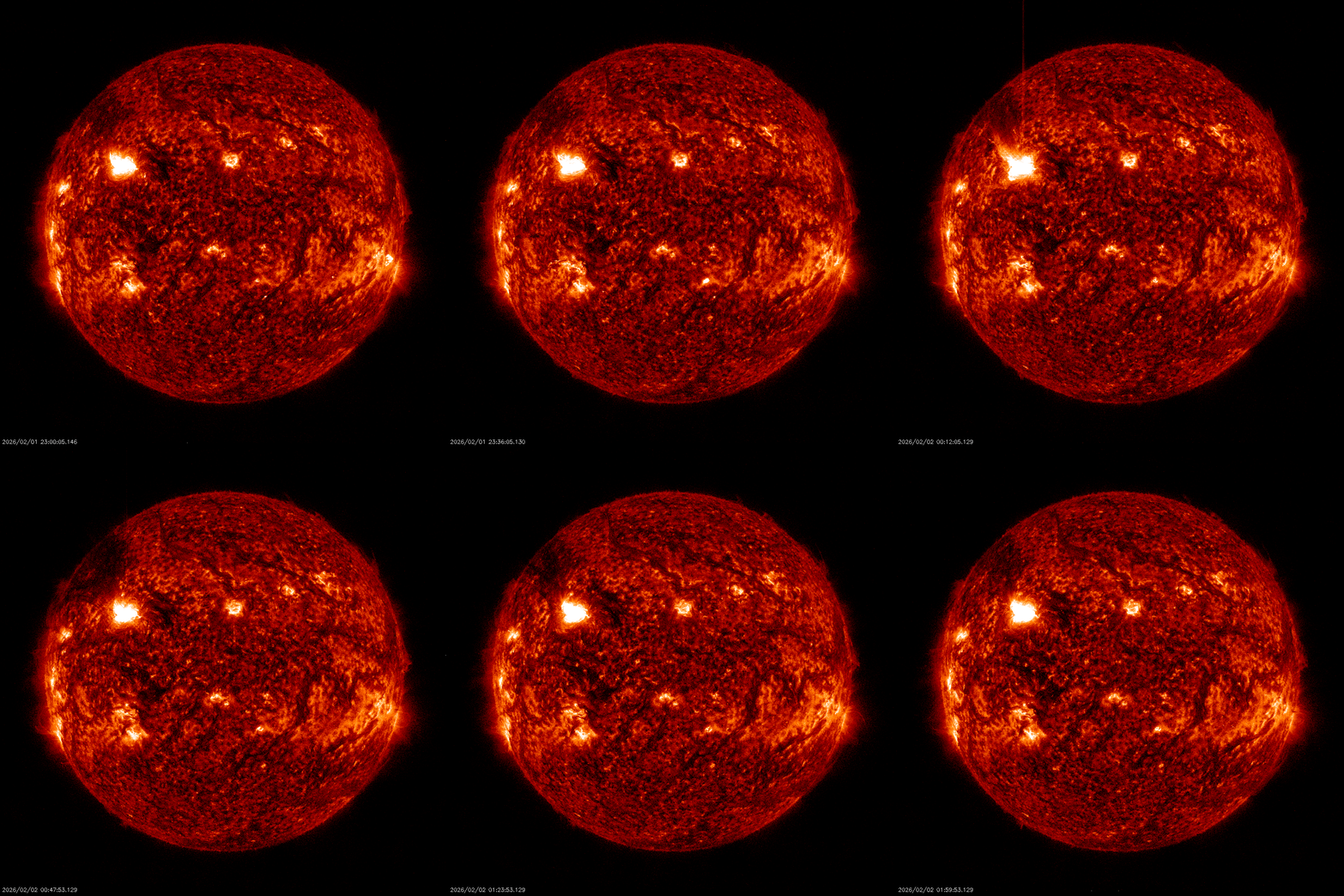
This X8-class solar flare peaked on Feb. 1st at 23:57 UTC.
Extreme ultraviolet radiation from the flare ionized the top of Earth's atmosphere. This, in turn, caused a shortwave radio blackout across the South Pacific Ocean: blackout map. Ham radio operators in Australia and New Zealand may have experienced loss of signal below 30 MHz for hours after the flare's peak.
Update: SOHO and NOAA coronagraph images confirm that several CMEs emerged from yesterday's collection of flares. None of them appears to be either potent or squarely Earth-directed. Glancing blows expected on Feb.4-6 could spark G1 (Minor) to G2 (Moderate) geomagnetic storms. CME impact alerts: SMS Text
This forecast is meant for patrons of Patreon only. A public version will be released later today that includes much-needed updates. This Space Weather News forecast sponsored in part by Millersville University:https://www.millersville.edu/swen
M 4.8 - 30 km NNW of Mysovoe, Ukraine
2026-02-02 09:47:51 (UTC)45.688°N 35.648°E10.0 km depth
Attachments
Sunspot activity is now facing Earth and whatever happens within the next few days would be within range of Earth. Some perspective via xras:

Well then. Wait and see!
The Artemis mission was moved to March 2026, BTW. They're not taking any chances!
From today until midday on Friday, February 6, the active center will be in the zone of direct hits on Earth at angles of approximately ±20° from the direction of the planet. In the event of large mass ejections and their normal propagation (vertically to the surface of the Sun), the interaction of the plasma clouds formed during this period with the Earth's magnetosphere will be almost frontal.
Frankly speaking, the Earth rarely experiences frontal impacts from large flares. The ±20° angle range is 1/9 of a full 360° rotation, which means that only about 10% of the total number of major events on the Sun occur opposite the Earth. In the past year of 2025, there were only two such cases: on June 1, 2025, after the M8.1 flare on May 31, and on November 12, 2025, after the X5.1 flare on November 11. This year, one such event has already occurred: the magnetic storm of January 20-21, 2026, with the largest radiation storm of the 21st century following a direct hit from the X1.9 flare on January 18.
They're refering to this event in 2003:There can be no prediction here. All such events are black swans. If you don't believe it, go to this graph, which shows one of the largest flares in history, mentally or physically cover the flare with your hand, and ask yourself honestly if there is anything in the remaining open left part of the curve that indicates that one of the major events of the century is about to happen. And the honest answer will be NO. Therefore, all studies of the current graph, discussions about whether it is falling or rising, whether it is stable or moving, are irrelevant; the previous graph before the flare, by the way, was clearly falling to the bottom. Once again, such events are black swans, and they cannot be predicted.
On the eve of the event, the active region increased its area by 50% in one day and set a new personal record for the number of strong flares (M + X) in a day. According to Moscow time, there were 18 such events, and according to world time, there were even 19. In both cases, this is the second highest number in a decade. The first place is still held by December 29, 2024 (23 events). Visually, the graph shows signs of a decline, which may mean something, but more likely means nothing. Most likely, with its new increased size, the active center simply developed internal reservoirs for energy storage, and the need for massive spam with flares (in the absence of a buffer for energy storage) disappeared.
We will definitely not make any predictions and will not even pretend that this is possible in this case.
We simply intend to spend four days looking at the color of the swans.
Well then. Wait and see!
The Artemis mission was moved to March 2026, BTW. They're not taking any chances!

Well then. Wait and see!
Xras
And here's the first swan.
An X-level flare has begun on the Sun.
The event's rating is X1.5.
The peak was reached at 17:08 Moscow time.
Xras
The event's rating is X1.5.
And it had no plasma ejection. Maybe the "bird" had something to do with it? Temporary window?
So in the end, no big show, no drama. There are 3 days left when Earth is within range from the sunspots, though.
Via xras.ru
Tomorrow, the first disturbances from the surge of solar activity that began a few days ago should begin to arrive on Earth. At the same time, despite the exceptionally high level of active processes (in the first 3 days of February alone, 5 high-class X flares and about 50 M-level flares were registered on the Sun), magnetic storms are still expected to be weak. The reason is that the centers of solar activity entered the Earth's zone of influence only yesterday, and the planet is expected to be affected only by the edges of plasma emissions that left the Sun in the previous period. Most of them will pass by the planet.
Yesterday, the first flare of the highest X-score occurred in the geoeffective zone, which, however, was not accompanied by plasma emissions. Thus, the first of four days, during which the active centers should be in the zone of direct impact on the planet, did not create any threats. At the same time, Active region 4366 continues to grow and overcame an important psychological barrier the day before — its area exceeded 1,000 square meters (million parts of a hemisphere). So far, only five groups of spots have been able to do this in the current cycle. The first place among them is occupied by the 3664 group, which in May 2024 produced the only magnetic storm of the highest, fifth level in the last 20 years.
Area 4366 will remain in the zone of maximum risks for the Earth for about three more days.
Trending content
-

-

-
Thread 'Coronavirus Pandemic: Apocalypse Now! Or exaggerated scare story?'
- wanderingthomas
Replies: 30K -
