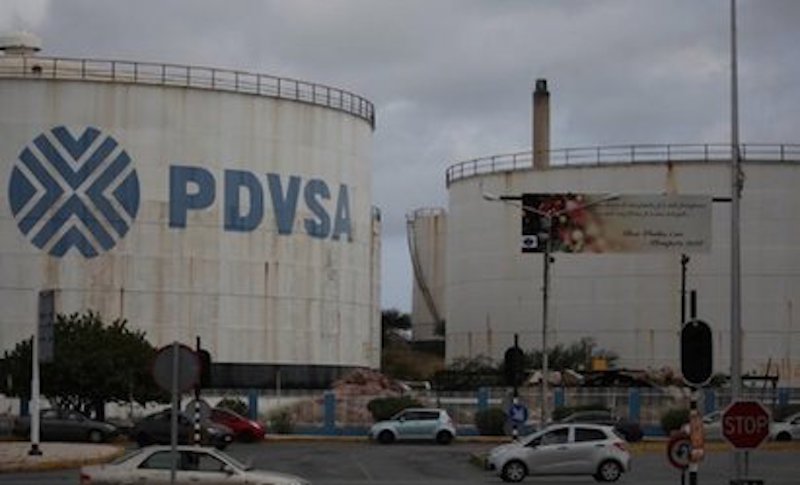
Despite the seriousness of a physical economic blockade, the US hasn't attacked,
Yes, there is a change of strategy.
Since they cannot cope with the terror campaign, they will begin to tighten people's pockets again and more through the naval blockade, as they have done with Cuba for years.
They will think "What better strategy than to suffocate the Venezuelan economically, to make them despair so much that they want to change the government without caring who the president is?"
It doesn't sound bad really, isn't it also a strategy to make people vote for a regime change when you "punch them in the stomach" economically?
You create more need, poverty, high prices, hatred, desperation for a quick exit, etc. And what would that exit be after cornering a population like that? elections!, and then they will call it "the discontented people vote against the dictatorship, miten as it has them going hungry" again.
What both the traitor of Petro, Lula, Maria Corina and other satellite countries have also been bothering for years, the damn transparent elections.
How can we get enough people to vote against it?. All that is in sight, it remains to be seen how much society will continue to endure in this country until nothing works for them and they have to desperately drop a bomb to make them react to terror for real.
Everything is obviously possible.
so there are reasons to think they prefer a deal, and that's what they're after. (Trump's rhetoric about Venezuela owing them money and oil for Chávez's expropriations could be part of that
Yup, you hit the target!
I'm just collecting some information about it because what Trump means by "returning the oil", something that even he doesn't know because Trump doesn't inform himself about anything, is that everything dates back to the "nationalization" of oil in 1976, "Nationalization" that was nothing more than a business based on interests, like everything and always benefiting foreign companies and not the country itself. That's what he calls "theft" by Maduro because in 2003 Chavez privatized PDVSA and that was the finger in the wound for the EE.UU and company.
In short, the privatization of PDVSA is what Trump refers to as theft of "his" oil, in addition to rare earths due to the exploitation of the mining arc that has also been another issue of fights of interests.
But I don't really know about these topics, it's not my area and there are many things I don't understand. I can only say, that they privatized PDVSA and that hurt them.
And if they want to connect much more, then it is enough just to look for
everything related to nationalization, privatization and expropriation by Chavez... there they will connect what Trump now calls
"returning what was stolen from us" very simple.
They turned off the "gifted" oil tap. That if the government does it right or does it wrong, according to everyone's opinion, well but on the one hand they never stopped sending oil to the EE.UU but not for free. That's the whole problem that they do not have access to oil as they did with previous governments and that applies with all the raw material and rare earths of Venezuela, they lost control, in short.
And what did the Cass's say about it? "Control". What does this map show? take back control.
There is not much to overthink, just thinking to connect what the panorama shows us.
“In the 70s, during the first government of Carlos Andrés Pérez, there was no nationalization of oil, but an agreement between national and international elites to share the dividends of that resource”
Entre las 12:00 de la medianoche del 31 de diciembre de 1975 y los primeros segundos del 1° de enero de 1976, se dio el “ejecútese” a la "Ley que Reserva al Estado la Industria y el Comercio de

www.vtv.gob.ve
This is a summary offered by the search engine ai, quite well to summarize what was then the privatization of PDVSA, by Chavez:
In 1976, Venezuela nationalized its oil industry under the government of Carlos Andrés Pérez, creating PDVSA (Petróleos de Venezuela S.A.) on January 1, but it was called "chucuta nationalization" because it involved paying huge compensation to transnationals and keeping them with technology and marketing contracts, ceding much of the control, a process criticized for being an agreement between elites rather than a sovereign takeover, according to experts such as Juan Pablo Pérez Alfonzo, a publication of VTV and the Central University of Venezuela notes.
What was the "chucuta" nationalization?
An unfinished process: The term "chucuta" (small or incomplete) was used to describe the nationalization of 1976 because, although the state took formal control, transnational companies (such as Creole, Shell) retained influence through technical assistance, marketing and refining contracts, which were crucial for the nascent PDVSA, VTV recalls, according to the Central University of Venezuela and the Ministry of Culture.
Millions in compensation: Venezuela paid high compensation to foreign companies for the remaining years of concession, which entailed a great cost to the public treasury, according to the Ministry of Culture, VTV notes.
To complement, there are enough videos of Chavez talking about the privatization/nationalization of PDVSA,
EE.UU said it was the worst oil in the world, if it's the worst oil then why do they want to kill for it?... It was not as "bad oil" as they said then.
But many argue that "everything was better before the revolution" no, it has always been "better before" for those who had no needs, failing that, those who were not "poor" and for those who cannot be on the same level as others in terms of access to what many call "equality for all" regardless of their ideology.
The country was not "destroyed" when the revolution came, it was already a disaster, just less publicized! but like everything, there are its nuances and there are those who only see the positive and others who only see the negative, but never any objectivity about reality.
Everyone defends their "vision" about the parallel Venezuela in their minds.
I haven't read all of this, I'm busy on other things but it addresses part of the story regarding. But I'm not the best person to talk about this:
50 Years after an Oil Betrayal. (Part IV)
Por Eleazar Mujica Sánchez[1] “La riqueza petrolera, por ejemplo, ¿en qué utilizarla? Algunos andan diciendo que yo soy un oligarca ahora, por ahí di
intersaber.org
Painfully, in a ridiculous and mocking way that “meritocracy” announced, through its maximum leader, Luis Giusti, in 1995 the creation of the Society for the Promotion of Petroleum Investments (SOFIP) through which the ordinary citizen, for the first time in our history, will be able to invest in the projects of the oil sector, this was done in a country with a poverty level of about 80% and, victim of the most terrible inequalities and exclusions that they themselves had generated with their actions on our main economic resource: oil .
It is important to emphasize that, in that context of Turbo Oil Opening, in the name of the neoliberal worldview, the last governments of the Fourth Republic and the “oil meritocracy”, despite the legendary colonization of PDVSA over the institutionality of the State, made a synergy to turn to other figures and even pass laws to authorize the sale of 49% of the share capital of the Petrochemical (Pequiven), as well as the participation of transnational capital in the corresponding activities of the natural gas industry [ 13], which by law has been reserved to the State, since 1971. Likewise, the old PDVSA proposed in 1998 the repeal of the Law on the Internal Market of Hydrocarbons[14], in force since 1973. Although, since 1996, the large transnationals such as Exxon, Shell, Mobil, Texaco, Amoco, Repsol and Castrol sold their fuels in the domestic market[15].
To close with a flourish, in 1998, the last year of the puntofijismo in the government, in the name of corporatist rationality, a new PDVSA organization was produced to facilitate with greater impetus the entreguismo and detach even more from the rationality of the Venezuelan State. On this I must emphasize that, in September 1997, the MEM ordered the functional reorganization of the parent company of the oil industry with effect from January 1, 1998.
Chavez did not betray his convictions for doing that, it was the most sensible thing to do without also ruling out that "defending the homeland to the death" was also Chavez's conviction. At a certain point, hopefully Maduro will do the same, if that's the case.
I also don't want unnecessary bloodshed if everything is already for lost from the beginning. The people's response could take many forms in such a situation.
That will depend on how he moves his chips and the endurance of people of course, since for example, Chavez did not betray his convictions by surrendering in 1992 and I do not doubt that there will be those who thought it was a cowardly act to surrender, but for what he could see towards the future, it was the most sensible thing without equally ruling out that "defending the homeland to the death" was also part of Chavez's conviction.
At a certain point, hopefully Maduro will do the same, if that's the case. I mean, if he see that everything is already lost, it's better to give up on time.
I don't put this out of nostalgia or identification, just to "see" the way to think about such situations and possible actions but when Chavez failed in the 1992 coup, this happened:
The Message of Chavez:
Recognition of Failure: "Unfortunately, for now, the goals we set were not achieved."
Call for Peace: "It is time to avoid more bloodshed, it is time to reflect and new situations will come and the country has to definitely move towards a destination."
Surrender: Despite the lack of full control in Caracas, the operation was stopped to prevent further violence.
Until 1999, when Chavez won the elections, there were no guerrillas, no leftist radicals in the mountains attacking Venezuelan right-wing politicians, selective kidnappings of politicians or assassinations of them, etc.
The country continued on its course, but because there was a "message" from Chavez to keep the peace and eventually, the elections came without so much drama.
And in interesting cases of life, may the revolution really end like Chavez's well-known phrase "until 2031" (laughs), symbolic things of life. Maybe not, but well, one never knows.