Watch the skies and land and oceans

If the guy still relative far away from the Artic Circle claiming that at this time (21 April) the sun isn’t going below -13 degrees… :whistle:

The sun went down to -16.5 degrees below horizon in Ørsta, Norway on 21 April - placing the town well within the astronomical twilight e.g. it is still almost completely dark, especially to the naked eye.

Nevertheless - the margins for dark nights up here are now shrinking very fast for each additional night.
Very interesting! From the same time period, this one was published by NASA (no comment added on the blue aurora):

JPLommamSg6oDhUL8KM8c9-970-80.jpg.webp

A meteor streaks Earthward as aurora light up the skies over Alberta, Canada. (Image credit: Harlan Thomas)

From Calgary, which is way down relatively speaking:

Astrophotographer Harlan Thomas captured a spectacular early morning natural light show on April 20, as a Lyrid meteor photobombed the northern lights above Alberta, Canada.

"The image was taken West of Calgary in an area called Jumping Pound on April 20, 2026 at 4:20 am MDT (1020 GMT)," Thomas told Space.com in an email. "A Coronal Hole High Speed Stream (CH HSS) had arrived the day earlier and the geomagnetic storm continued into the next day."
 
Fireball over Europe was witnessed with three hundred and thirty-one reports

We received 331 reports about a fireball seen over Aargau, Abruzzo, Auvergne-Rhône-Alpes, Île-de-France, Baden-Württemberg, Basel-Landschaft, Bayern, Bern, Bourgogne-Franche-Comté, Campania, Catalogna, Catalunya, Center-Val de Loire, Corse, Emilia-Romagna, Friuli-Venezia Giulia, Genève, Grand Est, Hessen, Lazio, and Liguria on Thursday, April 23rd 2026, around 22:46 UT.

Screenshot 2026-04-24 135357.png
 
Poland struck by meteorite after fireball lights up skies on April 17, impact crater and rock found on April 22

The meteorite was found when two researchers, Anna and Paweł Walczak, spotted a 40-centimeter-deep crater.
The meteorite was found when two researchers, Anna and Paweł Walczak, spotted a 40-centimeter-deep crater. © Koluszkowska Stacja Kosmiczna

Scientists in central Poland have recovered a rare iron meteorite believed to be the remnant of a spectacular fireball that streaked across the sky on April 17.

The 2.9-kilogram meteorite was discovered near Łódź in the village of Zadzim on Wednesday, just five days after it flew over Poland.

The rapid recovery makes it the first iron meteorite in Poland to be found so quickly after an observed fall, and one of only a handful worldwide with a precisely reconstructed orbit, the Skytinel meteor research network said on Friday.


A fireball is an exceptionally bright meteor that forms when a meteoroid enters Earth's atmosphere, often culminating in a meteorite impact.

Using observational data, experts at Skytinel were able to determine not only the atmospheric path of the object but also its previous orbit around the Sun, allowing them to narrow down the impact zone.

Experts were able to quickly determine an impact zone.
Experts were able to quickly determine an impact zone. © Skytinel meteor network/Facebook

Initial searches began almost immediately. Teams equipped with drones and metal detectors combed the area, but early searches yielded no results.

It was only after further collaboration with Czech scientists, who refined the impact model, that the search area was reduced to a 300-by-200-meter zone.

Skytinel's eventual discovery on April 22 came when two researchers, Anna and Paweł Walczak, spotted a 40-centimeter-deep crater and recovered the meteorite.


The recovered meteorite weighs nearly three kilograms.
The recovered meteorite weighs nearly three kilograms. © Skytinel meteor network/Facebook

Preliminary analysis confirms the specimen is an iron meteorite, most likely an octahedrite, a type characterized by distinct crystalline patterns formed over millions of years inside asteroids.

Skytinel said the freshly recovered meteorite provides "unique research opportunities—from radioactive isotope analysis to reconstructing the history of this piece of space."

The network added that the first tests would begin on Saturday. Once all procedures are completed, the meteorite is expected to appear on display at a museum, "where it will be able to delight future generations of space enthusiasts," Skytinel said.
 
LeoLabs is talking a good game ("uh, we think the thing maybe just blew itself apart"), but they can't be unaware of the uptick in fireballs we've been noting here. Can't have Starlink customers worried about their product being swept from the skies.

Speaking of malfunctioning or falling satellites, there was this news from the beginning of March:

(March 11) An unexpected failure of a Russian telecoms satellite last week has left millions of households without television service and forced major providers to seek emergency help from foreign operators.

The state-owned Russian Satellite Communications Company (RSCC) said its Express-AT1 satellite abruptly stopped functioning on March 4 for unknown reasons.
On March fourth, an off-nominal situation occurred aboard the Express-AT1 satellite, leading to the immediate shutdown of the spacecraft.

According to the operator, specialists from GP Kosmicheskaya Svyaz and the manufacturer, AO Reshetnev, undertook a set of measures to restore the platform's operability, but these actions produced no result. The company stated that the satellite is technically beyond recovery and may be considered lost.
 
Btw, just because it was discussed before in the sessions:

A: Fragment. Expect a lot of the "rocket launch" excuses. If it was really a "rocket launch" they would have been able to announce it in advance.

There is this mention about Russians not announcing launches anymore, at least from some locations:

Recently, launches from Russia’s northern spaceports have been carried out without prior notice, which was not the case in the past. This is likely due to the attacks on Plesetsk during a launch, as recently mentioned by the head of Roscosmos. Today’s launch successfully placed military spacecraft into orbit.
 
Thousands of bright-blue sea creatures known as Velella velella, commonly called “by-the-wind sailors,” washed up on Baker Beach in San Francisco on Monday, covering stretches of sand beneath the Golden Gate Bridge.

The striking organisms, which look a bit like tiny jellyfish with translucent sails, are a common sight on California beaches in spring and early summer. But when they arrive in large numbers, they can transform a shoreline almost overnight.

Despite their jellyfish-like appearance, Velella velella are not true jellyfish. The National Park Service describes them as free-floating hydrozoans, related to jellyfish, sea anemones and corals. They live at the ocean’s surface and drift with the wind, using a small, clear sail to move across the water.

That same sail is also what sends them ashore.

Screenshot 2026-04-27 at 22-08-55 Thousands of blue sea creatures wash up on California beaches.png


Thousands of bright blue Velella velella — commonly called by-the-wind sailors — washed up on Baker Beach in San Francisco on Monday, April 27, 2026, part of a seasonal phenomenon that can leave California beaches covered in the jellyfish-like creatures.
Aidin Vaziri/The Chronicle

“When the prevailing winds shift, such as during a storm, the Velella are driven towards the coast, where they often are stranded on beaches in great numbers,” Point Reyes National Seashore says on its website.

Once stranded, they don’t last long. As they dry out, the park service says, they become brittle and transparent, “looking like a cellophane candy wrapper.”

The Bay Area has seen big Velella wash-ups before. Scientists and park officials have long said the events are hard to predict, though they are most common when seasonal wind patterns push floating colonies toward shore.

The phenomenon has been showing up elsewhere in California. There were recently large beachings on Central Coast shores, and vast numbers had been spotted offshore in the Santa Barbara Channel and on local beaches.
The creatures use stinging cells to catch plankton, but officials say they are generally not dangerous to people. Even so, beachgoers are advised to leave them alone and keep pets from eating them.

For anyone walking the coast, the display is vivid but brief. The blue soon fades. Within days, the creatures dry into pale, papery shells that are carried off by wind and waves.

While the arrival of Velellas isn’t unusual, previous research has tentatively connected rising temperatures on the ocean’s surface with an increase in their strandings. “When we see signals coming from the ocean to the coast, we should pay attention,” Julia Parrish, a marine biologist at the University of Washington, told KQED’s Ezra David Romero in 2023. “The Velella velella is an early warning bell that we may be seeing some shifts.”
 
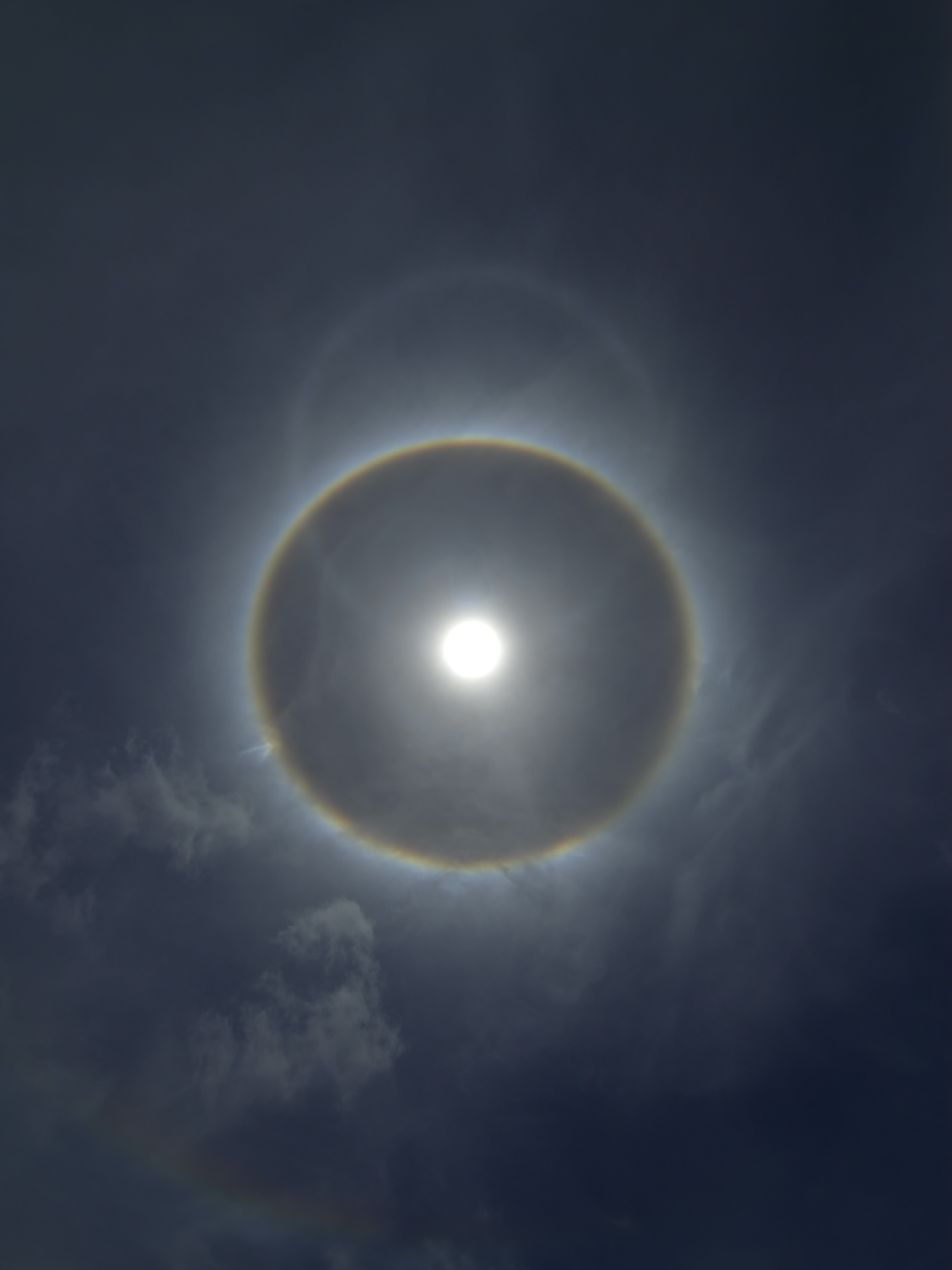
A rare double Sun Halo was observed in Christ Church, Bardaos, by David Marshall of the UK!

A FIGURE-8 IN THE SKY: David Marshall of Christ Church, Barbados, is a veteran observer of sun halos--arcs of light that circle the sun when icy clouds fill the sky. Yesterday, however, he saw something for the first time. "In addition to an ordinary 22-degree halo, there was also another circle crossing through the sun and centered on the zenith," he says. "I had never seen this before."


"It was easily visible to the naked eye and not a result of reflection within the camera," he adds.

Marshall photographed a complete parhelic circle--a rare sight when the sun is near the zenith. Normally, parhelic circles form when the sun is low in the sky, and the arc circles the horizon in a giant 360-degree sweep. These arcs are quite dramatic.

As the sun climbs higher in the sky, the parhelic arc shrinks in size, becoming even smaller than a 22-degree halo. This type of small parhelic circle is less dramatic than the giant version, but arguably more eye-catching. You can see the whole thing without turning around, and it creates an apparent figure-8 at the apex of the sky. Congratulations to David Marshall for catching this rare formation!
 
As I was reading this article, I had this super wild speculation... What if it's warming up because of 4D tampering? Maybe they need the region for the upcoming changes, i.e. Ice Age. Anyway, FWIW:

About 10 years ago, the amount of sea ice around Antarctica suddenly declined.

After many years of relatively stable sea-ice coverage, an expanse of ocean nearly the size of Greenland lost its seasonal ice within just a few years. At first, researchers thought the decline might be temporary. Today, however, this abrupt, step-like drop is understood to have been the onset of a new ‘low-ice era’. [...]

Here's another press release about it, with a "you've got to be kidding explanation" attached to it.

Antarctica's sea ice suddenly started shrinking a decade ago — and deep-diving robots are revealing why

A decade ago, southern sea ice suddenly and dramatically declined. Scientists say the culprit was a "very violent release" of deep, pent-up heat.

Something strange has been swirling in the waters around Antarctica. From the 1970s until a decade ago, the floating sea ice that radiates from the continent had been expanding, even with climate change already in full swing. Then, in 2016, it suddenly and dramatically contracted — and has yet to recover — as rising global temperatures seemed to catch up with the Southern Ocean. Far from being just a local issue, the loss of sea ice has huge implications for Antarctica's vast ice sheet, which would drive sea levels up 190 feet if it disappeared.

Now, scientists say they've identified what's behind this rise and sudden fall, thanks to an assist from deep-diving robots. It all comes down to salinity, winds, and churn. "One of the key takeaways from the study is that the ocean plays a huge role in sort of modulating how sea ice can vary from year to year, decade to decade," said Earle Wilson, a polar oceanographer at Stanford University and lead author of a new paper describing the research.

Doing the grunt work here was a network of data-gathering machines known as Argo floats. Torpedo-shaped and about the size of a human, they sink thousands of feet, sampling things like temperature and salinity, before popping back up to the surface and transmitting all that data to a satellite. Because they float passively, the instruments could for years gather data about how conditions were changing.

Now, forget about robots and think about swimming in a lake. When you dive, you're hit by a sudden rush of cold water. That's because the sun warms the surface, while the depths stay cool. This also happens in the world's oceans, though obviously the cold water goes much deeper.

The opposite happens in the waters around Antarctica. Because it's so cold down there, the air cools the ocean surface, while warmer waters swirl below. (Argo robots could detect this in fine detail as they ascended and descended.) With warmer liquid kept away from the surface, more sea ice can form.

As sea ice expanded in the decades before 2016, increased precipitation made surface waters fresher, in contrast to saltier waters below, resulting in stratification. (The saltier a liquid is, the denser it becomes.) This trapped the warmth in the depths, allowing it to build up.

Then the atmosphere played yet another trick, as winds intensified and shifted. This pushed surface waters away from Antarctica and churned up that deeper warmth. "What we witnessed was basically this very violent release of all that pent up heat from below that we linked to the sea ice decline," Wilson said.

This bluster was likely driven at least in part by climate change: As the planet warms, the atmosphere develops temperature gradients, which strengthen winds and change their patterns. Scientists, though, are still working out how much of this shift might be due to "natural variability," or what might happen anyway if humans hadn't released so much carbon since the Industrial Revolution.

Either way, the system shifted around 2016. Beyond bringing up warm waters, all that wind may have broken up the ice, both by pushing blocks together and by creating waves. "Recent research has shown that both atmospheric and oceanic warming is likely contributing to the sudden change in Antarctic sea-ice extent since 2016, and this paper helps to further develop the point that deeper ocean warmth is a significant player," said Zachary Labe, a climate scientist at the research group Climate Central who studies Antarctic ice but wasn't involved in the paper.

As sea ice has declined, it has imperiled far more ice elsewhere. The Antarctic ice sheet that rests on land is bolstered by ice shelves that float along the coast. These essential supports are already in serious trouble as warming seas and violent underwater storms erode their bellies, weakening them. If they also lose the sea ice floating around them, they lose a significant buffer, as the floating chunks absorb wave energy. In addition, a healthy amount of sea ice is quite bright, meaning it reflects a bunch of the sun’s warmth into space, reducing local temperatures. Because the ice shelves hold back the ice sheet, losing them would mean an accelerated decline of an extraordinary amount of frozen water sitting on the continent.

While the Argo floats provided invaluable data, scientists are scrambling to get still more measurements. "Overall, we need more international support to continue building observing networks across the Antarctic polar region, both for oceanic and atmospheric monitoring," Labe said. "This is critical given the rapid changes we are beginning to observe in this part of the world in a warming climate, with potentially significant consequences for global sea level rise."

The big question now is whether we're witnessing a permanent state of low sea ice, or whether atmospheric and oceanic conditions might swing back enough to encourage years of growth. The promise of this new research is that it will help researchers refine their models to predict how much the waters around Antarctica might change, and how quickly. Perhaps sea ice will see years of sharp decline, followed by years of growth. "But the long-term, multidecade trend will be negative," Wilson said. "That would be my guess, but we don't know for sure."
 
Green lights in the Kona sky, confirmed by Suspicious Observer as charged particles from the comet PANSTARRS

Mysterious green lights in the Kona sky leave astronomers searching for answers
Apr 27, 2026
A strange glow in the night sky over Hawaiʻi Island is raising eyebrows—and questions—after a Kona resident captured unusual green lights on camera over the weekend.

 
confirmed by Suspicious Observer as charged particles from the comet PANSTARRS
This is another one who draws a lot of people...

January 14th, 2023

Q: (Joe) That Suspicious0bserver guy is a bit whacky.

(Niall) And he speaks in a tone that's VERY self-assured. Always a red flag...

Like I said here, I think Ben is going by instinct, and he tries to support his hypothesis from published studies. Even though there's some pattern recognition run really amok, he means well. I think it's unnecessary overhystericization of the population, though. So I would be careful with him as a source of news.

Same goes for the Burns guy. Self-assured guys without giving proper due to the real concepts... Seems to be the winning formula while people still miss the crux of the matter. Some would be exposed to non mainstream concepts though, and will have the drive to go deeper. At least that.
 
Mysterious green lights in the Kona sky leave astronomers searching for answers
Apr 27, 2026
A strange glow in the night sky over Hawaiʻi Island is raising eyebrows—and questions—after a Kona resident captured unusual green lights on camera over the weekend.

Notice

that those "green lights" only move vigorously, as the cameras moves. While the glow is still, when the camera doesn't move.
I find that quite odd - but have no explanation or ideas on that. Nor what could be the source of the supposedly green lights.
 
Back
Top Bottom