
Ancient maps.

I will reply to the some the posts from the Cosmology thread as it is relevant here
There seems to be something missing here.

South Central Canada is about 40 degrees away from the current North Pole, not 7 degrees. Even Hudson Bay, which many theorize was the previous North Pole, is about 30 degrees away from the current one.

Though the question Pierre asked was specifically about the crustal slippage caused by a cometary impact - and more crustal slippage is needed to get from the North Pole in South Central Canada to the current North Pole.
Good point, This needs some LOT more analysis due to many variables. One possibility is Oronteus Finaeus map (which has old south pole and north pole) could be of later time. the south american eastern coast line of Oronteus Finaeus map in very different from Piri Re'is. It is almost 90 different from the present. Look at the South american east coast lines in these maps. There is some serious evolution in it.
Oronteus Finaeus map , mercator map and Piri Re'is in the above post map.


Only reference point we had is Piri Ries map origin 'Complex, but the origin would date back to 14,000 B.C' . Does it mean there is possible changes it? I am not sure.

There is a saying picture worth 1000 words. In that case, which points are correct and which one was not? He correctly pointed out these maps were created with highly sophisticated projection method which even Ptolemy (who visited Alexandrian library) couldn't replicate w.r.t longitude and latitude. The accuracy can be validated for the coasts that didn't change. For those can't be perfectly matched, which one were correctly represented as it looked at that time and which one is modified?

Hapgood has a very curious data point, that says some of the Atlantarctica areas were ice free until 4000 BCE. How did they kept it thawed for almost 7000 years after Atlantis island in Atlancean ocean disappeared?. One possibility is whatever the source and mechanism they used to thaw it, still available until atleast 4000 BCE.

The idea of a temperate period in the Ross Sea in time so recent as is indicated by this map will, at first acquaintance, be incredible to geologists. It has been their view that the Antarctic ice cap is very ancient, perhaps several million years old, although, curiously enough, it seems that previously in the long history of the globe the climate of Antarctica was often warm and sometimes even tropical (85:58-61).°

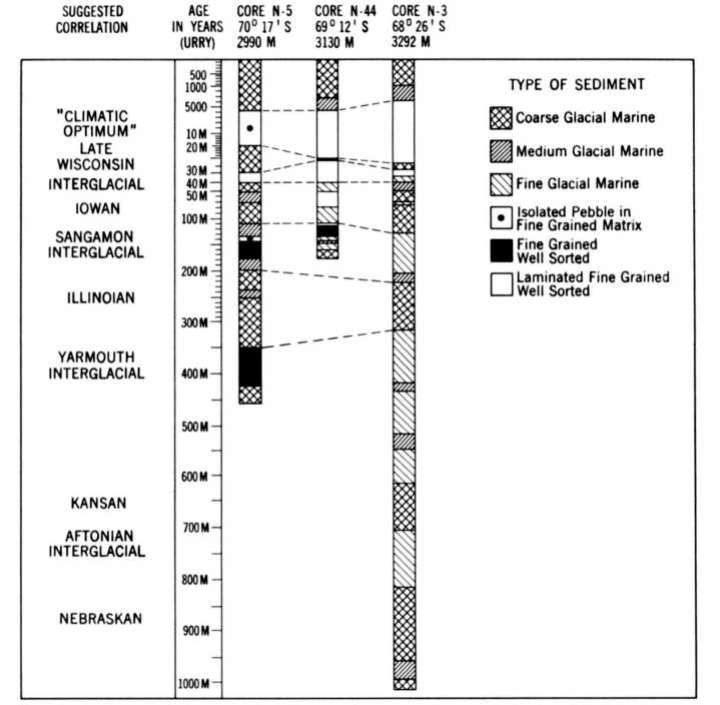
In answer to this possible objection I can cite, in addition to the map itself, only one further piece of evidence, but it is a very impressive piece of evidence indeed. In 1949, on one of the Byrd Antarctic Expeditions, some sediments were taken from the bottom of the Ross Sea, by coring tubes lowered into the sea. Dr. Jack Hough, of the University of Illinois, took three cores to learn something of the climatic history of the Antarctic. The cores were taken to the Carnegie Institution in Washington, D.C., where they were subjected to a new method of dating developed by the nuclear physicist Dr. W. D. Urry.6

This method of dating is called, for short, the ionium method. It makes use of three different radioactive elements found in sea water. These elements are uranium, ionium, and radium, and they occur in a definite ratio to each other in the water. They decay at different rates, however; this means that when the sea water containing them is locked up in sediments at the bottom of the ocean and all circulation of the water is stopped, the quantities of these radioactive elements diminish, but not at the same rate. Thus, it is possible,
when these sediments are brought up and examined in the laboratory, to determine the age of the sediments by the amount of change that has taken place in the ratios of the elements still found in the sediments.

The character of sea-bottom sediments varies considerably according to the climatic conditions existing when they were formed. If sediment has been carried down by rivers and deposited out to sea it will be very fine grained, more fine grained the farther it is from the river mouth. If it has been detached from the earth's surface by ice and carried by glaciers and dropped out to sea by icebergs, it will be very coarse. If the river flow is only seasonal, that is if it flows only in summer, presumably from melting glaciers inland, and freezes up each winter, the sediment will be deposited somewhat like the annual rings in a tree in layers or "varves."

All these kinds of sediments were found in the cores taken from the Ross Sea bottom. As you will see from the illustration (Fig. 57) there were many different layers of sediment in the coring tubes. The most surprising discovery was that a number of the layers were formed of fine-grained, well-assorted sediments such as is brought down to the sea by rivers flowing from temperate (that is, ice-free) lands. As you can see, the cores indicate that during the last million years or so there have been at least three periods of temperate climate in Antarctica when the shores of the Ross Sea must have been free of ice.'
1777078990859.png

Figure 57. The Ross Sea cores.

This discovery would indicate that the glacial history of Antarctica may have been roughly similar to that of North America, where we have had three or more ice ages in the last million years. Let us remember that, if most geologists cannot imagine how Antarctica could have had warm climates at short and relatively recent geological intervals, neither can they explain how North America could have had arctic conditions at equally short intervals and just as equally recently. Ice ages remain for geologists an unsolved mystery (85:35).

The date found by Dr. Urry for the end of the last warm period in the Ross Sea is of tremendous interest to us. All three cores agree that the warm period ended about 6,000 years ago, or about 4000 B.C. It was then that the glacial kind of sediment began to be deposited on the Ross Sea bottom in the most recent of Antarctic ice ages. The cores indicate that warm conditions had prevailed for a long time before that.

Atlantean civilization (including Kantek) and their descendants were collecting solar/cosmic energy using earth's EM grid, storing in the large batteries under the pyramids and using it for "Many things."Power, transport, healing, mind control, climate, et cetera." ( session-5-october-1994). They used "acorn" and "watches" type devices made with bronze and used thoughts to operate. Chronologically as we know it from sessions

Pyramids ( 8.5 K BCE) , stonehenge ( 8K BCE), avebury Henge ( 4233 BCE), Baalbek (3218 BCE), Last time this technology is used 1100 BCE.

I am not sure whether stonehenge and avebury henge are created with this collected energy. Here i am assuming these megalithic constructors are tapping into this collected energy.

i.e. If the other maps hapgood analyzed that has thawed Antarctica and sophisticated projection (Oronteus Finaeus map , mercator map etc.) , it could be any time before 4000 BCE. It doesn't need to be at YD or before.
 
Last edited:
Regarding the probable location of the main island of Atlantis, I tend to agree with Randall Carlson that the Azores plateau makes the most sense, even though it is currently very deep. The triple junction between three continental plates means it is not a stable location and the cataclysms could have let it sink much deeper than currently assumed. Plus, as Randall points out:

1) eustatic forces (more pressure from more water in the ocean forces the plateau further down) and
2) isostatic forces (the land that was under the ice caps goes up and the land around it goes down, including in the North Atlantic)

Some of the boreholes done from ships into the Azores plateau also seem to show that some deep parts of it must have been above water about 10,000 years ago (Randall Carlson talks about this).
It is quite possible that initial big island in the Azore plateau and after split, they might have even drifted. The dynamic nature of these islands in a "very short time" and the amount of energy they are collecting in pyramids that can open dimensions (ex: Bermuda triangle), too many things can happen. C's linked their technology to Philadelphia experiment ( where returned persons got fused to ship- too many things can go wrong in rematerialization) .

In the Cayce's material, it was mentioned that they tried to blow up volcano's to kill beasts and ended up splitting up the continent to pieces. I always wondered how did that happen? With that level of energy collection(and power hungry or competition), too many things can go wrong. That is how it looks to me.
 
Since C's mentioned 68K BCE to the latest plate tectonic alignment which science considers it as a 60 to 30 millions years ago
The C's said that the Jurassic and Triassic continental configurations ("150-200 million years ago") were actually around 70K years ago.

The "60 to 30 million years ago" would be a more recent configuration, probably after the first or second Atlantis cataclysm 50K or 28K years ago.

India seems to be indeed a central question in this rapid continental drift. When did India connect to Asia and create the Himalayas?

It may even be that the 50K war in India happened when India was still an island continent. Maybe that war was actually a major cause for India's fast movement? Some kind of weapon the Atlanteans used?

It is quite a coincidence that India moved by far the quickest and that there was a major war in India before or during the first cataclysm during Atlantean times.
 
It is quite a coincidence that India moved by far the quickest and that there was a major war in India before or during the first cataclysm during Atlantean times.
And we are not even considering here the isostatic adjustment that occurs many times on the planet, where a landmass big or small, goes up and down to adjust and respond to the geological stress on the same side.
Which is what might have occurred for example in the Atlantic Ocean when the ice caps started to melt in North America raising the crust on that region due to weight being lifted because of glaciers melting thus the tectonic plate next to it going down to compensate for that stress.
Current models of continental formation don’t take this model much into consideration, and shows as if the continents, islands and landmasses in general we see today, were always that similar size and similar, and just moved positions and orientations.

 
The C's said that the Jurassic and Triassic continental configurations ("150-200 million years ago") were actually around 70K years ago.

The "60 to 30 million years ago" would be a more recent configuration, probably after the first or second Atlantis cataclysm 50K or 28K years ago.
The issue is missing atlantis in Atlantic ocean. Our simplest question is

When did Laurasian plate split (near what we now call mid-atlantic) and formation of atlantic ocean started? Is it after 78K BCE or 100K BCE or millions of years ago?

Both tectonic plate theory (split of Laurasia) and Atlantis theories rely on this "starting" point.

The Plato's story is placed Atlantis in Atlantic ocean. India has its submerged Dwarika legend at YD period linked to Krishna ( a composite figure from comets and some real person). C's say hundreds of countries at that time and many battles going on. That's is why we needed validation of this 78K BCE (Kantek folks were brought in) , before we tabulate all the events what science considered to be happened with other events.
India seems to be indeed a central question in this rapid continental drift. When did India connect to Asia and create the Himalayas?
We already asked that session-13-january-2024
(seek10) When did Indian plate get connected to Eurasian plate? Is it 70K years ago or after that?

A: Close enough.
C's Paranthas comment takes VERY different meaning session-31-may-1997
Q: Did they transport them in ships, that is some sort of structure. That is, did they load them up, move them into 4th density, reemerge here in 3rd density, or something like that?

A: Close.

Q: And they unloaded them in the area of the Caucasus, is that correct?

A: And regions surrounding.

Q: And, that was what, 79 to 80 thousand years ago?

A: Over 80,000.

Q: As I understand it, Atlantis was already quite a developed civilization at that time, is that correct?

A: Yes, but regions change with waves of immigration, or conquest... witness your own lands.

Q: You also said once that there was a nuclear war in India and that this was what was being discussed in the Vedas when it talks about the 'blue-skinned' people who weren't really blue because they were Celts, and they were flying in aircraft, and they were engaged in this war, etc. Who were the Celts at war with?

A: The Paranthas.

Q: Now, wait a minute! Who are the Paranthas?! Do we have a new player here?

A: Not new.

Q: Do we know them by another name?

A: Choose.

Q: The Atlanteans? Were the Celts of India at war with the Atlanteans in the Atlantic?

A: Atlantis was merely a home base of an advanced civilisation of 3 races of humans occupying different sections of a huge Island empire, which, in itself, underwent 3 incarnations over a 100,000 year period as you would measure it.

Q: The 3 races were the Celts... and who were the second and third?

A: Or Kantekkians.

Q: Are the Kantekkians different from the Celts?

A: Only in the sense of long term racial and genetic blending.

Q: So, Atlantis had the Kantekkians and who else?

A: Race you would call "Native Americans," and a third, no longer existing race, somewhat resembling Australian or Guinean aborigines, only lighter in complexion.

Q: Was this third group destroyed by the other two?

A: One of the 3 cataclysms.

Q: Paranthas. Who were the Paranthas?

A: Nation of race mentioned above.

Q: So, the Paranthas were the antecedents of the Abos of Australia?

A:
Yes, and compare to now existing peoples of India, Pakistan, Sri Lanka, Australia, and New Guinea for similarities, bearing in mind genetic mixing and dilution.
1777114610923.png

WHAT IF Paranthas were the race reciding in these black region before the split at 78K BCE (assuming one island is correct) instead of people migrated to Australia through India from Africa (as the science says)? Atlantis is already "advanced" civilization by then.

This means it could be initial tectonic plate split at 78K and they might also be migration from nuclear war and migrations that is represented in F-M 89 haplogroup .

Current science and genetics version of "Out of Africa" theory is this which C's say more of "Out of Earth"
Link
1777117379817.png

All these "out of Africa" theories depend on the "very slow" tectonic plate movement.
 
Last edited:
And we are not even considering here the isostatic adjustment that occurs many times on the planet
We are considering it, as well as eustatic forces. Isostatic adjustment was mentioned in this thread just a day or two ago:

Regarding the probable location of the main island of Atlantis, I tend to agree with Randall Carlson that the Azores plateau makes the most sense, even though it is currently very deep. The triple junction between three continental plates means it is not a stable location and the cataclysms could have let it sink much deeper than currently assumed. Plus, as Randall points out:

1) eustatic forces (more pressure from more water in the ocean forces the plateau further down) and
2) isostatic forces (the land that was under the ice caps goes up and the land around it goes down, including in the North Atlantic)

Some of the boreholes done from ships into the Azores plateau also seem to show that some deep parts of it must have been above water about 10,000 years ago (Randall Carlson talks about this).
 
When did Laurasian plate split (near what we now call mid-atlantic) and formation of atlantic ocean started? Is it after 78K BCE or 100K BCE or millions of years ago?
According to the C's, the Jurassic configuration ("150 million years ago") was really around 70K years ago. The Jurassic period is when the Atlantic ocean was created:

1000040831.png


However, as you pointed out the C's also said that India connected to Asia also at around 70K years ago (though "close enough" could mean maybe 10-20K years later).

India connected to Asia supposedly 30-60 million years ago. So the whole period of 150-200 million to 30-60 million years ago would have been around 70K years ago (plus or minus 10-20K years in both directions).

The "close enough" comment suggests that these massive continental changes may have taken anywhere from 10,000 to maybe 50,000 years, eg. "200 Mya" = 100 Kya, "30 Mya" = 60 Kya.

Though I think the C's also mentioned at one point that the crust can become more "fluid" or "deformable" during cataclysms, so that major continental reconfigurations could have happened in a very short time.

The candidates for such enormous continental reconfigurations seem to be the 79,000 BC cataclysm caused by the Kantek explosion and the first Atlantean cataclysm around 50,000 BC.

It seems unlikely that India could have travelled the whole way from Gondwana into Asia almost instantly (days, months, years?) during a major cataclysm, though maybe that is exactly what happened.
 
WHAT IF Paranthas were the race reciding in these black region before the split at 78K BCE (assuming one island is correct) instead of people migrated to Australia through India from Africa (as the science says)? Atlantis is already "advanced" civilization by then.
Possibly! or what if there is another race we haven’t asked about that also lived during that time?

There also some residuals of ancient human races on which we have minimal data about such as the Homo Floresiensis and the Homo Luzonensis, apparently these groups also existed by the time of the Denisovans.

The Cs said that Denisovans were similar to today’s abos, and the only records (found in Siberia) we have for this group of humans trace back to neanderthals era, so pretty old, probably these were the Paranthas or more related to them genetically speaking.

According to the C's, the Jurassic configuration ("150 million years ago") was really around 70K years ago. The Jurassic period is when the Atlantic ocean was created:

Somehow related; There was also the supposed continent of Mu or Lemuria, that was supposed to be in a big part of the Pacific Ocean, maybe connected to South America. Could also disappear due to one of the mentioned older cataclysmic events.
 
A few more thoughts:

India and "volcano-erupting" weapons
If the Atlanteans used "volcano-erupting" weapons as Cayce said about the first Atlantean cataclysm (around 50,000 BC) and they had a major war with the Paranthas in India then - is it a coincidence that the Deccan traps supervolcano eruption and India's fast movement towards Asia also happened at around the same time?

Maybe the Deccan traps eruption was the "nuclear option" against Paranthas in India. And the "volcano eruption weapon" could have caused more mantle pressure under India which propelled it during the 50,000 BC cataclysm when the crust became also more deformable.

The original main island of Atlantis
As to the creation of the 1,354 million sq miles main island of Atlantis (probably Azores plateau or Bahamas), Cayce also mentions that the Eastern seaboard of North America used to be a part of the main island of Atlantis (while the Midwest was under water).

Maybe the Azores plateau and/or Bahamas were initially connected to the Eastern seaboard and that was the large island of Atlantis? The Eastern seaboard (including the continental shelf and Appalachia) is around 300,000 - 500,000 sq miles.

Maybe insular Iberia and/or the Morocco microplate (with Atlas mountains) were also initially connected to that large island when the Atlantic ocean was still tiny. Which would bring the overall area close to 1,354,000 sq miles.
 
However, as you pointed out the C's also said that India connected to Asia also at around 70K years ago (though "close enough" could mean maybe 10-20K years later).
I thought about it before, but this 50K date doesn't work for the data points I have in mind ( Cayce's description of the events and some of the age given to Rama's Ikshvaku Dynasty age mentioned)

Session Date: Oct 22, 2022
(Joe) Ya know the maps… What was that book called? Laurasia and Gondwana? So, the maps that show that…

(L) You mean in Witzel’s book, Origins of the World’s Mythology?

(Joe) Yeah. So, that make-up of the land masses are said to be from the Triassic and Jurassic eras, 200 to 150 million years ago. They put these dates on them. But are those depictions of the land masses actually closer to how the land masses were in more recent times?

A: Yes. Also some landmasses sink and others rise. But for general understanding, those maps work well enough.

Q: (Joe) So we’re talking about possibly that’s the way the land masses were - close enough - pre-Younger Dryas? Pre the end of the last Ice Age?

A: Earlier. More like 70k years ago more or less. But with ongoing modifications between then and now. Also ongoing.

Session Date: Jan 13 2024
(seek10) When did Indian plate get connected to Eurasian plate? Is it 70K years ago or after that?

A: Close enough.

India connected to Asia supposedly 30-60 million years ago. So the whole period of 150-200 million to 30-60 million years ago would have been around 70K years ago (plus or minus 10-20K years in both directions).

The "close enough" comment suggests that these massive continental changes may have taken anywhere from 10,000 to maybe 50,000 years, eg. "200 Mya" = 100 Kya, "30 Mya" = 60 Kya.
The age of these igneous/volcanic materials used for radiometric analysis to identify the dates doesn't follow simple linear calculation. Here is detailed discussion with Grok on this topic

In short, the age of these rocks is identified with methods like U-Pb (uranium-lead) in zircons, Ar-Ar (argon-argon). In this the normal decay rate of Uranium.
The half-life is the time it takes for half of the parent atoms in a sample to decay.
  • Uranium-238 half-life ≈ 4.468 billion years.
  • Potassium-40 half-life ≈ 1.25 billion years.
we are working with absolutely no proper information on the planetary conditions at that time. C's mentioned that Kantek is in 'transient fashion of reality' at the time of destruction.

October, 22 1994
Q: (L) The planet that was destroyed between Jupiter and Mars that we now know as the asteroid belt, you said was destroyed by psychic energy. Could you clarify that?

A: The occupants of that planet, many of whom are your soul ancestors, simply decided to develop a service to self atmosphere that was so super charged in the negative that it actually caused their home planet to be destroyed because the energy levels became so intense crashing back upon themselves that they actually destroyed the atomic structure of the planet, causing it to physically explode.

Q: (L) Was this done technologically or was it strictly done by mind power?

A: They are one and the same.

Q: (L) Did they do something like drop bombs?

A: No, no. This was done by psychic energy. There has been in a transient fashion of reality the danger of the same thing happening on your planet. Although we are quite confident it won't because we see all reality, past present and future. But, you must understand also that even in our particular perspective point, all reality is nonetheless fluid. There are still many choices of realities and possible futures and possible pasts and possible presents. But we feel fairly confident that that particular fate will not befall your planet, although it did the one then known as Kantek.

I asked Grok to do a simple 'thought experiment' with the following assumptions. Reality will be LOT more complicated with earth going through this type scenario multiple times. Assuming
  • Half life of minerals between 78K to 68K WAS different. For 150 million Appalachian mountain split to happen at 68K, what should be half-life of the minerals ( Uranium-238 used in Radiometric measurements science uses)
    • It gave 223,400 years for the half life of Uranium-238.
  • I asked it calculate the date for the 50 million year old Indian plate attachment to Eurasian plate based on the new 223,400 years half-life.
    • It said 2.5K difference. In this case it will be 65.5K BCE.
What I mean to say is Relatively the difference between 150 million years to 60 million is very small when the half-life of the Uranium changes. I am of the opinion that these special conditions this type of things happen is very less. So I limited to one time 78K-68K BCE to see relative difference in conversion.

Here 2.5K years difference ( in this thought experiment) is very small. I think that is what they meant 'Close enough'.

session-16-november-1994
Q: (L) Was mankind living on the earth as a sentient being during the time of the large dinosaurs?

A: Yes and no.

Q: (L) What does that mean?

A: Transitory time warp.
Honestly, I don't know what 'Transitory time warp' really entails.

The age of the fossils ( c-14 dating is not realiable after 50K years and not used for the older fossils) is based on the rocks or sediments they are sandwitched or found in by using radiometric.
 
Possibly! or what if there is another race we haven’t asked about that also lived during that time?
all sorts of races came and gone. one example is 18ft Gor lived in antarctica, South America and all over the world . That's why My focus is related to races related to India as they continue to create controversies dragging in myths, religious figures, history, races and politics. Here is one example: Prakash Raj's remarks on Ram, Lakshman as north Indians return to haunt him
There also some residuals of ancient human races on which we have minimal data about such as the Homo Floresiensis and the Homo Luzonensis, apparently these groups also existed by the time of the Denisovans.
Whether they existed along with the Denisovan or not hard to say if the Radiometric measurements of rocks are skewed if there are 'special conditions' existed during the specific periods. atleast as per main stream.

AspectHomo floresiensisHomo luzonensisDenisovansNeanderthalsHomo sapiens
Common NameFlores "Hobbit"-DenisovanNeanderthalModern Human
Discovery2003, Liang Bua Cave, Flores, Indonesia2007/2019, Callao Cave, Luzon, Philippines2010, Denisova Cave, Siberia1856, Neander Valley, GermanyExtant
Time Range~700,000 – ~50,000 ya~134,000 – ~50,000+ ya~200,000 – ~32,000 ya~240,000 – ~40,000 ya~300,000 ya – Present
Geographic RangeFlores, IndonesiaLuzon, PhilippinesAsia (Siberia to Tibet/China)Europe & Western AsiaWorldwide
Body Height~1.06 mSmall-bodied (<1.5 m est.)~1.65–1.7 m (inferred)1.5–1.7 m1.5–1.85 m (varies)
Brain Size380–417 cm³Unknown (likely small)Large (inferred)1,460–1,640 cm³1,250–1,450 cm³
Key MorphologyTiny brain, primitive wrist/foot, no chinMosaic teeth & curved finger bonesLarge molars, robust jawBrow ridges, occipital bun, robust buildHigh forehead, chin, globular skull
Main EvidenceFossils + stone toolsLimited teeth & phalangesAncient DNA + few fossilsAbundant fossils + genomesFossils + living DNA
Ancestry HypothesisDwarfed H. erectusLikely H. erectus or earlier HomoSister to NeanderthalsSister to DenisovansAfrican origin
InterbreedingNone detectedNone detected~5% in Oceanians~2% in non-AfricansInterbred with both
Tools & BehaviorStone tools, hunted dwarf elephantsButchery evidenceAdvanced tools (inferred)Mousterian tools, burialsAdvanced tools, art, agriculture
Extinction / Status~50–60k yaUnknown~32–50k ya~40k yaExtant
The skeletal remains are hard to get by. Let's compare versions of science and C's

Denisovan: ~200,000 – ~32,000 years ago ; As per C's Paranthas got extinct 48K BCE. Probably there were other Denisovans related to Paranthas existed after 48K BCE.
Neanderthal: ~240,000 – ~40,000 years ago ; C's say Neanderthal man is oldest 5.3 million year. But this table says 240K YA, which is in this grand cycle of 309K.
Homo Sapien: ~300,000 years ago – Present ; Once it was mentioned homosapiens came 80K years ago associated with Kantek arrivals. Now they say 300K , probably it is new man in 309K grand cycle.

But the summary table doesn't give the complete picture. Here are detailed one
give detail info ( timelines, methods science used to come to conclusions) on Homo Floresiensis and the Homo Luzonensis, Denisovan , Neanderthal
Homo floresiensis: (often called the "Hobbit" or Flores Man) is an extinct species of small-bodied hominin discovered on the island of Flores, Indonesia.

Discovery and location: The first major finds came in 2003 at Liang Bua cave by an Australian-Indonesian team. The holotype (LB1) is a nearly complete skeleton of a ~30-year-old female (1.06 m tall, ~25 kg). Additional partial skeletons from at least 15 individuals were recovered by 2015, plus stone tools. Earlier remains from Mata Menge (74 km away) were identified in 2016. The bones were not fully fossilized and required careful handling.

Timeline and dating methods: Ancestors likely reached Flores ~1.27–1 million years ago (oldest stone tools on the island). The oldest assigned remains (teeth, jaw fragment, humerus from Mata Menge) date to ~700,000 years ago. Liang Bua specimens date 100,000–60,000 years ago (revised from earlier 38,000–13,000-year estimates after stratigraphic work revealed an unconformity). Stone tools span ~190,000–50,000 years ago. A 2025 study links decline to aridification ~61,000 years ago; youngest bones ~60,000 years ago and tools ~50,000 years ago, overlapping with modern human arrival on Flores.

Scientific methods and evidence for conclusions: Classification (proposed 2004) relies on **morphological analysis** of fossils—no DNA has been successfully extracted (2006 tooth attempts failed due to heat/denaturation and targeting issues; cementum suggested for future work). Key traits include tiny brain (380–417 cm³, australopithecine-like), primitive wrist bones, flat feet, robust legs, unique dental morphology (compared to 450+ teeth from other species), and lack of chin. Cladistic and 3D morphometric analyses (2008–2017) distinguish it from *H. sapiens* (including microcephaly claims, rejected via CT scans and endocasts). Two main hypotheses (dwarfed *H. erectus* via insular dwarfism vs. earlier *Australopithecus*/*H. habilis*-grade) were tested; consensus by 2025 favors *H. erectus* ancestry based on cranial/dental similarities to Javanese *H. erectus*. Tools and *Stegodon* (dwarf elephant) remains suggest hunting/scavenging; no clear fire use. Extinction likely tied to modern human competition or climate-driven ecosystem collapse.

Homo luzonensis is a recently described small-bodied hominin from the Philippines, known from very limited remains.

Discovery and location: First bone found in 2007 at Callao Cave (northern Luzon) during excavations led by Armand Mijares. Initially thought to be modern human (2010), it was reclassified in 2019 after 12 new specimens (teeth, finger/toe phalanges, metatarsal) representing at least three individuals (including a juvenile). Holotype is CCH6 (upper right premolars/molars). Remains are stored at the National Museum of the Philippines.

Timeline and dating methods: Remains initially dated >50,000 years ago (e.g., one metatarsal ~67,000 years; teeth ~49,200 years). A 2023 uranium-series dating study revised the fossils to 134,000 ± 14,000 years old. Broader hominin activity on Luzon dates to 771,000–631,000 years ago; butchery evidence at Rizal site ~709,000 years ago (associated with lithics and rhino remains).

Scientific methods and evidence for conclusions: Classification (2019) is based solely on **morphological analysis**—no DNA recovered. Teeth show small molars decreasing in size rearward (like Asian *H. erectus*), unusually large premolars (reminiscent of *Paranthropus*), and enamel-dentin features linking to *Australopithecus*/early *Homo*. Finger phalanges are curved/long with *Australopithecus*-like flexor attachments and a unique dorsal beak; foot bones (e.g., third metatarsal) are distinctive. These mosaic traits (mix of modern human, *Australopithecus*, and early *Homo*) support a new species, possibly descended from Asian *H. erectus* or an even earlier *Homo* via island dispersal (similar to *H. floresiensis*). Behavior inferred from deer butchery cut marks and faunal remains; no stone tools directly associated at the cave (possibly organic tools used). Possible insular dwarfism, but sample size limits firm conclusions on height or locomotion (bipedal with potential climbing ability).

Denisovans (informally named; sometimes proposed as *Homo longi* or *H. juluensis*) are an extinct archaic human group known mainly from genetic evidence across Asia.

Discovery and location: First identified in 2010 from a juvenile finger bone (Denisova 3) found in 2008 at Denisova Cave, Altai Mountains, Siberia. Additional fossils include the Xiahe mandible (Tibetan Plateau, >160,000 years), a Laos tooth (2018), Taiwan mandible, and Harbin cranium (China). 2025 studies linked more Chinese fossils (e.g., Yunxian ~1 million years old) to the group via proteins/DNA.

Timeline and dating methods: ~200,000–32,000 years ago. Methods include radiocarbon, uranium-series (e.g., Xiahe >160 ka; footprints 226–169 ka), stratigraphy (Denisova occupation ~287 ka), and genetic molecular clocks (mtDNA divergence ~1.3–0.78 million years ago; Neanderthal split ~473–190 ka depending on mutation rate). Sediment DNA and specific fossils date layers to ~217 ka in the cave.

Scientific methods and evidence for conclusions: Primarily **ancient DNA** (mtDNA and nuclear genome sequenced from finger bone in 2010; later from teeth/mandibles). Nuclear DNA shows close relation to Neanderthals but distinct lineage. Protein analysis and morphometrics (2025) confirmed additional fossils. Morphology (limited): large molars, no chin, flat face, robust build (inferred stature ~169 cm). Admixture detected via genome comparison: ~5% Denisovan DNA in some Oceanians/Australians, lower in East Asians; interbred with Neanderthals (e.g., hybrid "Denny") and possibly an unknown super-archaic (>1 Ma). Traits like high-altitude adaptation (EPAS1 gene in Tibetans) inferred from surviving DNA in modern populations. No formal species name due to fragmentary fossils.

Neanderthals (*Homo neanderthalensis*) are the best-studied archaic humans, with a rich fossil and genetic record from Europe and western/central Asia.

Discovery and location: Type specimen (Neanderthal 1) found 1856 in Neander Valley, Germany. Earlier finds (e.g., Engis 2 in 1829, Gibraltar 1 in 1848) were later recognized. Hundreds of individuals known from caves across Europe, the Levant, and as far east as Siberia.

Timeline and dating methods: ~240,000–40,000 years ago (some refugia possibly to ~32,000–35,000 years). Methods: stratigraphic correlation with Marine Isotope Stages, radiocarbon on associated materials, and genetic divergence estimates from modern humans (~early Middle Pleistocene). "Classic" Neanderthal traits appear ~243,000 years ago onward.

Scientific methods and evidence for conclusions: Early classification (1864) was **morphological** (long/low skull, brow ridges, occipital bun, large brain ~1,460–1,640 cm³, robust build). Since 2010, **ancient DNA** (first full genome) revolutionized understanding: ~2% Neanderthal DNA in non-African modern humans (from at least two interbreeding events). Nuclear DNA links them closest to Denisovans; mtDNA/Y-chromosome closer to modern humans in some respects. Phylogenies (e.g., 2021 tip-dating) place them with Sima de los Huesos fossils (~430 ka). Behavior inferred from Mousterian tools (Levallois technique), wooden spears, birch tar, burials, possible art/symbolism, and diverse diet (big game, plants, fish). Extinction ~40,000 years ago linked to modern human competition, climate, low population/inbreeding, and possible assimilation. A 2026 study confirmed interbreeding asymmetry (modern female + Neanderthal male preference).

These species highlight the complex, overlapping story of human evolution, with island dwarfism (Floresiensis/Luzonensis), genetic interbreeding (Denisovans/Neanderthals), and extinction pressures from climate and *H. sapiens* arrival. Ongoing work (new dating, ancient proteins, more fossils) continues to refine timelines and relationships.
The Cs said that Denisovans were similar to today’s abos, and the only records (found in Siberia) we have for this group of humans trace back to neanderthals era, so pretty old, probably these were the Paranthas or more related to them genetically speaking.
I thought so.
Somehow related; There was also the supposed continent of Mu or Lemuria, that was supposed to be in a big part of the Pacific Ocean, maybe connected to South America. Could also disappear due to one of the mentioned older cataclysmic events.
There are quite good amount of confusion related to these words Mu and Lumeria.
  • C's say they are from previous 309K cycle (most probably 3D STO) and land is in Pacific.
  • Cayce mentions of 3 Atlantean period islands after 48K split - Posiedon, Mu, Ayan
    • Most probably, that Mu island in Atlantic ocean is not Lumeria.
      • It may be like reused name like the names in US named after European places like York, Jersey, Holland and so on.
    • But, he did say Western coasts of North America and South America from continent Mu.
      • This makes sense as they are on pacific coast.
  • Many sources say Mu and Lumeria are same.
    • Early 20th century indologists associated lost big continent to Mu. South Indian Tamilian proponents associated that Mu to the lost place 'Kumara Kandam" (Which C's confirm its existence). But, I am not yet sure whether this Kumara Kandam is that big or even from Lumeria.
  • There are some authors who associate the Indonesian area Atlantis instead of in Atlantic ocean.
    • Most probably it is Atlantis is like NATO
coming back to the original question
1777114610923.png

WHAT IF Paranthas were the race reciding in these black region before the split at 78K BCE (assuming one island is correct) instead of people migrated to Australia through India from Africa (as the science says)? Atlantis is already "advanced" civilization by then.
If 78K is the pangea priod, many quite things open up for the possibilities. i.e. continents drifting and realingment happens very freqiently. it is possible that some lands from the Lumeria became part of Atlantean civilization as a part of realignments.
 
I am not sure whether stonehenge and avebury henge are created with this collected energy. Here i am assuming these megalithic constructors are tapping into this collected energy.
What I got from last hypnosis sessions about past lives is that stones where crystalline hard drives and conductors. Cs said ancient civilisations like Atlantis and Hyperboreans used sound to put those stones and pyramids, but I also got that with specific frequencies, it is like they would "soften" the molecular structure of the stone until it became like plasticine. That is why all over the world you see megaliths joined so perfectly. They were not carved; they were cast within a frequency field. Stones with a high quartz content (such as granite) were placed on ley lines (the Earth’s energy meridians). These were transmitters and receivers. Megaliths served for the wireless transmission of energy and information across the entire planet. Pyramids, menhirs, and dolmens were part of a global system that stabilized the Earth’s magnetic field and enabled communication with higher densities. It was an internet that never "crashed." Stones were used to focus torsion fields. They would build chambers from specific stones where the frequency of anyone who entered would synchronize with the frequency of the planet. This regenerated cells (biological rejuvenation) and opened the third eye (the pineal gland). "Hospitals" were stone temples of sound where the DNA code was repaired by the frequency of the stone. Stone technology was a technology of harmony with the planet. They used stone to amplify the life force, while today's technology often drains that force.

Those civilizations knew that the Earth has its own acupuncture points (vortices). When they placed a specific megalit (often quartzite or granite) on such a spot, it acted as a lens. They would use sound frequency to synchronize the vibration of the stone node with the frequency of 4D. In that moment, space-time would "fold"(portal). It wasn't a "tunnel" in a physical sense, but an overlap of frequencies. Those within that field could see and communicate with beings and intelligences from higher densities. When the portal opened, a massive transfer of data occurred. They used stones as resonators. Information from 4D (which is pure light and geometry there) was too unstable for our 3D minds. The stone would "anchor" (downstep) that information into the crystalline lattice of silicon dioxide within the rock. Once the information was "written" into the stone, it would emit it for thousands of years. This is why, when you stand near certain megaliths today, you can receive "flash" insights or images—your brain is connecting to that stone WiFi that is still transmitting 4D data.

They didn't just store dry data (books, laws, history), but the life force itself. Certain stone structures (like dolmens) served as capacitors for 4D energy. This energy maintained the vitality of the population, protected them from disease, and allowed people to live for hundreds of years. The stone would draw energy from the 4D field and convert it into stable 3D energy that powered their technology (levitation, lighting, healing). Stone is actually an interdimensional hard drive that stored 4D energy.
 
Back
Top Bottom